Horned Killer’s attacks across Britain
The Death of Bunny MunroThe Horned Killer’s attacks across Britain enter the story first as unsettling television images and then as reports of lethal violence. Their repeated appearance in ordinary public spaces turns a distant news story into a mounting source of alarm for Bunny Munro.
First Sightings and Growing Alarm
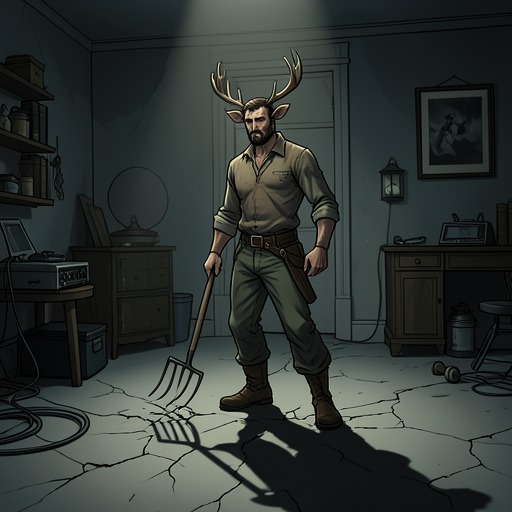
In a hotel room, Bunny Munro uses the remote to find muted black-and-white CCTV footage from a shopping mall in Newcastle. A bare-chested man in tracksuit bottoms moves through a crowd of frightened shoppers; he appears to wear devil’s horns and carries what looks like a large black stick. The image offers no explanation, only a public place disrupted by a strangely costumed figure. Bunny switches off the television, but the footage has already unsettled him.
The threat returns in print. At breakfast, Bunny sees a full-page CCTV image of the same man, now identified by his body paint, plastic devil’s horns and trident. He tries to read the accompanying report, but cannot make sense of its words and gives up, overcome by nausea. The sequence shifts the attack from a brief, soundless image to a story that newspapers are naming and circulating, while Bunny’s inability to follow the report leaves the danger vivid but indistinct.
The Reports Escalate
The first reports of lethal attacks make clear that the figure seen in Newcastle is not merely frightening shoppers. Television coverage tells Bunny Munro and Bunny Junior that the Horned Killer has murdered Beverly Hamilton, a young office worker, in an underground car park in Leeds. The report also says that, later that day, he appeared on CCTV at a nearby shopping mall before disappearing again, while police remained baffled. Bunny asks whether his son believes the report; Bunny Junior says he does not. Their brief exchange sets Bunny’s growing apprehension against the boy’s refusal to accept the televised account.
The violence soon appears again through a television that turns on when Bunny shifts on the sofa. Its upside-down footage shows the Horned Killer terrorising shoppers in a Tesco car park in Birmingham. A news ticker reports that two young nurses have been killed at their shared accommodation in Bordesley Green, and that panic has spread through the Midlands. The police are still baffled. Watching the report, Bunny mutters that the killer is only getting started and is coming their way. The remark turns a sequence of distant reports into a threat he feels to be approaching, even as River fails to hear him.
In a Western Road café, another special report gives the attacks a visible direction. A young mother has been murdered at home in Maida Vale; the broadcast also describes the killer’s appearance on CCTV at a shopping complex in Queensway before he vanished. A map of England traces his southbound route in red. Its outline reminds Bunny of a cartoon rabbit without ears, an incongruous image that makes the map feel personally charged to him, though he cannot explain why. When the café worker asks about the killer, Bunny answers that he is working his way to Brighton. The report’s geography gives shape to Bunny’s foreboding: the recurring television images now form a route toward the place he knows.
The apparent capture briefly changes the story’s direction. At the Empress Hotel, a tabloid photograph shows the Horned Killer between two policemen, shirtless and painted red, his hands cuffed and his plastic horns still on. The headline announces that he has been caught, and hotel guests react to the news. Yet the report does not settle the unease built by the earlier broadcasts. A receptionist points to another claim in the paper: the killer’s horns may be real after all. The shift from an apparent arrest to a rumor that his defining disguise is genuine leaves the threat unresolved, and comes as Bunny Junior is already wondering whether he is dead and why he keeps seeing his mother.
Media, Pattern, and Uncertainty
The attacks reach the reader through a chain of screens, headlines, photographs, and a news ticker rather than through a sustained, direct view of the killer. Each medium supplies a fragment: CCTV fixes him as a figure in public space, while reports attach names, locations, and police bafflement to those images. Their repetition makes the fragments feel like a developing pattern, but does not make the threat fully knowable. The recurring visual markers identify the same figure; the reports offer no settled explanation for him or his movements.
That gap between apparent evidence and uncertainty persists even when the tabloid presents an arrest as a resolution. The cuffed figure and triumphant headline seem to close the story, but the receptionist’s claim about the horns reopens it by casting doubt on the distinction between disguise and reality. The episode therefore gives the news a double function: it tracks a public crisis while continually revising what can be believed about it. Bunny’s apprehension grows within that unstable stream of information, where each new image appears to clarify the danger and leaves its central mystery intact.
Private Fear and the Unresolved Threat
The Newcastle footage intrudes into Bunny Munro’s private hotel-room encounter with violence at a distance but with immediate force: after watching the silent shoppers and horned figure, he curses, loses his energy, and turns off the television. His attention settles on a water stain on the ceiling; amid an electronic-sounding twittering he cannot identify, he hears his wife asking whether he is there. The broadcast does not explain the killer, but its arrival coincides with Bunny’s sense of disorientation and his awareness of Libby, drawing public menace and private bereavement into the same unsettled moment.
The reports never establish whether the apparent capture ends the attacks or whether the horns are truly part of the killer’s body. Instead, their changing claims leave the case suspended between a public account of a criminal on the move and an unexplained figure whose meaning exceeds what the screens can show. That uncertainty helps explain why Bunny reads the southbound map as personally significant: the news offers a route, but no reassurance that the danger has been contained.