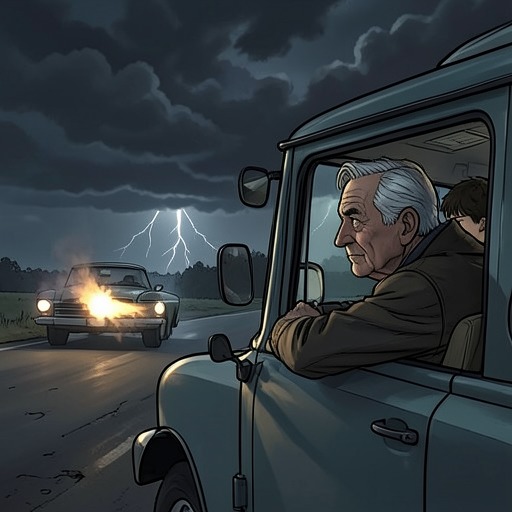
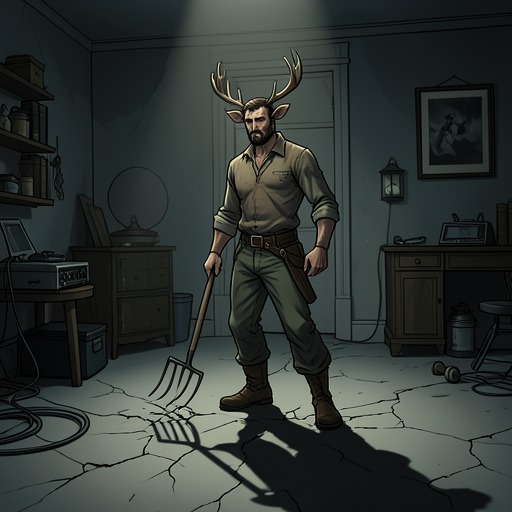
Horned Killer’s killing spree and capture
The Death of Bunny MunroThe Horned Killer’s killing spree and capture reaches the story not as a continuous police investigation but as a sequence of images and reports encountered in ordinary places. Black-and-white CCTV, a newspaper photograph, and television coverage carry the violence from northern shopping centres toward Brighton, making the killer’s advance feel both public and strangely intimate. His apparent capture offers a moment of closure, but a final claim about his horns keeps that closure uncertain.
First Images and the Leeds Murder
In a hotel room, Bunny uses the remote to search television channels and finds silent black-and-white CCTV footage from a shopping mall in Newcastle. A bare-chested man in tracksuit bottoms weaves through terrified shoppers, his mouth open in a soundless scream. He appears to have devil’s horns and waves a large black object. The image gives the threat a recognizable shape, while the mute button leaves the crowd’s panic visible but unheard. Bunny curses, loses his energy, and switches off the television.
The killer returns in print the next morning: a full-page CCTV image shows a man with body paint, plastic horns, and a trident. Bunny struggles to read the report, and the newspaper’s words seem to break apart on the page. Soon afterward, television coverage supplies a more definite account. The press has named the attacker the Horned Killer; he has murdered Beverly Hamilton, a young office worker, with a garden fork in an underground car park in Leeds. Later that day, he appears on CCTV at a nearby mall, frightening shoppers before disappearing again. The police are reported to be baffled. The sequence binds a killing to a further public appearance, so that each new image extends rather than resolves the threat.
Reports of a Southbound Trail
Later footage reaches a living room in Newhaven, where late-afternoon sunlight obscures much of the television screen. Bunny can only make out the familiar panic of the shoppers and the killer’s trident. The image is incomplete, but it prompts him to wonder how close the attacker is to Brighton. The danger is conveyed less by a clear view of the man than by Bunny’s recognition of the crowd’s terror.
In a café on Western Road, a special report describes the murder of a young mother in her home in Maida Vale. The attack was so severe that authorities initially had difficulty identifying the victim’s sex. That same afternoon, the killer made another appearance on CCTV, this time running through a shopping complex in Queensway, and then vanished. A stylised map of England marks his dismal southbound route with a red line. Its outline reminds Bunny of a cartoon rabbit without ears, an incongruous image that makes the report feel personally charged to him even though he cannot say why. When the café worker asks whether he can believe the story, Bunny answers that the killer is working his way to Brighton.
Apparent Capture and Lingering Doubt
At the Empress Hotel, Bunny recognizes the soundless terror of a familiar stampeding crowd before the receptionist announces that the killer is there. The broadcast prompts an apocalyptic outburst from the receptionist, while Bunny’s reaction is physical: a chill runs up his spine. The threat has moved from reports of distant attacks to an apparent presence in the local scene, intensifying the sense that the southbound trail has reached its destination.
A tabloid at the reception desk then presents what looks like the answer. Its photograph shows the shirtless, red-painted killer flanked by two policemen, his hands cuffed and his joke-shop horns still on his head; the headline announces that he has been caught. A guest treats the news as confirmation, and the arrest image briefly replaces the earlier footage of flight. Yet after Bunny pays his bill, the receptionist points to a further claim in the paper: the killer’s horns may be real. This is reported as something the newspaper is saying, not established as fact. The episode thus offers capture without complete reassurance: the man appears to be in custody, but the image that had made him a theatrical menace is reinterpreted as potentially literal.
Narrative Function
The spree is assembled through repeated media encounters rather than through direct access to the killer’s intentions or the police’s full inquiry. CCTV turns him into a recurring figure in public space; newspaper and television reports connect separate attacks, sightings, and disappearances into a route that can be followed on a map. Each return increases the threat’s reach, from Newcastle to Leeds, onward through reports of Maida Vale and Queensway, and finally toward Brighton.
For Bunny, the reports intrude on a sales journey and increasingly unsettle its everyday settings: a hotel room, a living room, a café, and a reception desk. The killer’s visibility is paradoxical. He is repeatedly shown, yet remains difficult to grasp: first a silent figure glimpsed through CCTV, then a headline and a mapped trajectory, and finally a cuffed man whose defining horns may not be a disguise. The apparent capture closes the public pursuit at the level of the image, while the last rumor preserves an unresolved note of menace.