Near-death experience
The Death of Bunny MunroNear-death experience is a concept Bunny Junior brings from his encyclopaedia into the bewildering events around him, using its reported features to interpret visions of his dead mother and his father’s mortal danger. The definition gives him a vocabulary for what might otherwise remain frightening and inexplicable, but it does not settle whether the appearances are supernatural, remembered, or shaped by crisis. The book lets the boy’s learned account illuminate these scenes without turning it into a definitive explanation.
The Encyclopaedia’s Definition
At breakfast, Bunny Junior has looked up near-death experience alongside entries on apparition and visitation. He reads that it is a striking occurrence reported by people who have recovered after being close to death. The wording makes recovery part of the concept: it is not simply a vision, but a report made by someone who has returned from danger. For Bunny Junior, the definition is useful because it links an extraordinary experience to an event that has a recognizable beginning and aftermath.
As he explains the entry to Bunny, the boy adds several elements associated with such reports. People may leave their bodies and travel through a dark void or tunnel toward light; they may encounter religious figures or deceased loved ones; and the experience may include a strong sense of peacefulness. These details are presented as claims he has read, not as a guarantee that every feature will occur. Their sequence nevertheless offers him a set of interpretive possibilities: separation from ordinary surroundings, movement toward another realm, a meeting, and calm.
Bunny Junior Uses the Concept
Bunny Junior does not keep this knowledge as abstract information. He recites it to his father as they leave the Empress Hotel, then continues with the reported encounters and feelings while they walk through the glare and sea mist. He wonders whether he is dead and whether that might explain why he keeps seeing his mother. His conclusion remains tentative, but the encyclopaedia gives him a way to connect the appearances to a condition beyond ordinary life rather than dismissing them as meaningless.
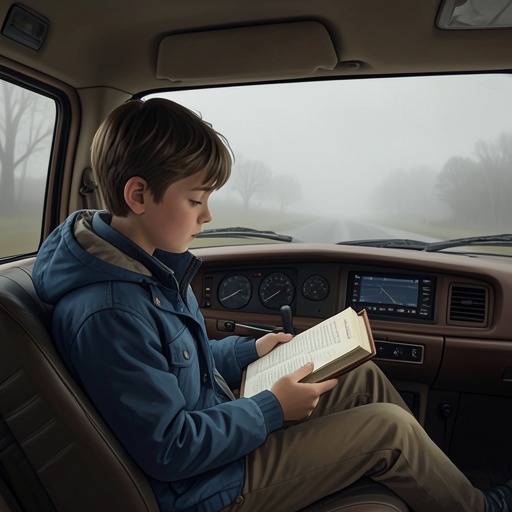
The lesson also becomes a form of practical care. As Bunny walks unsteadily and falls, Bunny Junior helps him up, notices a tear in his trousers, and listens when his father says he does not know what he would do without him. When Bunny is back in the Punto, the boy repeats that near-death experiences are often accompanied by peacefulness, then helps tend the scrape on his father’s knee. The concept thus passes from explanation to reassurance: Bunny Junior uses what he has read to speak to his father’s distress and to stay close to him, even though the definition cannot tell him what will happen next.
Visions, Memory, and the Dead
The idea of encountering deceased loved ones meets a particular need in Bunny Junior’s life. He is already troubled by the fading image of Libby. He can preserve vivid details of an outing, such as being pushed on a swing at St Ann’s Well Gardens, yet the person pushing him has become an incomplete, dissolving figure in his recollection. He tries to arrange their shared past like exhibits in the Booth Museum, as if careful mental preservation could keep it intact. The effort exposes the limit of memory: the scene remains, but his mother’s presence within it grows harder to recover.
A later vision gives that missing presence a more complete form. In the Punto on Meeching Road, Bunny Junior thinks his mother will eventually find him; he becomes aware of her hand cream and imagines her tracing his face. The encyclopaedia’s account of the most luminous objects in the universe has supplied a phrase that accompanies this encounter: he hears a voice telling him he is the most luminous object in the universe. The moment joins factual learning, physical surroundings, and a felt reunion without clarifying whether the voice belongs to him or Libby. The near-death framework makes such an encounter imaginable, but the scene remains intimate and uncertain rather than an illustration that proves the entry’s claims.
Crisis and the Limits of Explanation
After the collision involving the Punto and a DUDMAN concrete mixer truck, Bunny regains awareness in the street and later experiences a dramatic confrontation with lightning. These events place him in grave danger, and the narrative renders his return to awareness through disorientation and an altered sense of reality. Yet the supplied account does not identify his subsequent experiences as a near-death experience in clinical or certain terms. The encyclopaedia’s definition provides a parallel for reading a crisis, not a label that resolves what Bunny has undergone.
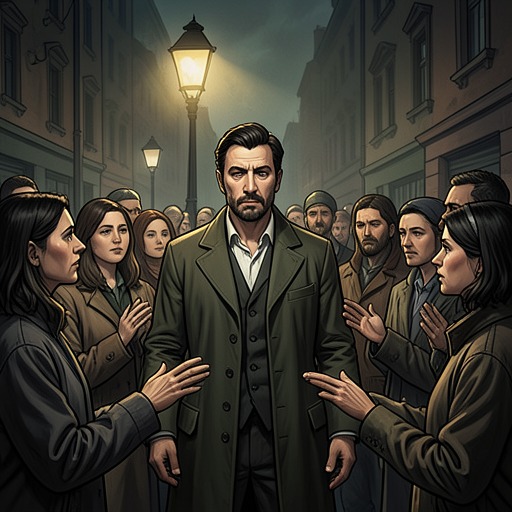
The distinction matters because Bunny Junior’s knowledge and Bunny’s experience are not interchangeable. The boy can repeat features from a book, while the father must pass through events whose meaning remains uncertain. Later, during the public gathering, Bunny sees Libby in her orange nightdress and asks her to forgive him. When he says that he misses her and suggests that she has been haunting him, she denies having haunted him; she then disappears into the crowd. The encounter echoes the boy’s account of meeting deceased loved ones, but Libby’s answer resists making the resemblance conclusive. The narrative does not certify the scene as a supernatural meeting or as a near-death report.
Narrative Function
Near-death experience supplies a child’s provisional map for experiences that exceed his ordinary explanations. Bunny Junior’s encyclopaedic habit—storing facts and retrieving them when needed—becomes especially consequential here: his knowledge lets him approach his mother’s appearances and his father’s vulnerability with language rather than silence. He also acts on that knowledge by explaining, reassuring, and helping his father, so the entry becomes part of their relationship rather than a detached lesson.
At the same time, the concept’s reported qualities create a productive ambiguity. Darkness, movement toward light, peacefulness, and encounters with the dead may seem to match the novel’s visions, but their recurrence does not establish a single cause. Memory, bereavement, bodily crisis, and the possibility of supernatural presence remain in play. The encyclopaedia names a pattern that Bunny Junior can recognize; the narrative preserves the uncertainty that the pattern cannot remove.