Orange dressing gown
The Death of Bunny MunroThe Orange dressing gown is the recurring image through which Libby Munro remains vividly present to Bunny Munro and Bunny Junior after her death. Once associated with the beginning of her marriage, it becomes inseparable from the discovery of her body and later appears in visions that give the bereaved family different ways of encountering her absence.
Wedding Memory and Discovery
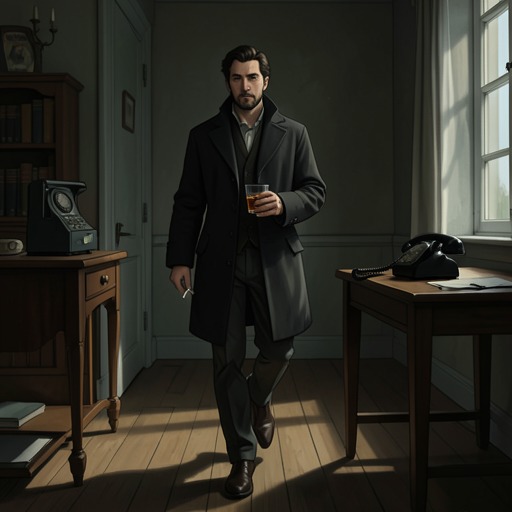
Bunny first sees the Orange dressing gown through a keyhole while kneeling among spilled Coco Pops. Libby stands by a window wearing the garment she wore on their wedding night, which he has not seen for years. The sight abruptly carries him back to their honeymoon hotel, where the sheer nightgown had seemed almost invisible against her body. His response is not recollection alone: he quickly interprets her presence as an opportunity for sex and calls to her as though she might answer.
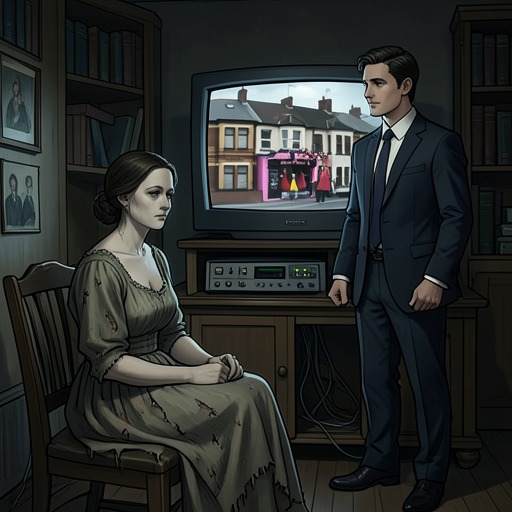
When Bunny opens the bedroom door, Bunny Junior follows him inside. The boy keeps looking toward a television on the floor and notices his father’s stillness only at the edge of his vision. Libby is hanging from the security grille in the Orange dressing gown, her feet resting on the floor and her knees buckled. Bunny’s quiet exclamation and the gesture of bringing his hand to his mouth mark the shock of recognition; even then, his thoughts veer toward an intrusive sexual appraisal. The garment that moments earlier had revived an erotic memory is now part of the scene of her suicide, exposing the disjunction between Bunny’s desire and the reality of his loss.
Returns in Bunny’s Grief
Later, during sex with River, Bunny sees what appears to be Libby by the window, hidden in the folds of rose-coloured curtains and dressed in the Orange dressing gown. She waves at him. He makes a wounded, startled sound and struggles against River, who is in the middle of climaxing; after he looks again, Libby has vanished. He tells River that his wife was there watching. The garment thus returns not as a stable memory but as a sudden apparition inside Bunny’s present, intruding on the behavior through which he tries to escape grief.
The appearance is bound to Bunny’s sense of being observed by his dead wife, though the experience remains his perception rather than an independently confirmed haunting. In the final crowd scene, after people have embraced and forgiven him, Bunny sees Libby in the Orange dressing gown and moves toward her to ask forgiveness. When he later speaks of being haunted, she denies that she ever haunted him. Her answer unsettles the meaning of the repeated image: the gown has made Libby seem present to Bunny, but the encounter does not confirm that she has been pursuing him.
Bunny Junior’s Encounters with His Mother
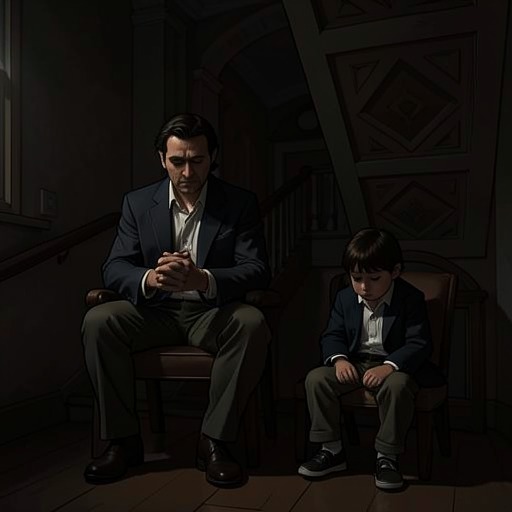
For Bunny Junior, the Orange dressing gown is connected to the struggle to retain an image of his mother. He can recall facts with precision, yet finds it increasingly difficult to remember what Libby looked like. He tries to preserve shared moments as if they were exhibits in the Booth Museum, but in his memory of being pushed on a swing at St Ann’s Well Gardens, he can see himself rising into the air and cannot make out who is pushing him. Around the same time, he sees a woman with blonde hair, partly lost in shadow and dressed in the Orange dressing gown, near the stairwell where his father has disappeared. She steps farther into the shadows and vanishes from sight.
Later, alone in the car on Meeching Road, Bunny Junior believes that his mother will eventually find him. He senses a change in the air and the smell of her hand cream, then feels a hand trace his face and press a finger to his lips like an approximation of a kiss. This encounter links the absent mother to touch and remembered care, even as the boy is unsure whether the voice he hears is hers or his own. In a later vision, mist surrounds the car and he sees Libby sitting on a low cream-brick wall opposite it, smiling and beckoning. He leaves the car to sit beside her, apologizes, and rests his head against her. The Orange dressing gown anchors this meeting in the same recognizable image that has accompanied his fear of losing her from memory.
An Image of Continuing Loss
The garment changes meaning as it recurs: it is first remembered through Bunny’s desire, then encountered at Libby’s death, and afterward seen in visions by both father and son. For Bunny, its appearances sharpen the conflict between his sexual appetites, his guilt, and his longing for Libby’s forgiveness. For Bunny Junior, they answer the fading of his memories with moments of imagined closeness, from the shadowed figure near the stairwell to the mother he approaches through the fog.
The Orange dressing gown therefore does more than identify Libby across scenes. Its repeated visibility holds together memories and apparitions without resolving whether those apparitions belong to the supernatural or to grief. It makes the loss concrete while allowing the family’s continuing bond with Libby to take different forms: for Bunny, a troubling sense of surveillance and a plea for pardon; for his son, the hope of finding and touching his mother again.