Patience Law
The Death of Bunny MunroPatience Law is Bunny’s foundational lesson in salesmanship, but its meaning shifts as it passes from father to son. Bunny presents patience as calculated pursuit: become quiet, approach the target, and strike. Bunny Junior later uses the same principle to wait for his mother, making a sales tactic serve grief and hope before hunger overwhelms it.
The First Rule of Salesmanship
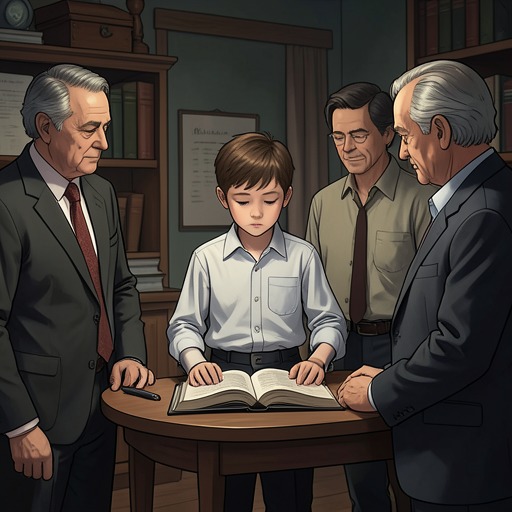
Bunny introduces the rule on the road, after Bunny Junior observes that his father had been inside for a long time. Turning onto Brighton Road, Bunny tells him that anyone joining him on the road must first learn patience, which he calls the first and fundamental law of salesmanship. The lesson is not simply to wait; it is framed as essential training for the work Bunny expects his son to learn.
The teaching arrives amid motion rather than stillness. Bunny guns the engine and overtakes a maroon cement truck, then reaches for a hunting analogy. A warrior, he explains, cannot stamp noisily through the bush and expect prey to remain in place; success requires stealth as well as patience. Bunny Junior supplies the missing word when his father trails off, compressing a smile. The boy has understood the lesson’s terms, even as the exchange leaves open what, exactly, he is being prepared to sell.
Patience as Pursuit
Bunny elaborates the analogy by describing a hunter becoming one with the prey, moving quietly towards it, and finally driving a spear through its heart. His solemn beat against his chest gives the explanation the air of a performance, while the sequence itself makes patience instrumental: quiet approach is valuable because it enables a decisive attack. In Bunny’s account, the customer is not named, but the hunting image casts the person being approached as prey.
That image exposes the distance between patience as a virtue and patience as Bunny teaches it. His rule calls for restraint, but not for consideration of the person on the other side of the sale. Waiting is a method of control, part of the craft of reaching a target without alarming it. Bunny Junior’s attentive completion of the lesson suggests that he is learning the vocabulary of his father’s trade; it does not show that he has adopted the predatory purpose embedded in the analogy.
Bunny Junior’s Use of the Rule
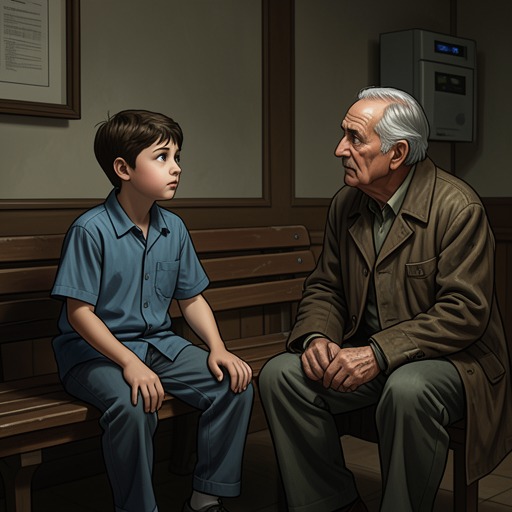
Later, the Punto is parked on the Marine Parade. Bunny Junior rests his head against the window and wonders what he is doing there, and when Bunny will teach him how to sell something. He fears that advanced blepharitis may be making him go blind, and worries that he may also be going insane. To make sense of what he thinks he sees, he consults The Encyclopaedia: its definitions of mirage and apparition describe distorted distant objects and the sight of someone who is not actually present. The explanations do not resolve his confusion.
The boy has come to believe that his mother is looking for him and has something important to tell him. He thinks that if he stays where he is, she will eventually find him. Patience Law, learned as a sales technique, now offers a shape for his expectation: remain in place and wait for the person he hopes will come. He also thinks that he has something to tell her, though he cannot remember what it is because he is too hungry. The rule provides a way to endure uncertainty, but it cannot supply the message or bring his mother to the car.
Hunger and the Rule’s Limit
His hunger makes the lesson increasingly difficult to follow. He regrets not eating his Cornish pasty at lunchtime and watches youths pass, eating chips; the smell from a fish-and-chips booth across the road sharpens his appetite. He knows he is not allowed to leave the car, but fears that without food he will die of hunger. His three one-pound coins make buying something seem possible, while he imagines his father returning to find him dead in the Punto and wonders what that would say about the Patience Law.
Bunny Junior does attempt to obey: he sits and counts to one hundred, then looks over one shoulder and the other. At last, he opens the door and climbs out, jingling the coins in his pocket. The action marks the rule’s boundary. Patience has helped him wait for his mother and has given him a way to interpret waiting as something learned, but it cannot override his immediate bodily need. Where Bunny’s lesson culminates in a metaphorical strike against prey, the boy’s patience ends in a practical decision to seek food.