Rhinoceros beetles
The Death of Bunny MunroRhinoceros beetles give Bunny Junior a subject he can observe, classify, and remember with precision, even as life on the road with Bunny leaves him uncertain about what he is learning and where he belongs. They recur as real creatures in his natural-history interests and as a point of concentration when his father’s choices and the demands of the journey press on him.
Natural History and Distinctive Traits
Bunny Junior knows the Rhinoceros beetle for its three horns and extraordinary strength. He recalls that it can lift 850 times its own weight, an ability he translates into the human-scale comparison of lifting 65 tons. He also knows that Rhinoceros beetles belong to the Scarab family, are among the largest beetles, and that males use their horns in contests with other males. This knowledge is specific rather than vague admiration: Bunny Junior can place the creature within a family, describe its features, and explain what its strength means.
His interest extends beyond this one kind. He mentally reviews a broad collection of beetle names, including Devil’s Coach-horses, Black Clocks, Brown Chafers, Whirligigs, Malachites, Red Soldiers, Sextons, Red Cardinals, and Stag Beetles. When he was smaller, he kept beetles in a cigarette box, though he cannot now remember what became of it. The Rhinoceros beetle stands out within this remembered catalogue as his favourite.
Bunny Junior’s Attention on the Road
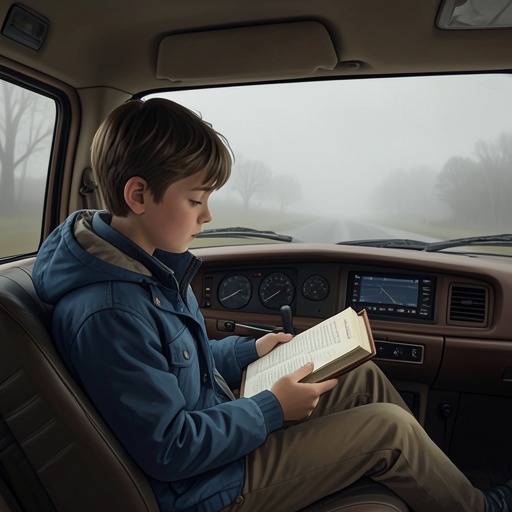
During the sales journey, Bunny Junior sits in the Yellow Fiat Punto and watches a Sun beetle move across the windscreen. He follows its path with a black marker, turning the glass into a record of the insect’s movements. The tracks do not reveal a clear system; he recognizes that the beetle’s course is random. His close observation therefore brings both concentration and uncertainty: he can trace what the insect does, but cannot make its movements resolve into an order.
The scene also places his natural-history knowledge beside his assigned work as navigator. Bunny Junior thinks he is doing well at reading maps and giving directions, and Bunny has praised his performance. Yet the boy wonders what he is doing in the car all day instead of at school, and tentatively calls it learning the ropes. The beetle’s wandering course becomes part of this moment of doubt—not an answer to his situation, but something he can attend to while the larger purpose of the trip remains unsettled.
Recurrence and Significance
When Bunny’s tie makes Bunny Junior unhappy, the boy turns his thoughts to Rhinoceros beetles: their place among Scarabs, their horns, and the contests between males. The return to beetle facts offers a marked contrast with the immediate tension between father and son. Rather than explain the boy’s feelings outright, the narration shows his attention shifting to a subject he knows in detail.
The beetles’ importance lies partly in this combination of knowledge and attention. Bunny Junior’s facts about size, strength, and horns give him a dependable store of information, while the Sun beetle’s unpatterned movement resists the order he tries to find by tracing it. Across these moments, beetles are neither merely an emblem nor a solution to the boy’s difficulties: they are living creatures that occupy his curiosity, provide a measure of continuity, and shape what he notices during the journey.