Starlings
The Death of Bunny MunroStarlings are among the novel’s most persistent signs of disturbance: first a real flock above the burning West Pier, then a recurring presence in Bunny’s thoughts and perceptions as his fear intensifies. Their circling, falling, and rising give a visible and audible form to the story’s movement between ordinary events and ominous interpretation. They also link two different responses to loss: Libby’s grief for the birds and Bunny’s increasingly fearful sense that the world around him is gathering into a warning.
The burning West Pier
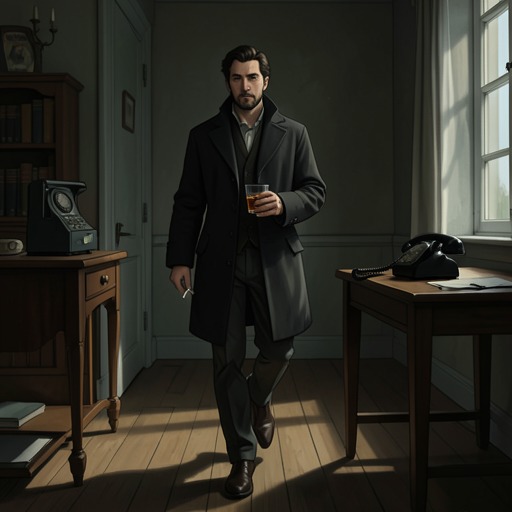
At a hotel, Bunny has been drinking heavily when he opens the curtains and sees a dark cloud of Starlings over the smoking, burning West Pier. The flock is unmistakably part of the scene before him: birds move above the pier as it stands out in the sea, and their noise adds to the force of the discovery. The moment interrupts Bunny’s disordered attention. He wonders why he did not notice the fire sooner, then how long he has been in the room, before remembering Libby and returning to their phone conversation.
Libby responds to the fire through concern for the birds. She imagines their young in nests exposed to the flames and tells Bunny that she cannot bear it. The passage presents this as her anguished perception of the disaster, not as a separate account establishing the fate of particular birds. Her response places tenderness toward vulnerable life beside Bunny’s intoxication and distracted attention. The Starlings are therefore more than background to the pier fire: through Libby’s distress, they make the event a source of grief as well as spectacle.
A sound that returns
The flock’s importance grows through recurrence rather than through any change in what Starlings are. Later, Bunny remembers the burning pier and thinks of Starlings circling. That recollection occurs amid his perception of shadows taking on threatening forms and a wasps’ nest that seems to him to be preparing for danger. The birds thus enter an accumulating pattern of foreboding. Their return does not prove that they have followed Bunny or that they cause the events he fears; instead, the remembered flock gives his apprehension a concrete image to attach itself to.
The birds also appear within an ordinary working day. As Bunny Junior sits in the yellow Fiat Punto, he watches a beetle cross the windscreen and tries to make sense of its path. The late-afternoon sky changes color, Bunny has promised that the last sales call is near, and Starlings make their racket. This setting contrasts the boy’s patient attention to one small insect with the flock’s collective sound. The Starlings mark the passing day while the child is left to navigate alongside his father, whose work and emotional state make the journey uncertain.
From flock to foreboding
At Mrs Brooks’s home, Bunny’s unease becomes harder to separate from the surroundings. After selling her a large order of beauty products, he sees Starlings moving above the sea and recognizes that what he had taken for a hangover is becoming terror. The change is significant: an apparently routine visit and completed sale give way to a sense of approaching danger. The flock’s movement in the distance does not explain what is happening, but it accompanies Bunny’s recognition that his fear has another source.
The disturbance then intensifies. Bunny experiences the room darkening and cooling, hears the radio fall silent, and becomes convinced that Libby is present. Starlings begin to peck and scratch at the window; he perceives them as diving against it while heavy piano chords sound. In this scene the birds’ ordinary behavior, Bunny’s fear, and the apparently uncanny events converge without settling into a single explanation. Their activity belongs both to the physical setting and to the escalating terror through which Bunny experiences it.
Narrative significance
Across these scenes, Starlings connect a public disaster to private distress. At the West Pier, they are a flock visible above a fire; in Libby’s response, they are vulnerable young she fears for; in Bunny’s later memories and perceptions, they become part of an ominous atmosphere. The movement from observed birds to a recalled and fear-laden sign is a change in the narrative’s use of them, not evidence that the birds themselves have become supernatural.
Their repeated sound and movement also offer a counterpoint to the characters’ attempts to understand what is happening. Bunny Junior can preserve information and study the natural world, while Bunny interprets scattered signs through the pressure of grief and apprehension. The novel does not make the Starlings explain that grief or resolve the uncertainty around Bunny’s experiences. Instead, their recurrence lets the same natural image carry different emotional weight: compassion in Libby’s response, uneasy recollection in Bunny’s mind, and mounting alarm as his sense of control weakens.