West Pier
The Death of Bunny MunroWest Pier is a seaside landmark whose burning and remembered past connect the novel’s private grief to a visible loss in Brighton. For Bunny, the pier’s flames emerge through a disorienting encounter with Libby Munro’s voice; for Bunny Junior, it is also a place tied to a birthday outing with his mother, making its destruction inseparable from memories of her.
Setting and Fire
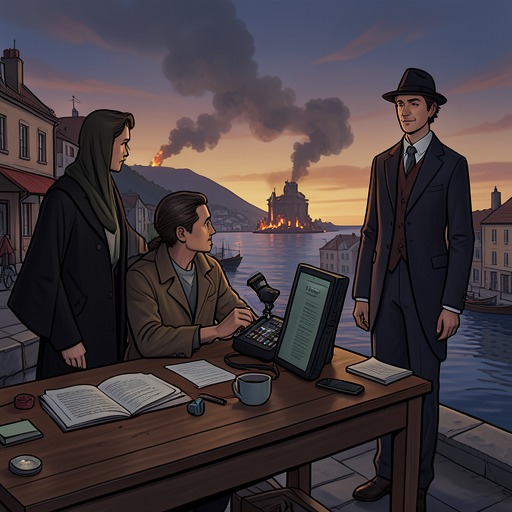
Bunny first hears that West Pier is burning from Libby Munro, who says she can smell the smoke. After emptying a small bottle of vodka, lighting another cigarette, and struggling across the room to the window, Bunny draws back the curtains and sees the pier as a smoking, flaming structure in the sea. A dark cloud of Starlings circles above it, their cries compounding the scene’s disturbance. The discovery also sharpens his disorientation: he wonders why he had not noticed the fire sooner and how long he has been in the room before remembering his wife and hearing her call to him.
Libby’s response focuses on the birds and their young, which she imagines burning in nests. Her distress makes the fire more than a distant spectacle: the destruction is registered through vulnerable life caught within it. The scene does not establish how the fire started. Instead, the pier’s burning is presented alongside Bunny’s intoxication, the birds’ cries, and the uncanny persistence of Libby’s voice.
Bunny Junior’s Memory of the Pier
For Bunny Junior, West Pier is not merely a ruined landmark. His mother once took him on a special guided tour for his eighth birthday, after which they walked to Marrocco’s for ice cream. At the funeral, the sight of a cigarette butt striking a Seagull brings that memory back. The bird flies off with the cigarette, and Bunny Junior imagines a chain of events in which it carries the butt to a nest of baby Seagulls in the pier’s disused ballroom, setting the nest and then the structure alight. This is his conjecture, not a confirmed account of the fire.
His imagined explanation draws on a fierce dislike of Seagulls. He recalls them as large and aggressive, remembers reading about them at the Booth Museum, and believes they target people and attack reflective colors. He connects that belief to the mess on the Punto, which he and his father both associate with the birds. His certainty about their supposed habits gives a child’s theory the force of a private verdict: the bird, the cigarette, and the lost pier become part of one story of blame.
Narrative Significance
The pier links two different forms of remembrance. Bunny encounters its destruction in a present-tense scene that destabilizes his sense of time and brings Libby’s voice back into the room; Bunny Junior carries it as a remembered place of companionship with his mother. The fire therefore has both public scale and intimate consequence: it consumes a landmark while intensifying the book’s attention to bereavement, memory, and the way a child makes sense of loss.
The contrast between the two scenes also matters. Bunny sees the burning pier directly but is too drunk and disoriented to understand his own delay in noticing it. Bunny Junior, by contrast, reconstructs the fire from a small incident at the funeral, turning an accidental encounter with a Seagull into an explanation for a destruction he connects to a cherished childhood visit. West Pier persists in the narrative as a place altered by fire and preserved in memory.