
The Three Rings and Religious Uncertainty
The DecameronThis flow traces how the ring parable converts a threat into a meditation on competing claims and the limits of judgment.
increasing Bearing strength in each event
 decreasing
Bearing strength in each eventdecreasingThree Heirs, One Promise

Three Heirs, One Promise
A father’s rule
A wealthy man declares that possession of a precious ring will prove which son is his rightful heir.
Equal affection
The ring passes from generation to generation. Eventually its holder faces three beloved sons and cannot choose among them.
Copies Commissioned
Copies Commissioned
A hidden solution
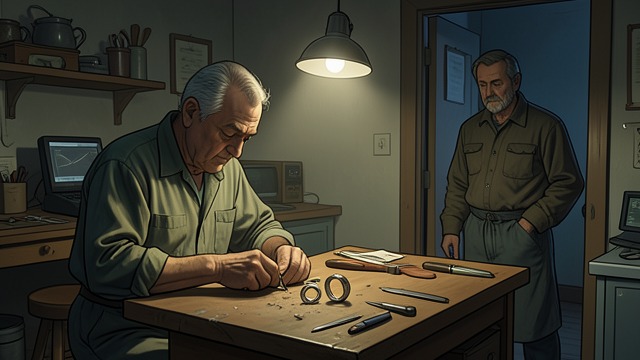
The father asks a skilled craftsman to make two rings indistinguishable from the original. Even the father cannot tell them apart.
A dilemma deferred
He gives a ring to each son, preserving equal affection but making proof impossible.
Competing Inheritances

Competing Inheritances
Claims presented
Each son produces a ring and asserts that he alone received the inheritance. The others deny his claim.
Unresolved judgment
The rings cannot be distinguished, so the question of the true heir remains open. The parable supplies no final human test.
Three Religious Claims
Three Religious Claims
The analogy explained
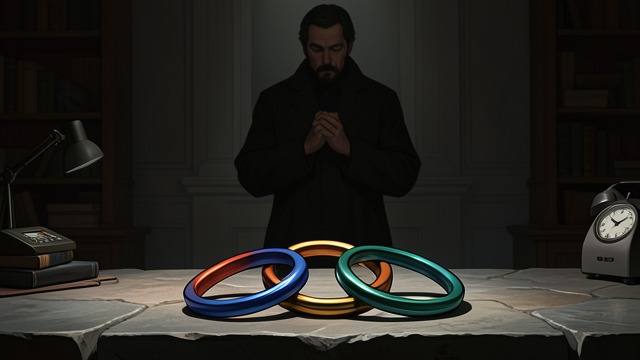
Melchizedek compares the sons’ claims to the claims of Judaism, Christianity, and Islam. Each community believes it possesses the true law and inheritance.
Humility before uncertainty
As the rings cannot be separated by human judgment, the religious question remains unresolved in the story. The answer avoids declaring one faith false.
A Threat Becomes Trust

A Threat Becomes Trust
Saladin abandons coercion
Recognizing the prudence of Melchizedek’s response, Saladin reveals his financial need rather than pursue his trap.
Reciprocal generosity
Melchizedek lends him money; Saladin later repays him and rewards him. The encounter turns uncertainty into a basis for friendship.
Within Melchizedek’s parable
As the father nears death
After the father’s death
Immediately after the parable
After Saladin understands the answer
