Abbot of Cluny
The DecameronThe Abbot of Cluny’s encounter with the robber Ghino di Tacco turns captivity into an unlikely act of reciprocity: after Ghino captures him and treats his stomach complaint, the abbot repays him not with punishment but with friendship and help in returning to honorable standing. In Elisa’s story, his response supplies the day’s striking example of magnanimity from a churchman toward a man who might have been treated as an enemy.
Identity and Narrative Introduction
The abbot is presented as one of the richest prelates in the world, a churchman whose rank, wealth, and large travelling household make him a conspicuous target. After damaging his stomach at the papal court, he receives medical advice to visit the baths of Siena, where the physicians expect him to recover. With the pope’s leave, he sets out in great display, accompanied by horses, servants, baggage, and an extensive train. The narrative introduces him through this public authority and material abundance before placing him in the power of a man living outside the protection of Rome.
Elisa frames the episode as a contrast with the preceding story of King Alfonso’s generosity. A king’s liberality to someone who had served him is praiseworthy, she observes; a churchman’s generosity toward someone he could justly regard as an enemy seems more extraordinary. Her introduction also makes the abbot’s conduct a pointed counterexample to the story’s broad criticism of clerics as miserly and eager for vengeance. His actions, rather than his ecclesiastical rank alone, establish the quality that the story sets out to display.
Capture and Confinement
Ghino di Tacco, notorious for cruelty and robbery, has been expelled from Siena and is at feud with the Counts of Santa Fiore. Based at Radicofani, he has his armed followers plunder travellers in the surrounding country. Hearing that the abbot is approaching, Ghino surrounds him and his entire household in a confined place, leaving no footboy able to escape. A messenger then politely invites the abbot, in Ghino’s name, to stay at his castle. The abbot answers furiously that he will not comply and intends to continue his journey.
The invitation is backed by force: armed men have already encircled the place. Realizing that he and his company are captured, the abbot reluctantly goes to the castle with his household and belongings. Ghino has him lodged alone in a very dark, mean little chamber in one of the pavilions. The others, however, are accommodated according to their station, and the horses and baggage are kept safe; none of the goods is touched. The confinement is therefore real, but its limits matter. Ghino holds the abbot and his property in his power without treating the whole party as spoil.
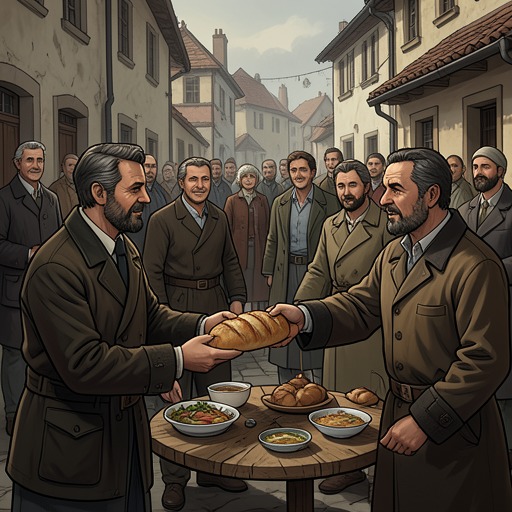
When Ghino visits, he asks where the abbot is going and for what purpose. The abbot has by then put aside his pride and tells him plainly about the journey and the stomach complaint. Ghino takes his leave and decides to attempt a cure without the baths. He keeps a great fire burning in the abbot’s little room and has it guarded, then returns the following morning with two slices of toasted bread in a very white napkin and a large beaker of his own Corniglia vernage. He presents this simple meal as the beginning of the remedy he intends to give.
The Abbot’s Response to Ghino
The treatment culminates in Ghino’s announcement that the abbot has been cured. He leads him into the hall where the abbot’s belongings are gathered and to a window overlooking the horses in the courtyard. There Ghino explains that expulsion, poverty, noble birth, and powerful enemies—not an evil disposition, as he tells it—drove him into robbery to defend his life and standing. He says that, because the abbot seems to him a worthy gentleman, he will not take what he could claim from a captive. Instead, the abbot may select whatever share of his goods he thinks appropriate, or take everything, and may leave or stay as he wishes.
The abbot is astonished that a highway robber should speak so generously. His anger at being captured falls away and gives place to goodwill: he embraces Ghino and says he would willingly have endured a much greater affront to gain the friendship of a man he now judges worthy. He curses the fortune that forced Ghino into robbery, recognizing the difference between Ghino’s present occupation and the account Ghino gives of the circumstances that brought him to it. When offered the abbot’s possessions and horses, he takes only a few necessities and leaves the rest to Ghino. His choice turns an imposed release into an exchange grounded in trust: Ghino has spared the goods, and the abbot answers by not claiming them all.
Advocacy, Restoration, and Narrative Significance
Back in Rome, the abbot encounters Pope Boniface VIII, who asks how the baths have helped him. The abbot replies with a smile that he found a worthy physician nearer than the baths and recounts what happened. Moved by his experience and by Ghino’s generosity, he asks the pope to restore Ghino to favor and to provide him with a means of living according to his condition. He presents Ghino’s wrongdoing as more a consequence of fortune than of character and urges the pope to judge him as a man of worth.
The pope agrees to receive Ghino in safety if the abbot’s account proves accurate. At the abbot’s urging, Ghino comes to court; the pope takes him into favor, first has him made a knight of the Knights Hospitaller, and then grants him a grand priory. Ghino holds that office for the rest of his life, proving himself a loyal friend and servant of the Church and of the Abbot of Cluny. The abbot’s advocacy thus changes the consequences of the capture: the man who had controlled the abbot’s passage through the countryside is brought back into an institution, while the abbot himself converts a humiliating encounter into a lasting friendship.
The episode’s moral force rests on reciprocal change rather than on a simple triumph of authority. Ghino gives the captive food, preserves his property, and ultimately leaves him free to choose; the abbot responds by relinquishing most of the goods and using his influence to secure Ghino’s rehabilitation. In Elisa’s framing, this conduct makes the abbot a rare example of clerical magnanimity. The ending also gives that generosity practical consequences: it does not merely reconcile two men, but helps replace Ghino’s outlaw life with an honorable position in the order of the Church.