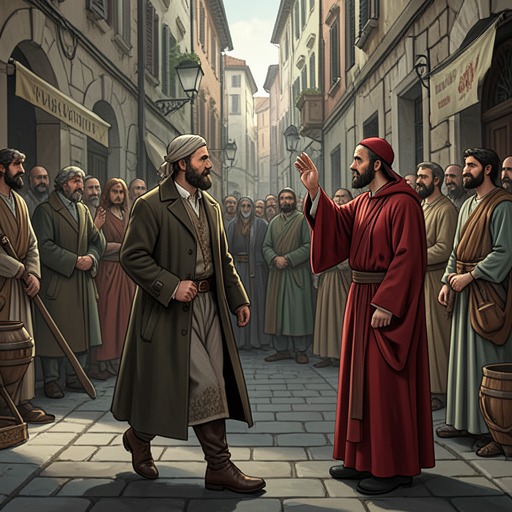
Abraham
The DecameronAbraham is a wealthy, honest Jewish merchant whose journey to Rome reverses the purpose of his investigation: the corruption he finds among Christian churchmen persuades him that Christianity is true, because it continues to flourish despite their efforts. In this story, a proposed inspection of religious authority becomes an unexpected test of the distinction between a faith and the people who represent it.
Identity and Friendship
Abraham is introduced in Paris as both very rich and notably honest and trustworthy. His friend Jehannot de Chevigné, a merchant in silks and cloth, esteems these qualities and is troubled by the thought that so worthy a man might be lost through remaining outside the Christian faith. Their friendship gives Jehannot’s appeal its personal urgency: he wants Abraham to share the religion he believes is holy and good, not merely to concede an argument.
Abraham, however, is not persuaded simply by his friend’s conviction. He says that he regards the Jewish faith as the only holy and good one, because it is the faith in which he was born and in which he intends to live and die. Jehannot returns to the subject and offers further arguments for Christianity, though the narrative characterizes his merchant’s case as rudely made. The arguments begin to please Abraham, but they do not yet make him abandon his own belief. His resistance is neither casual nor a sign that he has failed to listen: he continues to consider the question while refusing to convert on another person’s say-so.
The Roman Test
Abraham proposes a test of Jehannot’s claims. He will go to Rome and observe the Pope, the cardinals, and the other leading members of the Christian court. If their conduct, together with Jehannot’s arguments, persuades him that Christianity is superior, he will convert; if not, he will remain Jewish. The decision makes Abraham an investigator rather than a passive recipient of persuasion. He wants to compare the faith’s claims with the behavior of its highest representatives.
Jehannot immediately fears that this inquiry will defeat his purpose. He expects Abraham to encounter the clergy’s wicked life and return not only unconvinced but more firmly attached to Judaism. He tries to dissuade his friend by pointing to the journey’s cost and danger for a wealthy traveler, and by arguing that Abraham could receive instruction and baptism in Paris. Abraham does not change his mind. Jehannot’s objections prove ineffective, and he eventually stops trying to prevent the journey.
At Rome, Abraham is received honorably by his fellow Jews. He does not announce why he has come; instead, he carefully watches the Pope, the cardinals, the prelates, and the rest of the court, supplementing his own observations with what he learns from others. The account stresses his quick judgment and presents his inquiry as sustained rather than based on a single encounter.
What He Sees at Court
Abraham finds the churchmen, from the highest to the lowest, given to lust. The story specifies that their sexual conduct includes both what it calls the natural way and the Sodomitical way, and emphasizes their lack of restraint or shame. Courtesans and catamites, he observes, can exercise substantial influence in obtaining favors. His investigation also reveals, in his judgment, habitual gluttony and drunkenness: the clergy seem devoted to food and wine as well as to sexual appetite.
He sees greed operating alongside these appetites. Money, he concludes, is pursued so eagerly that even human and Christian blood, as well as sacred things associated with altar services and church benefices, is bought and sold. The narrative makes the discrepancy between conduct and language especially pointed: simony is called procuration, and gluttony is called sustentation, as though changing the names could hide the intentions behind them. Abraham, described as sober and modest, is deeply displeased by what he has seen. Concluding that he has gathered enough evidence, he returns to Paris.
Conversion and Aftermath
Jehannot greets Abraham joyfully but expects the report to end his hopes. When he asks what Abraham made of the Pope, the cardinals, and their court, Abraham condemns the lack of piety, devotion, good works, and exemplary conduct he observed. He judges the court to resemble a workshop for diabolical rather than divine things, and believes its leaders are diligently trying to destroy the Christian religion they should support.
Yet that apparent contradiction determines his conclusion. Christianity has not been destroyed; it continues to grow and become more glorious. Abraham reasons that its persistence, in spite of the churchmen’s conduct, shows that the Holy Spirit must be its foundation and support. The spectacle that Jehannot feared would discredit the faith therefore supplies Abraham with the evidence that completes his conversion. He tells his friend that he will not forgo becoming Christian and asks to be baptized.
Jehannot accompanies him to the Church of Our Lady of Paris, where the clergy baptize Abraham at his own request. Jehannot serves as his sponsor at the font, and Abraham is given the name Giovanni. He is then instructed by learned teachers in the tenets of the Christian faith, which he quickly understands. The narrative ends by describing him as a good and worthy man who thereafter leads a devout life.
Narrative Role
Abraham’s conversion turns on an irony: the Christian institution’s visible failures do not persuade him that Christianity itself is false. Instead, its continued growth despite the apparent efforts of its leaders to undermine it becomes, for him, evidence of divine support. His decision preserves the distinction the story draws between religious truth and the moral conduct of religious officials. Abraham’s scrutiny is central to that reversal: he does not overlook the corruption or excuse it, but interprets the gap between the faith’s claims and its representatives’ behavior as the reason the faith’s endurance requires a higher explanation.