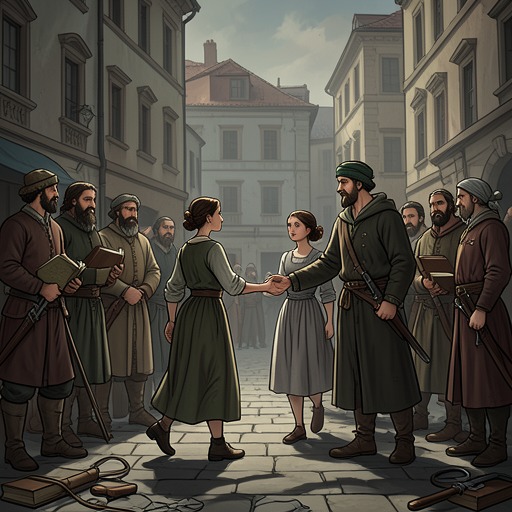
Agnesa
The DecameronAgnesa’s story turns on the recovery of an identity thought lost in a city’s sack: a small cross-shaped scar over her left ear proves that the young woman raised by Giacomino da Pavia is the daughter of Bernabuccio. Her recognition reunites her with her birth family, helps end a feud involving their households, and makes possible her marriage to Minghino. In the fifth day’s sixth story, a bodily mark preserved through years of separation becomes the decisive evidence that joins personal memory, family history, and public reconciliation.
Childhood and Uneasy Origins
Agnesa’s separation began when she was about two years old. Guidotto da Cremona later recounted that, during the sack of Faenza by Emperor Frederick, he and his companions entered a house filled with booty and deserted by its inhabitants. Agnesa alone remained there. When she saw Guidotto coming up the stairs, she called him father. Taking pity on the child, he carried her away to Fano with the goods found in the house. The episode gives her first remembered family connection a painful ambiguity: as a toddler, she addressed the man who took her as her father, while her actual parents were left believing she had perished in the burning of their home.
Before his death, Guidotto entrusted Agnesa and his possessions to his friend Giacomino, charging him to give her the property that had belonged to her as a dowry when she came of age. Giacomino raised her and, as she approached marriageable age, hoped to find a suitable husband. Her origins remained unknown to both of them: neither Giacomino nor Agnesa could discover whose daughter she was. The inheritance and the search for a marriage both show that her future was being arranged under another household’s care, while the facts of her birth remained beyond reach.
Recognition Through the Scar
Agnesa’s birth comes to light amid a conflict involving Minghino, Giannole, and other young men. After officers arrest several of them, including Minghino and Giannole, Giacomino explains that the young woman at the center of the affair is not a native of Cremona or Pavia, as some suppose, but a Faentine. He then recounts Guidotto’s deathbed story. Guiglielmino da Medicina, who had been present during the sack, recognizes the account and recalls that the plundered house belonged to Bernabuccio, who had lost a daughter of roughly Agnesa’s age in those same troubles.
Bernabuccio remembers a specific mark from his daughter’s infancy: a small cross-shaped scar above her left ear, left by an operation to remove a tumor. He asks Giacomino to let him see the young woman, then raises her hair with his right hand and finds the scar. The recognition does not rest on resemblance alone, although Agnesa’s face reminds him of her still-beautiful mother. The scar makes the resemblance verifiable, linking a particular childhood injury to the family that had grieved for her. Bernabuccio recognizes her as his daughter and explains that she had been forgotten in the confusion when the household fled; until then, the family had believed she died when the house burned.
Agnesa initially resists Bernabuccio’s embrace. Hearing his account and seeing him, she comes to believe him; she then submits to his embrace and weeps with him, moved, as the story puts it, by an occult instinct. Her response gives the recognition both evidence and feeling: the scar establishes who she is, while her tears and eventual acceptance mark the emotional force of a kinship restored after years of ignorance.
Reunification and Marriage
Bernabuccio sends for Agnesa’s mother, sisters, brothers, and other relatives, presents Agnesa to them, and recounts how she was lost and found. After a succession of embraces, he brings her to his home amid general rejoicing. The family’s welcome reverses the belief that she had died in the fire and restores her place among her birth relatives. At the same time, she does not simply return to the household she left as a toddler: Giacomino, who protected and raised her, remains central to the resolution, and Bernabuccio’s gratitude and affection are expressed through cooperation with him.
The discovery also changes the outcome for the young men under arrest. The town-captain learns that Giannole, one of the prisoners, is Bernabuccio’s son and therefore Agnesa’s brother. He releases Giannole, Minghino, Crivello, and the others implicated in the affair, then mediates between Bernabuccio and Giacomino. As part of making peace between the two young men, he gives Agnesa in marriage to Minghino. The story thus links the recovery of her parentage to a concrete public consequence: recognition alters the status of the prisoners and allows the rival households to settle their conflict through marriage.
Agnesa’s wedding to Minghino is celebrated with the approval of both families. She is carried home as a bride, and the couple live together for many years in peace and prosperity. The ending completes the tale’s movement from loss to belonging, but it does so through several forms of repair at once: the lost daughter is restored to her family, Giacomino’s guardianship is acknowledged rather than discarded, the young men are freed, and a marriage turns antagonism into a lasting household bond.
Narrative Role and Significance
Agnesa is not presented as the author of the conflict or its settlement. The account explicitly establishes that she is not at fault; the decisive actions are undertaken by Giacomino, Bernabuccio, Guiglielmino, and the town-captain. Yet she is more than the object around which the men’s dispute turns. Her initial resistance, subsequent belief, and tender response to Bernabuccio give the recovered identity an emotional dimension, while the marriage that follows determines her future within both families.
The tale makes identity recoverable through a detail that survives when memory and ordinary family ties have failed. Agnesa’s infant scar is at once intimate and evidentiary: it belongs to her body, but its meaning depends on Bernabuccio’s remembered knowledge and Guiglielmino’s confirmation of the past. Recognition then becomes a social act, not merely a private discovery. By bringing the family together and resolving the dispute that had led to arrests, Agnesa’s return changes the fortunes of a wider group. Her story’s happy ending depends on the conjunction of chance survival, preserved memory, corroboration, and communal agreement.