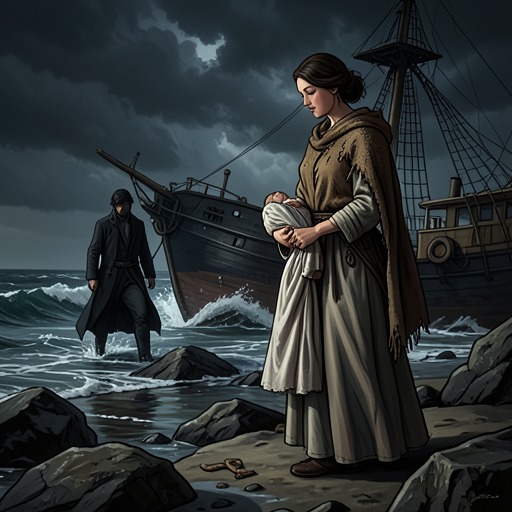
Arrighetto Capece
The DecameronArrighetto Capece’s story joins political upheaval to a family’s long separation: a governor and partisan of Manfred, he is captured after the defeat at the Battle of Benevento, but the revolt against Charles I of Anjou restores his freedom, honors, and possessions. His return to power matters not only as a reversal of fortune but because it makes possible the recovery of his wife and sons, from whom he has heard nothing since his capture.
Identity and Position
A gentleman of Naples, Arrighetto Capece is presented as a man of high standing in Sicily during Manfred’s rule. He has the governance of the island in his hands and is among those closely connected to the reigning king. His authority is therefore political as well as personal: when control of Sicily changes, his position exposes him directly to the dangers of the new regime.
Arrighetto Capece is married to Madam Beritola Caracciola. At the time of the political crisis, their elder son, Giusfredi Capece, is about eight years old, and Madam Beritola Caracciola is pregnant with their second son, Scacciato. The abrupt loss of Arrighetto Capece’s authority thus becomes the rupture of a household as well as the downfall of a governor.
Capture and Family Separation
After Charles I of Anjou defeats and kills Manfred at the Battle of Benevento, the Sicilian realm turns to the new ruler. Arrighetto Capece prepares to flee rather than become the subject of his lord’s enemy. The Sicilians discover his intention, however, and seize him along with other friends and servants of Manfred, delivering the prisoners to Charles I of Anjou together with possession of the island.
Madam Beritola Caracciola does not know what has happened to her husband and fears the consequences of the change in power. Pregnant and worried about dishonor, she abandons her possessions and flees with Giusfredi Capece. After reaching Lipari, she gives birth to Scacciato; the family’s planned return to Naples is then disrupted when their ship is driven to Ponza. The political defeat that removes Arrighetto Capece from public life also disperses his family, leaving each side without news of the other.
Recognition of Giusfredi
Years later, while imprisoned apart from his wife, Giusfredi Capece hears that Pedro of Aragon has raised Sicily against Charles I of Anjou. He laments that the long-awaited revolt has come while he is still confined, then reveals to his gaoler that he is not the man known as Giannotto: he is Giusfredi Capece, son of Arrighetto Capece, and remembers having been lord of Sicily as a child.
The disclosure turns the family’s lost political identity into a means of recognition. When the report reaches Currado Malespina, he privately questions Madam Beritola Caracciola, who confirms that her elder son would bear that name and would now be about twenty-two. The narrative verifies Giusfredi Capece’s identity through the match between his account and his mother’s recollection. Arrighetto Capece is absent from this recognition, but his name and former rank establish the history that Giusfredi must recover.
Return to Power and Family
The revolt brings a second reversal for Arrighetto Capece. When the people rise against Charles I of Anjou, they kill his guards, free Arrighetto Capece from captivity, and make him their captain. He leads them against the French, and Pedro of Aragon restores him to his honors and possessions. The former governor thus returns to authority through the same island whose loss had brought about his imprisonment.
The news arrives at a gathering where Madam Beritola Caracciola and her sons have already been reunited. A messenger reports that Arrighetto Capece is alive, has recovered his position under Pedro of Aragon, and has rejoiced at learning that his wife and son have been found. Because he has known nothing of them since his capture, their recovery is not a continuation of contact but the sudden end of a long silence. Arrighetto Capece sends a brigantine carrying gentlemen to bring his family to him.
Narrative Significance
Arrighetto Capece’s arc is largely conveyed through absence, report, and restored identity. His capture sets in motion the dispersal of his family; his son’s remembered status helps make recognition possible; and his liberation allows the separated family to move toward reunion. Political fortune and domestic fortune turn together: the Sicilian revolt restores Arrighetto Capece’s public standing, while the messenger’s news connects that restoration to the recovery of those he had lost.