Chiassi
The DecameronChiassi is the setting for the decisive turn in Nastagio degli Onesti’s story: he retreats there from Ravenna to escape the pain and expense of unrequited love, but in its pine wood witnesses a woman’s repeated supernatural punishment. He later stages a banquet at the same site, where the spectacle reaches the woman he loves and, according to the story’s account, leads her to marry him. Chiassi thus serves first as a refuge for solitary brooding and then as a carefully chosen public stage.
Setting and Distance from Ravenna
The narrative places Chiassi about three miles from Ravenna. Nastagio rides there with many friends after his kinsfolk urge him to leave the city for a time: they fear his hopeless attachment will consume both him and his considerable inheritance. He has inherited great wealth from his father and an uncle, and has spent without measure in pursuit of a daughter of Messer Paolo Traversari, whose family is of higher rank than his own. His friends imagine distance as a remedy for both passion and prodigality; Chiassi is the nearby destination where that proposed separation begins.
Nastagio makes no permanent departure for France, Spain, or another far country, as he had initially prepared others to believe. Instead, he rides with his companions to Chiassi, sends for tents and pavilions, and tells them he intends to remain while they return to Ravenna. The contrast between the promised distant journey and this short retreat gives the place a provisional character: it is far enough from the city for Nastagio to withdraw, but close enough for his social circle to visit and for a later gathering to bring the Traversari household there.
A Retreat That Repeats His Extravagance
At Chiassi, Nastagio continues to live magnificently, inviting different people to dinner and supper as he had done before. The retreat therefore does not immediately cure the conduct his relatives hoped to change. Away from Ravenna, his lavish hospitality persists; the setting initially shelters rather than ends his expenditure. This matters to the story’s progression: Chiassi is not simply a quiet place where he recovers, but a space in which his old habits continue until an encounter gives the retreat a new purpose.
Near the beginning of May, on a day when the weather is fair, Nastagio goes into the pine wood alone to think about the woman who has treated him with such cruelty. The fifth hour is nearly past when, after walking about half a mile into the wood, he realizes he has wandered farther than intended. The marked time, distance, and season locate the extraordinary encounter within an otherwise specific excursion from his encampment. The wood lies within the Chiassi episode, but feels removed from the company and hospitality that have defined his stay there.
The Pine Wood and the Repeated Punishment
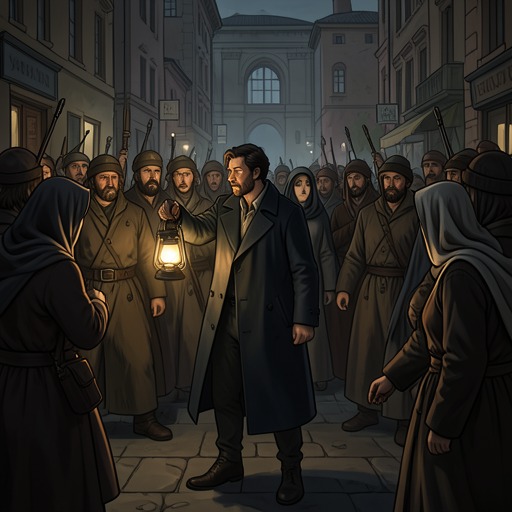
In the wood, Nastagio hears a woman’s cries and sees a naked young woman running through thickets, torn by bushes and brambles. Two huge Mastiffs pursue and bite her; behind them rides a knight in dark armour on a black horse, carrying a sword and threatening her. Nastagio, moved to pity and finding himself without weapons, takes a tree branch as a club and advances to defend her. The knight knows Nastagio’s name and tells him not to interfere, claiming that the woman has merited the punishment.
The knight explains that the chase and killing are not a single event but a recurring spectacle. He pursues and kills the woman, cuts out her heart, and gives it to the Mastiffs; then she rises again and flees toward the sea, still pursued. Nastagio watches the figures disappear and remains caught between pity and fear. He learns that the scene happens every Friday. Chiassi’s wood is therefore not merely the location of an apparition: it is the repeated setting of a punishment whose recurrence supplies Nastagio with a plan.
The Banquet as a Staged Encounter
Recognizing that the Friday repetition may serve his purpose, Nastagio asks his kinsfolk and friends to arrange a dinner for the coming Friday. He specifically wants Messer Paolo Traversari, his wife and daughter, their female relatives, and other ladies to attend, promising that they will understand the reason when they see what happens. His friends invite them, and the daughter whom Nastagio loves comes with the other women, although persuading her to attend is not easy.
Nastagio orders a magnificent banquet and places the tables beneath the pines, around the spot where he witnessed the woman’s slaughter. He seats his beloved directly opposite that place. The arrangement turns Chiassi’s landscape into part of the action: the wood is not a backdrop to the meal but the site from which the anticipated spectacle will emerge, while the chosen seating ensures that the woman Nastagio hopes to persuade must face it.
As the final dish arrives, the hunted woman’s cries are heard. The guests rise in alarm and see the woman, knight, and Mastiffs enter among them. Some try to help, but the knight’s address makes them draw back, and the punishment unfolds again. Many of the women present weep as if they themselves had suffered it; some are related to the woman and the knight and remember the history of their love and deaths. The story’s account connects this witnessed scene to its outcome: Nastagio’s beloved, fearing a similar fate, changes her mind and takes him as her husband. Chiassi’s movement from refuge to pine-wood spectacle to arranged banquet makes the place central to that reversal.