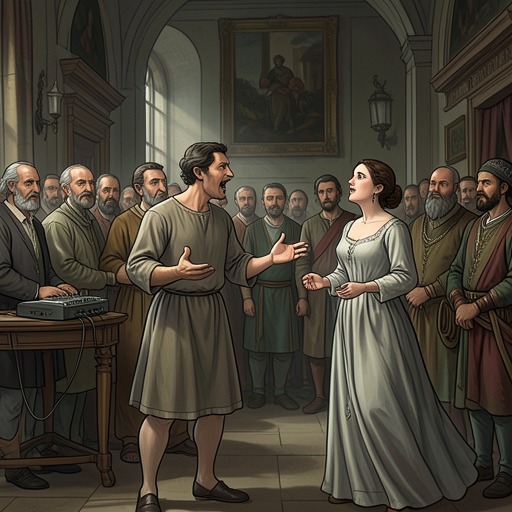
Chichibio’s one-legged crane excuse
The DecameronChichibio’s one-legged crane excuse transforms a missing supper dish into a test of authority, observation, and quick speech. Having given a Crane (bird) thigh to Brunetta, the cook invents a claim that cranes have only one leg; at dawn, when his master makes him face the birds, Chichibio turns their posture into apparent evidence and escapes the threatened punishment with a final, improvised answer. The story’s decisive reversal is not that his original lie becomes true, but that his master’s own call supplies the comic condition under which it might have been.
The Supper and the Missing Thigh
Currado Gianfigliazzi is introduced as a noble citizen, known for liberality and a knightly life, and fond of hawks and hounds. After his falcon brings down a young, fat crane, Currado sends it to his Venetian cook, Chichibio, with instructions to roast and dress it for supper. The bird is nearly done, and its savoury smell fills the kitchen, when Brunetta, a woman of the neighbourhood whom Chichibio loves, comes in and asks for a thigh.
Chichibio first refuses in song, but Brunetta answers with a threat: if he will not give her the thigh, she will never again grant him anything that could please him. Their exchange turns the kitchen into a small contest between his duty to his master and his desire to please the woman he loves. He gives way, cuts off one thigh, and gives it to her. The concession is an act of affection, but it leaves a visible absence that cannot be concealed when the roasted bird is served.
At supper, Currado shares the crane with visiting guests and notices that it lacks a thigh. Asked where the other one has gone, Chichibio answers without hesitation that cranes have but one thigh and one leg. The lie is audacious because it contradicts an ordinary sight, and Currado immediately challenges it. Chichibio offers to show him a living crane as proof. Currado does not prolong the quarrel in front of his guests; instead, he makes the cook’s offer into a test for the next morning and warns him that, if the claim proves false, he will remember the punishment.
The Dawn Test
Currado’s anger survives the night. As soon as it is day, he has the horses brought, mounts Chichibio on a rouncey, and rides with him toward a watercourse where cranes can be seen at daybreak. The journey changes the lie from a verbal escape at table into a claim that must withstand direct demonstration. Chichibio rides in great fear, unable to see how he can make good his assertion and wishing he could flee.
His anxious scanning of the scene shapes what he notices: at first, he takes the cranes he sees for birds standing on two feet. Then, before Currado sees them, he spots a round dozen on the bank, each standing on one leg as cranes do when they sleep. He points them out as confirmation that he told the truth. The detail of the birds’ posture gives his false explanation a momentary foothold in reality. For an instant, the test seems to have reversed: the master has been brought to the scene, but the cook appears to have the evidence on his side.
The Answer That Changes the Ending
Currado does not accept the sleeping birds as proof. He moves closer and cries out, startling them; they put down their other legs and take flight. Their movement exposes Chichibio’s claim, and Currado asks how he can now maintain that cranes have only one leg. The birds’ bodies have supplied the decisive counter-demonstration, and the threat of punishment seems ready to return.
Chichibio is confused and frightened, but finds one last answer: Currado had not cried out to the crane served the previous night; had he done so, it too would have put out its other thigh and leg. The excuse cannot restore the missing portion or make the original claim credible. Instead, it redirects attention from the cook’s theft to the master’s hypothetical failure to perform the same gesture. Its wit lies in answering a demonstration with an impossible comparison, delivered at exactly the moment when the birds have disproved him.
Laughter, Fortune, and Verbal Ingenuity
The answer changes Currado’s response. His wrath gives way to mirth and laughter, and he concedes that Chichibio is right in the comic terms the cook has just established. Chichibio makes peace with his master and escapes the punishment that had been threatened. The outcome depends not on a successful defense prepared in advance, but on a prompt reply that finds a new use for the evidence against him.
Neifile introduces the tale by distinguishing ready wit from the help fortune may suddenly give a fearful speaker. Chichibio’s story holds both explanations together: he supplies the final verbal turn himself, but the sleeping cranes first give him an unexpected image on which to build his defense. The narrative escalates through successive proofs—the missing thigh at supper, the birds standing on one leg, then their flight after Currado’s cry—and saves its sharpest reversal for the last line of the exchange. What begins as a cook’s private concession to Brunetta ends as a public contest before his master, in which laughter rather than punishment settles the matter.