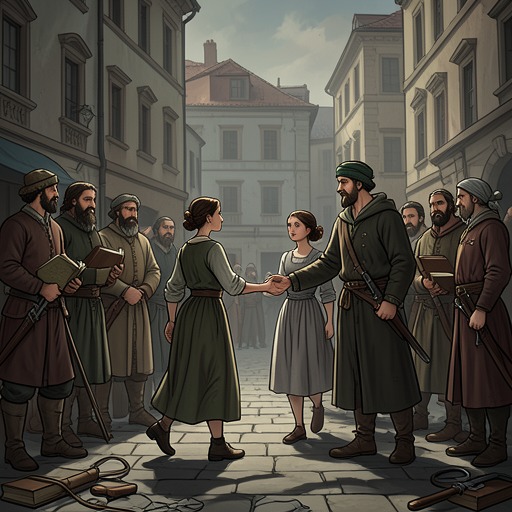
Cimon
The DecameronCimon is the name given to Galesus, a wealthy Cypriot nobleman’s son whose sudden love for Iphigenia awakens abilities that had seemed entirely absent. His transformation—from a youth mocked as brutish to a learned and accomplished man—makes him the story’s central example of Love as a power capable of releasing hidden human capacities. Yet his pursuit of Iphigenia also turns that ideal of transformation into a story of force: unable to obtain her through her father’s consent, Cimon attacks the ship carrying her to another marriage and claims her for himself.
Identity and Early Life
Cimon is the son of Aristippus, a gentleman on Cyprus who possesses great wealth and status. His true name is Galesus, but those around him call him Cimon, a name that in their language signifies a brute beast. The disparaging name reflects his reputation: although exceptionally tall and handsome, he is considered nearly an idiot, incapable of learning letters or good breeding despite his father’s efforts through teaching, persuasion, punishment, and study.
His rough voice and uncouth manners reinforce the judgment that he is more suited to animal life than to society. Aristippus, distressed and having abandoned hope of improving him, sends him to the family’s country estate to live among the farmworkers. Cimon welcomes the change; the habits of country people suit him better than those of townsmen. At this stage, his noble birth and good looks have not translated into the education or conduct expected of a gentleman.
Iphigenia and the Awakening of Love
The turning point comes in May, when Cimon passes through a leafy grove between farms and finds Iphigenia asleep in a meadow beside a clear spring. Her servants are asleep nearby. Seeing her, he stops and gazes at her, but does not approach or touch her. When she wakes and asks what he is doing there, he cannot answer at first. She calls her attendants and sets off, wary of him; Cimon insists on accompanying her and follows her all the way to her house.
After this encounter, Cimon returns to his father’s house in the city and refuses to go back to the countryside. His family and acquaintances wonder at the change. Love, the story says, enters a mind untouched by teaching and becomes the cause of Cimon’s transformation. He asks Aristippus to dress him as his brothers are dressed, and his father gladly agrees. Cimon begins associating with young men of rank and learning the manners and bearing expected of a gentleman, especially of a lover.
Education and Transformation
Cimon’s improvement is rapid and comprehensive. He learns the elementary letters and becomes distinguished among students of philosophy. He makes his speech civil, acquires musical skill, and becomes expert in riding and in martial exercises on land and sea. By the fourth year after he first fell in love, he is described as the most accomplished young man on Cyprus, distinguished across many areas of excellence.
This change is more than a social polish: it reverses the judgment that his nature is fixed. The narrator interprets Cimon’s abilities as virtues implanted in his soul but bound and obscured by adverse fortune; Love breaks those restraints and brings his capacities into the open. Aristippus sees the practical result—Love has turned his son from a dunce into a man—and not only tolerates Cimon’s excesses but encourages him to pursue his desires. Cimon himself continues to use the name Cimon, remembering that Iphigenia had called him by it, rather than returning to Galesus.
Iphigenia, Pasimondas, and the Seizure at Sea
Cimon tries twice to secure Iphigenia’s hand by asking her father, Cipseus, to give her to him in marriage. Cipseus refuses, explaining that he has already promised her to Pasimondas, a young nobleman of Rhodes, and will not break his word. Cimon’s love thus meets a limit imposed by an existing marriage arrangement, not by any stated choice on Iphigenia’s part.
When the time comes for Iphigenia to be conveyed to Pasimondas, Cimon decides to take her by force. He secretly gathers a group of young noble friends and equips a ship for battle, then waits at sea for the vessel carrying the bride and the bridegroom’s party toward Rhodes. The next day he overtakes them, orders them to stop or face attack, and grapples the ships together. He boards alone and fights with a cutlass; the Rhodians eventually lay down their arms and surrender.
Cimon tells the defeated party that he has not attacked them out of hatred or a desire for plunder. He says that he wants Iphigenia, whom he loves above all else, and that because her father would not give her to him peacefully, Love has compelled him to win her from them as an enemy and by force of arms. He claims he intends to take the place Pasimondas would have held as her husband. The scene makes his motive explicit, but it does not erase the coercion in his action: Iphigenia is the object of a contest between men, and the account gives no response from her to Cimon’s demand.
Narrative Arc and Significance
The story’s heading carries Cimon’s fortunes beyond this first seizure: he is imprisoned at Rhodes, delivered by Lysimachus, and joins him in taking Iphigenia and Cassandra from their wedding celebration. The two couples flee to Crete, where the women become their wives, before all four are recalled home. This larger arc places Cimon’s transformation within a romance of pursuit, capture, escape, and eventual marriage, while the detailed scene of his awakening supplies its central explanation: Love has made a gentleman of the man his society dismissed as a beast.
Cimon’s story therefore holds two kinds of change together. His education and new accomplishments are presented as genuine enlargement, overturning the assumption that he is incapable of reason or refinement. His conduct toward Iphigenia, however, shows that becoming accomplished does not mean learning restraint: after pursuing a marriage refused by her father, he substitutes armed action for consent. The story celebrates Love’s power to awaken latent excellence, even as the course of that love depends on choices that expose the difference between personal transformation and respect for another person’s will.