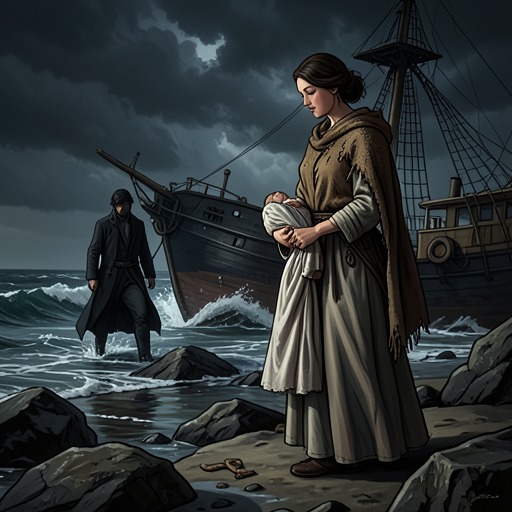
Currado Malespina
The DecameronCurrado Malespina is a nobleman whose compassion turns a chance encounter with an exile into a lasting act of protection. In the story of Madam Beritola, he gives shelter to a woman living as a wild creature on an island; later, he recognizes her lost son and offers him marriage to Currado’s daughter Spina. His authority matters not as a means of punishment, but as a means of restoring kinship, dignity, and a future to people whose lives have been broken by political upheaval and separation.
Identity and Position
Currado belongs to the family of the Marquises of Malespina and is presented as a man of standing, hospitality, and piety. He is returning by ship from a pilgrimage to the holy places in Apulia with his wife, a woman of worth and devotion, when their vessel puts in at Ponza. His journey places him at the scene of Madam Beritola’s isolation by coincidence, but his response to what he finds there shapes the course of her family’s story.
The Encounter on Ponza
While passing time on the island, Currado goes exploring with his wife, servants, and dogs. The dogs chase two young kids into a cavern, where Madam Beritola has been living alone. She springs up with a staff and drives the dogs away. Currado and his wife find a woman changed by her months in the wilderness: darkened, thin, and hairy. At Currado’s request, he calls off the dogs, and he and his wife persuade her to explain who she is and what has happened to her.
Beritola tells them of her losses and her resolve to remain alone. Currado knows her husband, Arrighetto Capece, and is moved to tears by her misfortune. He tries to dissuade her from continuing what he regards as a barbarous course, offering either to take her back to her home or to keep her in his household and honor her as a sister until better fortune comes. When she refuses to go anywhere she might be recognized, Currado does not force her. Instead, he leaves his wife to provide food and clothing and asks her to find a way to persuade Beritola to accept help.
His wife’s care, and her persistence, eventually bring Beritola to agree to go to Lunigiana. She travels with Currado and his wife, taking the kids and their mother, the she-goat, with her. At Currado’s castle she lives in widow’s clothing as his wife’s modest and obedient attendant, still caring for the animals that had been her only company on Ponza. Currado’s intervention thus offers safety without requiring Beritola to abandon the attachments she formed in her solitude.
Recognizing Giusfredi
Meanwhile, Beritola’s elder son has been taken into servitude under the assumed name Giannotto di Procida. He grows up in Currado’s household, where he enters into a love affair with Currado’s daughter Spina. The pair are imprisoned after the relationship brings them into trouble. When Giannotto reveals his identity to a gaoler, the gaoler reports what he has said to Currado.
Currado does not accept the claim on trust alone. He privately asks Beritola whether she had a son called Giusfredi; she answers that, if her elder son still lives, he would be about twenty-two. Currado concludes that Giannotto may be that son and examines him in detail. Manifest signs convince him that the young man is indeed Giusfredi, the son of Arrighetto and Beritola. The recognition changes the meaning of the young man’s presence in Currado’s household: he is not merely a servant who has wronged his lord, but a nobleman whose identity has been hidden by capture and misfortune.
Spina, Giusfredi, and the Offer of Marriage
Currado acknowledges that Giusfredi’s relationship with Spina has injured him and his daughter’s honor, and that others might have answered such an offense with a shameful death. He says that his clemency has spared the young man. Yet, rather than use his power to exact punishment, he proposes to end both men’s troubles: Spina, who has been Giusfredi’s lover, can lawfully become his wife, and Giusfredi can remain with Currado as a son.
Giusfredi accepts the offer, while insisting that he never laid snares for Currado’s life or property and that his love for Spina has been genuine. Currado is struck by the young man’s generous spirit and tender affection. He rises, embraces and kisses him, and has Spina brought to them. The two lovers contract marriage in Currado’s presence according to custom. After several days, when he has provided for the newly married pair, he tells his wife and Beritola what he has arranged, presenting the return of her elder son as a gift and Spina as his wife. Beritola receives the news with tears, saying that the restoration of her son is dearer to her than herself.
Character and Narrative Role
Currado’s actions repeatedly turn authority toward mercy. On Ponza, he offers Beritola food, clothing, companionship, and a place in his household without demanding that she immediately surrender her chosen solitude. Later, he responds to Giusfredi’s offense with a marriage proposal rather than the fatal punishment he says other lords might have imposed. The two episodes mirror one another: first he protects a mother whose family has been scattered; then he recognizes and restores the son she believes lost.
In Emilia’s account of Fortune’s reversals, Currado is the human agent through whom recognition becomes reunion and clemency becomes a practical remedy. His generosity does not erase the hardships that preceded it, but it converts a clandestine affair and a prison sentence into a lawful marriage, and an exile’s household into the place where a mother can recover her child. The story gives his rank its clearest value in what he chooses to do for those dependent on his judgment.