Cyprus
The DecameronCyprus is more than a point on a voyage in the Decameron: it is a recurring island setting where commercial hopes can collapse, love can remake a life, and a displaced traveler can find a route home. Its roles vary from story to story, but the island repeatedly stands at a meeting point between movement and settlement. Characters arrive there seeking trade, refuge, or a new life; what happens on Cyprus shapes whether they depart diminished, transformed, or restored.
Island Setting and Narrative Connections
The tales identify Cyprus as an island and place it within a network of sea routes linking ports and kingdoms. It is a destination for a merchant sailing from Ravello, the home of the nobleman Aristippus and his son Cimon, and a place where the Florentine Tedaldo Elisei makes a new life under an assumed name. In Alatiel’s story, Cyprus is also connected to Famagosta and Baffa, where recognition and royal assistance help turn a long sequence of displacements toward a return to her father.
These uses give the island no single, fixed narrative character. It can be the setting of an established household, a stage in a merchant’s career, or a temporary station in a journey shaped by storms and political danger. Its importance lies in the way the stories make it part of a connected maritime world: arrival on the island does not end movement, but changes the possibilities available to those who land there.
Trade, Risk, and a Reversal of Fortune
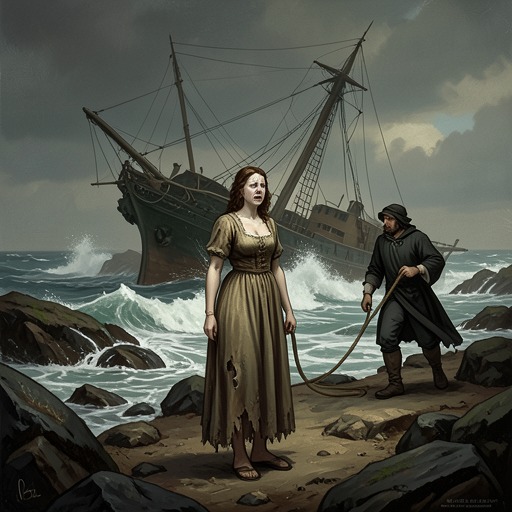
Landolfo Ruffolo’s voyage makes Cyprus the scene of a commercial reversal. Already exceedingly rich in Ravello, he loads a large ship with his own merchandise and sails there to trade. On arrival, he finds other ships carrying goods of the same kind and quality. Competition forces him to sell his cargo at a great loss, and he comes close to ruin.
The failure does not keep Landolfo in commerce. Rather than return home impoverished, he sells his large ship, uses the proceeds and what remains from his goods to buy a smaller vessel suited to cruising, and turns to piracy, especially against Turkish ships. Fortune proves kinder to him in this dangerous new occupation: after some years he has recovered what he lost in trade and gained more. Cyprus therefore marks the sharp turn between a merchant’s failed venture and the predatory enterprise by which he rebuilds his wealth. The island is not presented as the cause of his loss; the immediate cause is the glut of competing merchandise. But his arrival there makes the risk of trade concrete and sets the next phase of his career in motion.
A New Life and a Return to Florence
Cyprus also becomes a place of prolonged exile for Tedaldo Elisei. After Madam Ermellina, the married woman he loves, withdraws from him, he leaves Florence secretly and travels to Ancona. There he takes service with a rich merchant, accompanies him to Cyprus, and gradually rises from employee to trusted associate. His careful management of the merchant’s affairs earns him a good wage and responsibility; over several years he becomes a rich and well-known merchant in his own right.
Yet commercial success does not erase the attachment that caused his departure. Tedaldo continues to remember his former beloved, though for seven years he masters his longing to see her. The decisive prompt comes when he hears a song in Cyprus that he himself had made earlier, a song about their love and the pleasure he had taken in it. The remembered song rekindles his desire, and he resolves to return to Florence. After putting his business in order, he travels back secretly, disguised as a pilgrim returning from the Holy Sepulchre. Cyprus thus holds both the years of his self-imposed absence and the moment when memory breaks that separation. His return begins a new part of his story, but the island’s particular contribution is to make possible the merchant’s life he built before choosing to go home.
Love as Transformation: Cimon’s Cyprus
In another tale, Cyprus is the home of Aristippus, a nobleman richer than anyone else in the country, and of his son, whose true name is Galesus. The young man is so unteachable and uncouth that people mockingly call him Cimon, a name said to mean brute beast. His father, distressed and having lost hope of educating him, sends him to live at the country estate among the farm workers, whose ways suit him better than those of the townspeople.
Cimon’s encounter with Iphigenia in the woods changes that course. When she wakes and sees him standing over her, he cannot answer her question; he is fixed instead on her beauty. He follows her home despite her fear and reluctance. Afterward he refuses to return to the country estate. His love prompts him to seek fine clothes like his brothers’, learn the manners expected of a gentleman and a lover, and study. In a short time he learns the elements of letters; he goes on to distinguish himself in philosophy, refine his speech, and become skilled in music, riding, and military exercises. Within four years of first falling in love, he is described as the most accomplished young gentleman in Cyprus.
Cyprus is not simply the backdrop to this change: the story presents Cimon’s transformation as the revelation of virtues that had been hidden within him. His father, recognizing that love has turned a dunce into a man, tolerates and encourages his son’s pursuit. Cimon asks Iphigenia’s father, Cipseus, for her hand, but Cipseus refuses because he has promised her to Pasimondas of Rhodes. When Iphigenia is sent away for that marriage, Cimon attacks her ship at sea and takes her by force. The island is consequently both the place of his education and the home from which he launches the violent attempt to secure the woman he loves.
Cimon is later imprisoned at Rhodes and freed by Lysimachus. In concert, the two men seize Iphigenia and Cassandra on their wedding day; Pasimondas and Ormisdas are killed in the raid. The couples flee to Crete and marry there. After their friends and relatives negotiate an accommodation, Cimon returns to Cyprus with Iphigenia, while Lysimachus returns to Rhodes with Cassandra. Cyprus is the endpoint of Cimon’s return as a changed man, but the tale’s happy resolution follows an abduction and lethal violence, not a peaceful agreement with Iphigenia’s family.
Royal Protection and Alatiel’s Restoration
Cyprus also figures as a realm whose ruler can intervene in the fortunes of a displaced traveler. After a long succession of upheavals, Alatiel is living at Baffa with a merchant who has represented her as his wife. When the merchant is away, Antigonus of Famagosta sees her and recognizes her as the Soldan’s daughter, believed to have drowned years earlier. She recounts what has happened since her shipwreck and asks him to help restore her to her former position if he can.
Antigonus goes to the King of Cyprus and explains that Alatiel is alive, that she wishes to return to her father, and that sending her under his protection would bring honor to the king. The king agrees, receives her at Famagosta with honor, and gives her a suitable escort. Alatiel’s return is not achieved by the island’s location alone: it depends on Antigonus’s recognition and advocacy, followed by the king’s generous decision to assist her. The story thus gives Cyprus a place in the movement from concealment to recognition and from vulnerability to safe passage. Alatiel eventually returns to her father, while Antigonus’s service is included in the honor and gratitude attached to her reception.
Narrative Significance
Across these episodes, Cyprus gathers together distinct kinds of turning point. Landolfo arrives as a merchant and leaves the logic of ordinary trade behind; Tedaldo establishes himself there in exile before a song sends him home; Cimon’s island upbringing gives way to education, martial action, and return; and Alatiel’s passage through Baffa and Famagosta leads toward recognition and restoration. The island is therefore associated with both settlement and departure, with the work of building a life and the possibility of recovering an earlier identity.
The tales do not make those outcomes equivalent. Landolfo’s recovery depends on piracy, Cimon’s return follows an abduction and deaths, Tedaldo’s departure from Cyprus is a personal choice renewed by memory, and Alatiel’s homeward journey is secured through assistance from a ruler. Read together, these differences make Cyprus a narrative junction rather than a simple symbol of good fortune: what it offers depends on the people who arrive, the dangers they face, and the decisions made around them.