England
The DecameronEngland is more than a distant destination in the Decameron: it is a setting where exile can become a livelihood, where children separated from their family are placed in new households, and where fortunes rise or fail with political change. Its stories make the country a place of both refuge and risk, connecting financial enterprise, royal service, and the concealment of identity.
A destination for exile and enterprise
The clearest pattern is the arrival of people driven from their former homes. Three Florentine brothers, after extravagant spending consumes their inheritance and revenues, leave Florence for London. They take a small house, keep their expenses low, and lend money at interest. Their enterprise prospers: in a few years they accumulate a large fortune, return to Florence, buy back much of their property, acquire more land, and marry.
Their success does not end their dependence on England. They continue lending there and send their nephew Alessandro to manage the business. He advances money to English barons against their castles and other possessions, a source of substantial profit. England thus supplies both the capital that appears to restore the family and the political risks that will undo that restoration.
Credit and political reversal
The brothers’ renewed prosperity at home depends on money remitted from England. Though now householders and fathers, they again spend lavishly and borrow freely from Florentine merchants, confident that the English revenues will continue. That confidence rests on Alessandro’s loans to the barons and on the expectation that his claims will remain recoverable.
War breaks out between the King of England and his son, dividing the island into opposing parties. The barons’ castles are taken from Alessandro, and his other sources of income yield him nothing. He waits for peace, expecting that principal and interest will eventually be restored, while his uncles continue spending and borrowing. After several years without a settlement, their credit fails. Their creditors demand payment; their property proves insufficient, and the brothers are imprisoned for the remaining debt. Their wives and children scatter into the countryside and elsewhere, left facing an uncertain future. England’s conflict therefore reaches Florence through credit: political upheaval abroad becomes insolvency, imprisonment, and family dispersal at home.
The Count of Antwerp’s family in England
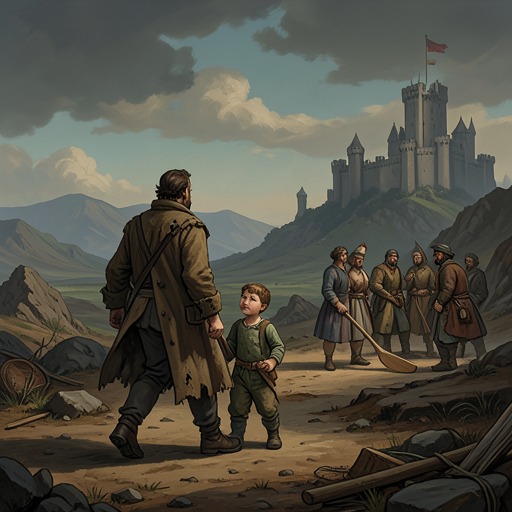
England also becomes a refuge for Gautier of Antwerp, falsely accused and driven into exile. He reaches Calais with his two children, crosses to England, and goes to London in humble clothing. Before entering the city, he instructs his young son and daughter to endure poverty patiently and never disclose their parentage. He changes their names as an added safeguard: his son Louis becomes Perrot, and his daughter Violante becomes Jeannette.
At a church door in London, a marshal’s wife sees the family begging. Gautier tells her that he comes from Picardy and presents the children as his own, explaining their departure through the misconduct of an elder son. The lady, moved by Jeannette’s beauty and manner, offers to take her into her household and eventually arrange an honorable marriage if she proves worthy. Gautier accepts, entrusting his daughter to the woman’s care.
He then travels through England with Perrot, begging as they go, until they reach Wales. At the household of another English marshal, Perrot joins the young people in running and leaping and shows himself as capable as, or better than, the others. The marshal asks for the boy and takes him into his household. Gautier agrees despite the pain of separation. England has become a shelter for both children, but only by dividing them from one another and from their father.
Service, identity, and changed fortunes
After arranging for his children, Gautier leaves England. Perrot grows in favor with the marshal and becomes famous as Perrot the Picard for his prowess in tournaments, jousts, and other feats of arms. A pestilence then kills the marshal, his wife, their only son, and many of their kin. With the marshal’s daughter the surviving heir, the remaining gentlemen approve her marriage to Perrot, whose worth and ability make him a suitable husband and lord of the inheritance. The King of England later appoints him marshal in place of his dead patron.
The story’s summary presents the larger arc: Gautier’s children are left in different places in England, and he returns in disguise, finds them prospering, and eventually has his innocence recognized and his former rank restored. Within the English episodes, however, the contrast is especially sharp: Gautier survives by concealing his identity and accepting menial work, while Perrot’s adopted name becomes the means by which his talents are publicly known. The country first receives a dispossessed family as beggars and servants, then provides the setting in which one child acquires an estate and royal office.
England’s narrative significance
These stories give England distinct but related functions. For the Florentine brothers, it is a faraway financial center whose lending opportunities support a return to wealth, but whose political instability can destroy the foundations of that wealth. For Gautier and his children, it is a refuge in which anonymity and service offer protection after false accusation has stripped them of rank and home.
The outcomes differ, but both plots make security conditional. The brothers’ fortunes depend on barons’ property and a war they cannot control; Gautier’s family depends on other households’ compassion, the children’s ability to adapt, and Perrot’s demonstrated worth. England is therefore neither simply a place of rescue nor a guarantee of prosperity. It is a setting where people displaced from their origins must build new lives under uncertain political and social conditions.