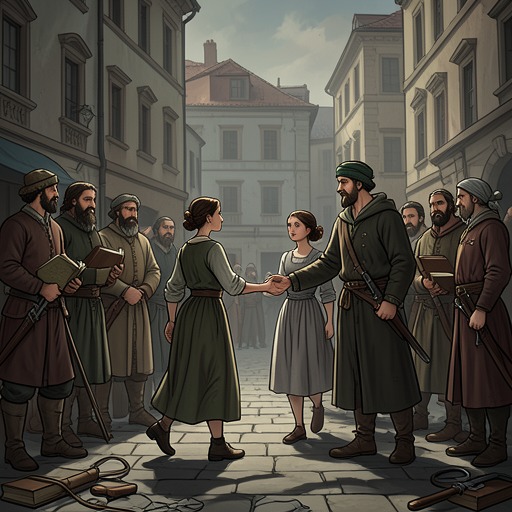
Faenza
The DecameronFaenza is both a city recovering from war and the place where a lost child’s identity is restored. In the story told by Filostrato, its troubled recent past shapes the girl’s separation from her family; years later, its local community and authorities help turn a contest between two suitors into a peaceful marriage and reunion.
A city emerging from war
Faenza had been at war and in poor condition for a long time. When circumstances improved enough for people to be permitted to return, Giacomino da Pavia chose to come back: he had lived there before and was fond of the place. He brought his possessions with him, as well as a girl left in his care by his dying friend Guidotto da Cremona. The account links the city’s partial recovery to the resumption of ordinary life, but the girl’s presence also carries the consequences of an earlier upheaval into that returning community.
The story explains that Guidotto had found the girl during the earlier sack of Faenza, when the city was taken by Emperor Frederick and its houses given over to pillage. In one house, largely emptied of its inhabitants and filled with booty, he encountered the child, then about two years old. She called him father; moved by pity, he carried her away to Fano with the goods he had taken. Before his death, he entrusted her and his possessions to Giacomino, charging him to provide her with a dowry and marry her when the time came. The circumstances of her rescue thus began in violence and appropriation, even though Guidotto’s pity gave her a protector and a future.
Return and life in Faenza
After returning, Giacomino treated the girl as his own child. She grew up in Faenza, becoming known for her beauty, virtue, and good breeding. By the time she was fifteen, several young men were courting her, but Giannole di Severino and Minghino di Mingole became her most determined suitors. Both were of comparable standing and wished to marry her; when her guardian did not grant their wishes, each sought another way to win her. Their rivalry brought the household and its servants into the conflict and eventually erupted into a disturbance serious enough for the town’s officers to arrest those involved.
Faenza is therefore more than a place-name attached to the girl’s origin. It is where a child displaced by the city’s capture grows up under another man’s guardianship, and where the consequences of her uncertain family history later become public. The town’s return to better order makes her upbringing and courtship possible, but the contest over her marriage briefly threatens to reproduce disorder within the household and among the young men’s families.
Recognition and reconciliation
After the arrests, Giacomino returned home and learned that the girl herself had not been at fault. He resolved to arrange her marriage promptly, partly to prevent a similar incident. When the suitors’ relatives asked him to show mercy, he explained that she was neither from Cremona nor Pavia, as people might suppose, but a native of Faenza. Neither he, Guidotto, nor the girl had known who her parents were.
Giacomino recounted how Guidotto had found her in the plundered house. A man present among the assembled parties, Guiglielmino da Medicina, recognized the account: he had been with Guidotto and knew the house had belonged to Bernabuccio. Bernabuccio then understood that the missing little girl was his daughter. He embraced her and explained that, amid the sudden alarm, her mother had left her behind; the family had believed she perished when their house burned. The account brings together two kinds of loss associated with Faenza’s fall: the girl’s separation from her kin and her family’s mistaken belief that she had died.
The city’s resolution
The girl, named Agnesa, accepted Bernabuccio’s account and was reunited with her mother, siblings, and other relatives. The town-captain, learning that Giannole was Bernabuccio’s son and therefore Agnesa’s brother, released him along with Minghino, Crivello, and the others implicated in the disturbance. With the captain’s intervention, peace was made between the two young men, and Agnesa was given in marriage to Minghino with the agreement of the families. Their wedding and long life together in peace and prosperity close a story that began with the city’s violent capture.
Faenza’s narrative significance lies in this movement from disruption to restoration. The city’s wartime sack scatters a family and leaves a child’s identity unknown; its later social life brings the relevant witnesses and relatives together. Recognition resolves the uncertainty, while the town-captain’s decision converts an arrest and rivalry into reconciliation. The ending does not undo the violence or the years of separation, but it returns Agnesa to her family and gives her a marriage accepted by those around her.