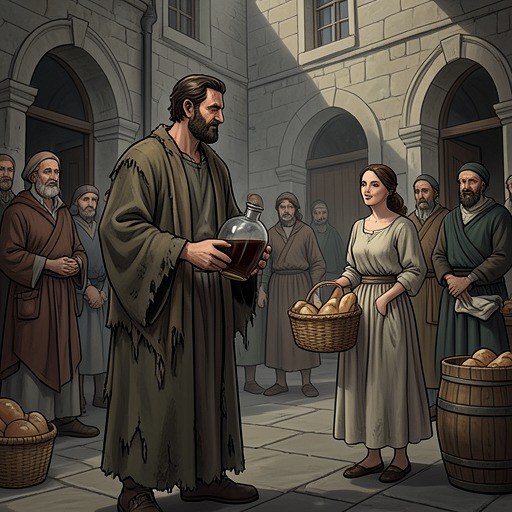
Federigo degli Alberighi
The DecameronFederigo degli Alberighi is the central figure of the Ninth Story of the Fifth Day of the Decameron: a once-prosperous admirer whose extravagance leaves him poor, but whose final act of hospitality reveals a worth that wealth could not give or poverty erase. His story turns on a bitter coincidence: the falcon he serves to honor Madam Giovanna is precisely the gift she has come to request for her sick son. That failed request becomes the measure of his character—and the reason she eventually chooses him.
Identity and Reputation
Federigo is the son of Messer Filippo Alberighi and, in his youth, is renowned throughout Tuscany for his deeds of arms and courtesy. The story is introduced through the recollections of Coppo di Borghese Domenichi, who presents Federigo as a Florentine of an earlier time. His distinction rests not simply on birth or martial reputation: the narrator frames his conduct and merit as more worthy of lasting renown than noble blood.
Federigo falls in love with Madam Giovanna, described as among the fairest and most lively women in Florence. His courtship takes the public, costly forms associated with a gentleman of his standing: he holds jousts and tournaments, gives entertainments, and makes gifts. Madam Giovanna, virtuous as well as beautiful, is unmoved by these efforts. Federigo spends beyond his means without winning her affection, and his devotion continues even as its material basis disappears.
Decline and Life at Campi
His wealth eventually runs out. What remains is a modest farm near Campi, whose limited returns support a meagre life, and a falcon, among the best in the world. Federigo leaves the city because he can no longer sustain the grand figure he once wished to cut there. At the farm he bears his poverty patiently, hunts with his falcon when he can, and asks no one for help.
This retreat marks a change in circumstance, not a withdrawal from the values that shaped his earlier life. The means of his generosity have narrowed dramatically, but he still measures himself by his ability to honor others. The falcon becomes at once his last prized possession, his diversion, and the emblem of a gentility that survives the loss of his fortune.
Madam Giovanna also comes to the country after her husband’s death, staying with her son at an estate near Federigo’s. Her husband had left their son as heir and named her as a substitute heir should the boy die without lawful issue. The boy becomes acquainted with Federigo and, after seeing the falcon flown, grows passionately eager to possess it. He does not ask for it, understanding how dear the bird is to its owner.
The Falcon and the Unintended Gift
When Madam Giovanna’s son falls ill, she keeps close to him and repeatedly asks whether there is anything he wants. At last he names Federigo’s falcon, saying he believes he would soon recover if she could obtain it. His request places her maternal hope against her awareness that the bird is Federigo’s one remaining solace. She nevertheless decides to visit and ask for it, taking another lady as a companion.
Federigo receives Madam Giovanna with joy and amazement. He recalls her visit as a kindness more precious than the money he once spent in courtship, and welcomes her into his house and garden. But when he has to arrange dinner, his poverty becomes painfully apparent. He has nothing suitable with which to honor the woman for whom he once entertained countless guests. He will not ask his laborer or anyone else for help, and finds neither money nor anything he can pawn.
Seeing the falcon on its perch, Federigo concludes that it is worthy food for such a guest. He wrings its neck, has it plucked and prepared, and serves it at a table covered with the fine white cloths he still owns. Madam Giovanna eats without knowing what she has been given. The gesture is both the culmination of his old habit of lavish hospitality and its most costly instance: he sacrifices the last possession that makes his reduced life pleasurable, believing it the only honorable way to receive her.
After dinner, Madam Giovanna explains why she came. She needs the falcon for her son, and appeals to Federigo’s nobility, asking him to help preserve the child’s life. Federigo weeps before he can answer. At first she takes his tears for grief at parting with the bird; she then learns that he cannot grant her request because he has already served it to her. He explains that, wanting to honor her, he judged the falcon the choicest dish he could provide. As proof, he shows her its feathers, feet, and beak.
Loss, Recognition, and Marriage
Madam Giovanna first reproaches Federigo for killing so fine a falcon to feed a woman. Yet she also recognizes the greatness of spirit that his poverty has not diminished. The bird cannot be recovered, and she returns home without the gift her son desired. Within days the boy dies. The story leaves open whether his death follows from grief at not having the falcon or from the course of his illness; it does not present Federigo’s sacrifice as having saved him.
After grieving, Madam Giovanna is left very rich and still young. Her brothers urge her to marry again. Although she would prefer to remain a widow, she remembers Federigo’s final magnificence and names him as the only man she will accept. Her brothers object that he has nothing. She answers that she would rather have a man who lacks riches than riches that lack a man. Their consent allows her to marry him, bringing her wealth and Federigo’s merit together.
Federigo becomes a better steward of his substance, and the couple live out their days in joy. His ending is not a return to his former pattern of reckless expenditure: the story explicitly connects marriage with greater prudence in managing wealth. He gains the woman he had long loved not through the tournaments, gifts, and feasts that once consumed his fortune, but through the character made unmistakable when he had almost nothing left to give.
Narrative Role and Significance
The queen introduces the tale as a story about how a woman’s love can matter to a noble heart, and about women’s ability to bestow their rewards rather than leave everything to Fortune. Federigo’s fortunes do turn through circumstances he cannot control: his courtship fails, his wealth vanishes, and Madam Giovanna’s request arrives only after the falcon has been eaten. Yet the story distinguishes chance from character. Fortune creates the painful predicament; Federigo’s response reveals the courtesy and generosity by which Madam Giovanna ultimately judges him.
The falcon concentrates the story’s reversal. It is first the last remnant of Federigo’s former standing, then the meal through which he honors his guest, and finally the unavailable gift that exposes the difference between his intention and hers. The same act that prevents him from granting her request makes his worth visible. His marriage and renewed prosperity therefore follow not from a successful bargain or a calculated display, but from an act of hospitality whose cost he accepts without knowing what it will mean to the person he loves.