Filostrato
The DecameronFilostrato is one of the three young men who enter the church during the plague and join the company that will tell the stories of the Decameron. A lover whose hopes have repeatedly been disappointed, he turns personal misfortune into a public storytelling theme: as king, he asks for tales of love ending unhappily, then yields the crown to Fiammetta, who answers his grief by choosing stories of lovers made happy after cruel adventures. His part is therefore both social and structural: he governs the company for a time, tells comic tales, and gives its changing themes the shape of his own wounded expectations.
Identity and Introduction
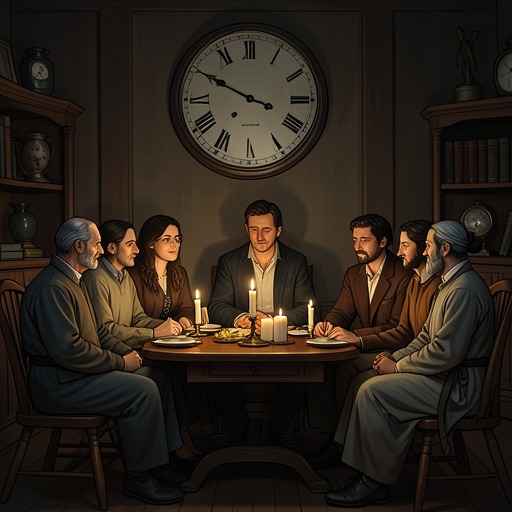
Filostrato enters with Pamfilo and Dioneo while the women are discussing how to leave the city and conduct their company safely. All three men are at least twenty-five, agreeable and well-bred; neither the disorder of the time, the loss of friends and relatives, nor fear for themselves has cooled their capacity for love. They have come seeking the women they love, and all three of their beloveds happen to be among the seven women already gathered in the church. The introduction thus places Filostrato’s desire inside the company’s social arrangement from the start: the storytellers are not detached observers, but people whose affections accompany them into the shared refuge.
His name carries a pointed association with love and strife. In the company’s later exchange, he himself connects the name with his unhappy experience in love, saying that it was given to him by someone who understood its meaning. The narrative makes that claim more than a playful etymology: Filostrato repeatedly presents himself as a man who has been abandoned and expects further disappointment.
Storytelling and Rule
On the first day, Filostrato tells the story of Bergamino’s courteous rebuke of Cane della Scala. He introduces it by contrasting an easy target with a difficult one: the clergy’s dissolute life, he observes, readily invites satire, whereas a sudden and unfamiliar fit of miserliness in a previously magnificent nobleman calls for a more resourceful answer. His choice of a story about tactful rebuke shows his interest in wit that can address power without direct confrontation. Bergamino’s story turns an unexpected change in Cane’s conduct into an occasion for criticism, delivered through an example rather than an open accusation.
Filostrato later becomes king when the previous queen places the laurel crown on his head after Dioneo’s story has amused the company. The exchange begins in teasing: Filostrato jokes that, if the women had listened to him, the wolves would have taught the ewes the lesson that Rustico taught Alibech. Neifile answers with a counter-jibe about Masetto of Lamporecchio and the nuns. Filostrato takes the rebuke in stride, stops the banter, calls the seneschal, learns the state of affairs, and makes arrangements intended to satisfy the company during his rule. The episode gives his kingship a comic entrance, but also shows him moving from flirtatious sparring to the practical duties of governance.
When he sets the theme for the following day, Filostrato makes his personal history explicit. He says that since he first knew good from evil he has remained subject to love; his humility, obedience, and persistent service have not prevented him from being abandoned for another, after which his circumstances have continued to worsen. He expects no better ending for himself, and therefore directs the company to tell of loves that have ended unhappily. His choice turns private disappointment into a rule for everyone’s stories, giving his temporary authority an unmistakably personal cast.
The Unhappy-Love Theme and Its Reversal
The fourth day begins under Filostrato’s theme. After Fiammetta’s story of the deaths of Ghismonda and Guiscardo has moved the women to tears, Filostrato says that he would gladly give his life for even half the delight Guiscardo had with Ghismonda. He compares his own condition to a life of repeated deaths without a particle of such delight, then asks Pampinea for a tale of woeful events and fortunes resembling his own. Pampinea understands the women’s need for diversion as well as the literal request. She keeps within the proposed subject but chooses a story that can also make the company laugh, showing that the king’s theme does not entirely dictate the emotional effect of the tales.
The day’s stories leave the company with a different need from the one Filostrato’s theme has imposed. When the sun begins to set and his rule ends, he courteously apologizes to the women for making them dwell on lovers’ misfortunes. He gives the crown to Fiammetta, trusting her to console them with the next day’s entertainment. She responds by choosing stories of lovers who achieve happiness after cruel and unfortunate adventures. The change does not erase the sorrow of Filostrato’s theme; it places that sorrow in a larger sequence, where adversity may be followed by reunion or joy.
Filostrato also sings at Fiammetta’s request. The song speaks of a heart complaining over betrayed love and faith pledged in vain, making his state of mind legible through a performance rather than a further explanation. A lady in the dance appears to show her response in a blush, though the gathering darkness hides it. The song extends the unhappy-love theme beyond the day’s stories: Filostrato’s own grievance remains present even as another storyteller takes up the crown and changes the subject.
Tales and Narrative Manner
Filostrato’s stories range from social satire to domestic deception. On the sixth day, he introduces the tale of Madam Filippa by praising the ability to speak well when necessity demands it. The story concerns a Prato statute that condemns women found in adultery to be burned, without distinguishing them from women who sell sex. Rinaldo de' Pugliesi finds his wife with Lazzerino de' Guazzagliotri and, rather than kill the pair himself, brings an accusation under the law. Filostrato’s framing emphasizes the woman’s timely eloquence as the means by which she escapes a death sentence. His selection gives wit a material consequence: a verbal answer can confront not merely a jealous husband but the law he invokes.
On the seventh day, Filostrato introduces Peronella’s trick as a story about women’s capacity to answer the deceptions practiced on them by husbands. He argues that hearing such stories may restrain men from assuming that women are easy to deceive. The tale’s circumstances are sharply domestic: Peronella is a poor woman in Naples whose husband works as a mason, while she earns money by spinning. She has arranged meetings with Giannello Strignario during her husband’s customary absence. When the husband returns unexpectedly, she must preserve herself and her lover while responding to his arrival. Filostrato presents the episode not simply as an adultery anecdote but as a contest of alertness shaped by poverty, marriage, and unequal expectations about who may outwit whom.
On the eighth day, a passing reference to Maso del Saggio prompts Filostrato to tell the story he had set aside about Maso and his companions. He describes a judge, Messer Niccola da San Lepidio, whose shabby dress and conspicuously ill-fitting breeches make him seem like an outlandish figure on the bench. Maso fetches two companions to see the spectacle. Filostrato’s narration lingers on the contrast between the judge’s office and his appearance, using that mismatch as the comic starting point for an irreverent episode in a court of law. The story extends his interest in verbal and practical wit into public institutions: authority does not prevent its bearer from becoming the object of a prank.
On the ninth day, Filostrato returns to Calandrino and his companions with a story he had intended to tell earlier. An aunt has left Calandrino two hundred crowns in small coin, and he discusses buying an estate as if he had ten thousand gold florins, though his negotiations fail when the price becomes real. Bruno and Buffalmacco, who have already urged him to spend the money entertaining them, enlist their painter-companion Nello in a scheme to make him pay for food. Their first move is to suggest that Calandrino looks changed and may be ill. Filostrato presents the deception as a comic exploitation of Calandrino’s vanity and credulity, while the concrete sum and failed land purchase establish why his companions see an opportunity.
Character and Narrative Function
Filostrato’s role depends on the tension between his personal sorrow and the variety of stories he helps shape. He can introduce a rebuke to a powerful patron, a woman’s escape from a lethal statute, a wife’s quick response to an unexpected husband, a prank directed at a judge, and a fraud aimed at a gullible acquaintance. His own declared expectation is much narrower: love, for him, has meant abandonment and a worsening succession of disappointments. That contrast lets his rule become a temporary experiment in making the whole company inhabit his outlook, while the company’s responses keep that outlook from becoming the only available one.
The frame also gives Filostrato’s melancholy a public and reversible form. The company listens to unhappy love, recognizes the pain in his song, and then entrusts the next day to Fiammetta, whose theme promises happiness after adversity. His grief is neither dismissed nor treated as the final truth of love. It is one emotional register among many, given force by the tales and then answered through the company’s succession of storytellers, rulers, and themes.