Florence
The DecameronFlorence is at once the point of departure and the principal civic stage of the Decameron: a city emptied by the plague, remembered through its churches and streets, and repeatedly brought to life through stories of its families, customs, fortunes, and public encounters. Its significance lies in this double image. The city is vulnerable enough to be abandoned, yet socially vivid enough that even characters who leave it remain tied to its households, obligations, and reputation.
Plague and the City’s Emptying
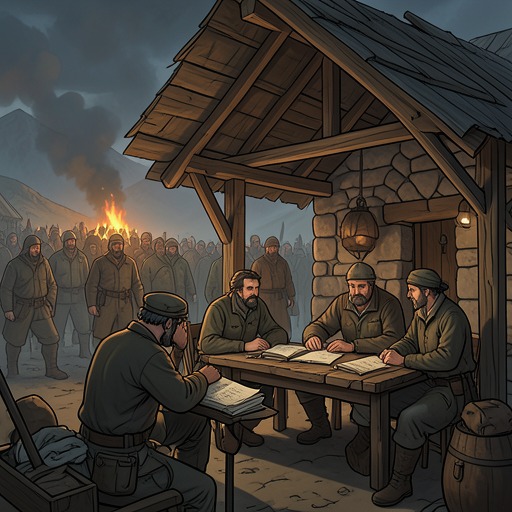
The book dates the arrival of the pestilence in Florence to 1348. It describes the disease as having appeared earlier in the East, where it had taken innumerable lives, before spreading westward. The narrator leaves open whether the catastrophe arose through the influence of the heavenly bodies or from human wrongdoing, and presents it as sent by God’s just wrath for the correction of mankind. Neither wisdom nor foresight could prevent it. The city did take measures: officers were appointed to purge impurities, sick people were forbidden to enter, and counsels were given. These efforts could not keep the pestilence from transforming the city’s life.
The scale of that transformation is conveyed through Florence’s near-absence of inhabitants. In the venerable church of Santa Maria Novella, on a Tuesday morning when almost no one else was present, seven young women encountered one another after divine service. They wore mourning clothes appropriate to the season. The narrator describes them as connected by friendship, neighbourhood, or kinship; all were between eighteen and twenty-eight, and of noble birth, beauty, discretion, and good manners. Their meeting makes the deserted city more than a setting for catastrophe: it is the circumstance that brings together a company whose shared storytelling will give the work its structure.
Departure, Refuge, and Return
The women consider leaving Florence for the countryside rather than risk the danger and disorder surrounding them. The proposal is framed as a deliberate effort not to succumb to wilfulness or carelessness when escape remains possible. Country houses offer distance from the city and the prospect of birdsong, green hills and plains, ripening fields, and open sky. The appeal of that landscape is practical and restorative: the women seek diversion and pleasure without exceeding the bounds of reason, while avoiding the peril and dishonour associated with remaining amid the city’s misery.
The refuge is temporary, and its limit is measured in days. Near the end of the company’s stay, the king observes that the next day will mark a fortnight since they left Florence to preserve their health and lives from the woes of the pestilential season. As evening approaches, the company prepares to return. At dawn, with their belongings already sent ahead by the seneschal, they travel back under the guidance of their king. The three young men take leave of the seven women at Santa Maria Novella, the place from which they had first set out together; the women later return to their own houses. This circular movement—from a city nearly emptied, to country retreat, and back to the city—gives the storytelling frame its shape without suggesting that the danger itself has been resolved.
Wealth, Households, and Reversals of Fortune
Florence is also the home of families whose fortunes rise and collapse through their own choices and external events. Messer Tedaldo, whose family affiliation is disputed between the Lamberti and the Agolanti, dies a very rich man, leaving his three sons, Lamberto, Tedaldo, and Agolante, his movable and immovable possessions. The eldest is not yet eighteen. The young heirs spend lavishly; their inheritance dwindles, and they sell and mortgage their estates until poverty forces them to recognize what wealth had concealed. At Lamberto’s urging, the brothers leave Florence with what little remains.
Their departure does not end their connection to the city. They continue to lend money in England, while Alessandro, their nephew, manages the English business and lends to barons against castles and other possessions. The brothers themselves return to Florence and again spend extravagantly, borrowing against the money they expect from England. War there abruptly interrupts their calculations. The eventual collapse scatters their households, leaving their wives and children in distress and uncertainty. Later, Alessandro and the lady he has married return to Florence. She pays what is owed, frees the three brothers, and restores them and their wives to their possessions. Florence thus becomes the place where a family’s ruin is exposed and where restoration, brought about by a marriage and the payment of debts, is made visible.
Other stories make the city a measure of individual status and changing circumstances. Federigo, son of Messer Filippo Alberighi, is celebrated for arms and courtesy and spends lavishly in an effort to win Madam Giovanna’s love. Her virtue and beauty do not make her responsive to his gifts or entertainments. His substance eventually fails; he is left with a small farm and a falcon and settles at Campi, where he lives meagrely and patiently. The contrast between his former life in Florence and his reduced circumstances beyond it shows how quickly expenditure can overturn a gentleman’s position. In another account, Coppo di Borghese Domenichi is remembered as a venerable Florentine whose authority rests more on his conduct and merit than on the nobility of his blood. His recollection of Federigo’s story also presents Florence as a place where tales of past lives circulate through the speech of its inhabitants.
Streets, Gatherings, and Public Reputation
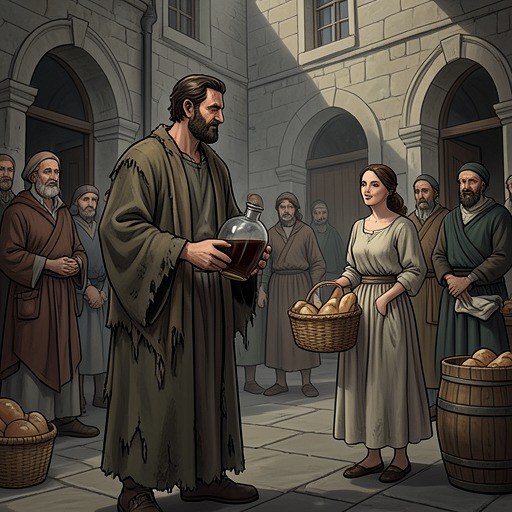
Florence’s social life is represented not only through private houses but through shops, streets, churches, and civic customs. Cisti is a baker whose humble occupation contrasts with his lofty spirit. He becomes rich without abandoning his trade and is known for excellent wines from Florence and its surroundings. When Pope Boniface sends gentlemen on an embassy, they lodge with Messer Geri Spina; their business takes them past Cisti’s bakehouse near Santa Maria Ughi. Cisti’s wine draws Messer Geri and the ambassadors back repeatedly during their stay. The episode places a prosperous artisan’s establishment alongside diplomatic business and shows how hospitality can make a shop a point of contact between social ranks.
The city’s older customs likewise depend on collective hospitality. Gentlemen of different quarters form companies, admitting members able to bear the expense. Each household, in turn, holds an open banquet for the company; visiting gentlemen and Florentines may be guests. At least once a year the members dress alike and ride in procession through the city on notable days. The narrator says that such practices, once commendable, have disappeared as avarice has grown with wealth. This remembered civic generosity stands against the financial excess and self-interest that recur elsewhere in Florence’s stories.
Public space can also sharpen questions of rank and honour. At Monte Ughi, Michele Scalza hears Florentines debate which families are oldest and best, with different speakers naming the Uberti, the Lamberti, or other houses. He answers with a comic claim that the Cadgers surpass them all. The exchange turns genealogical pride into a subject for popular wit. In another scene, Guido Cavalcanti passes among the marble tombs near San Giovanni, between the porphyry columns and the church door, when Messer Betto Brunelleschi and his company ride up intending to plague him. Their challenge, framed around whether Guido will find that God does not exist, makes the tombs a charged setting for an encounter about belief and intellectual reputation.
Civic Life, Exposure, and Narrative Meaning
The stories also show how public reputation is formed—and compromised—in the city. On Saint John’s Day, while people watch the ladies along the route of the mantle race, Bishop Antonio d’Orso points out Nonna de’ Pulci to Messer Dego della Ratta and asks whether she could win him over. Nonna judges that the remark threatens her honour in front of the many people who hear it. The episode recalls an earlier scandal: Dego had paid a miserly husband with silver coins gilded to resemble gold florins in return for access to the man’s wife, who did not consent. The story became widely known; the husband suffered both financial loss and public ridicule, while the bishop affected ignorance. The festive street therefore serves as a stage on which women’s honour, men’s conduct, and the appearance of authority are exposed to public view.
Florence’s religious associations are equally woven into ordinary social life. Gianni Lotteringhi, a wool-comber in the quarter of San Brancazio, is a man of substance but limited judgment who takes pride in his offices among the Laudsingers of Santa Maria Novella. His gifts to clergy bring him prayers and devotional texts, which he keeps carefully for the good of his soul. The description links confraternity, material patronage, religious practice, and self-importance within one household’s civic identity.
Across these episodes, Florence is not a static backdrop but a changing measure of human security. Its plague empties churches and houses; its countryside offers temporary shelter; its streets and shops reconnect inhabitants across differences of rank; and its households register the consequences of extravagance, scandal, and generosity. The return to Florence closes the frame’s first movement, while the accumulated stories make the city legible as a community whose pleasures and institutions persist in memory even when epidemic danger drives its people away.