Giusfredi Capece
The DecameronGiusfredi Capece’s story turns on an identity hidden for survival and disclosed at the point when his prospects seem most hopeless. Separated from his family after the fall of Manfred, he passes through flight, enslavement, and years of wandering under another name. When he finally speaks the truth in prison, that confession makes recognition and reunion possible—and gives Currado Malespina a way to resolve the shame surrounding Giusfredi’s love for Spina.
Identity and Origins
Giusfredi is the elder son of Arrighetto Capece and Madam Beritola Caracciola. After Charles I of Anjou defeats and kills Manfred at Benevento, Arrighetto prepares to flee rather than become subject to his former lord’s enemy. His plans are discovered, however, and he and other supporters of Manfred are captured and delivered to Charles I. Madam Beritola, pregnant and unsure of Arrighetto’s fate, abandons her possessions and escapes by boat with Giusfredi, then about eight years old. She gives birth to a second son, Scacciato, on Lipari.
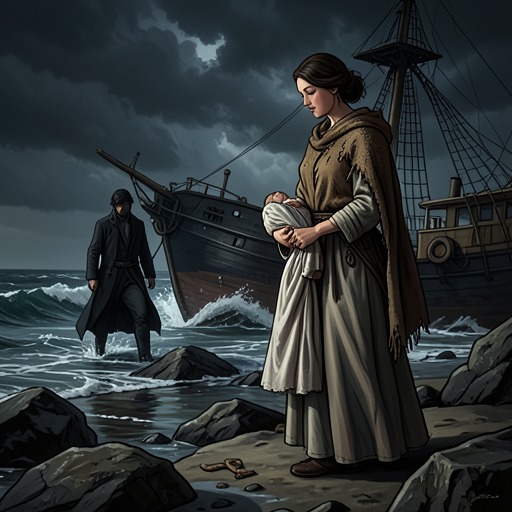
The family’s journey back toward Naples is diverted when a storm drives their ship to Ponza. There, Madam Beritola goes alone to mourn Arrighetto. Corsairs seize the ship and take the nurse and both boys to Genoa, leaving Madam Beritola behind, unseen. The boys and nurse are allotted as booty to Messer Guasparrino d'Oria and sent to serve in his household.
A Name Adopted for Survival
The nurse fears that the boys might be harmed if their parentage becomes known. She presents them as her own sons, renames Giusfredi Giannotto di Procida, and repeatedly explains to him why the concealment matters. He is quick-witted and follows her instructions. The false name protects him, but it also separates him from the identity and status he has lost.
The three remain for years in Messer Guasparrino’s household, poorly clothed and assigned menial work. At sixteen, Giannotto rejects the low condition of a servant and leaves aboard galleys bound for Alexandria. He travels through various places without improving his fortunes. Three or four years after leaving Genoa, he hears that the father he believed dead is still alive, imprisoned by Charles I. Wandering almost without hope, he reaches Lunigiana and enters the service of Currado Malespina, where he earns acceptance through his aptitude.
Love, Separation, and Imprisonment
Madam Beritola is also in Currado’s household, serving with Currado’s lady. Mother and son see one another there but do not recognize each other: time has changed both since their last meeting. Their proximity makes the family separation especially poignant, though neither knows that reunion is within reach.
Currado’s widowed daughter, Spina, is a little over sixteen and is described as fair and agreeable. She and Giannotto fall passionately in love. Their secret relationship lasts for months, but growing confidence leads them to act less discreetly. When Currado discovers them, he is enraged and considers killing them. Currado’s wife persuades him not to put them to death; instead, he orders them imprisoned separately, under guard, with little food and considerable hardship. They remain in this condition for a year, apparently forgotten by Currado.
Recognition and Return
While Giannotto and Spina are in prison, news arrives that Pedro of Aragon has raised Sicily against Charles I and taken the island. Currado, a Ghibelline, rejoices. Giannotto, hearing the news from a guard, laments that the change he has sought for fourteen years has come too late: he is imprisoned and sees no way to return to Sicily alive. Asked why the revolt concerns him, he reveals that his father once ruled there in the time of Manfred.
He then gives his true name as Giusfredi and identifies Arrighetto Capece as his father. He explains that, if freed, he believes he could regain a high position in Sicily. The guard reports this to Currado, who discreetly questions Madam Beritola about her missing elder son. Her account of Giusfredi’s age and name, together with the evidence Currado obtains by examining the young man’s history, confirms his identity. Currado then arranges Giusfredi’s marriage to Spina, a resolution that both joins the lovers and addresses the shame attached to their discovery. Giusfredi’s recognition restores more than a name: it opens the way back to his family and lost standing.