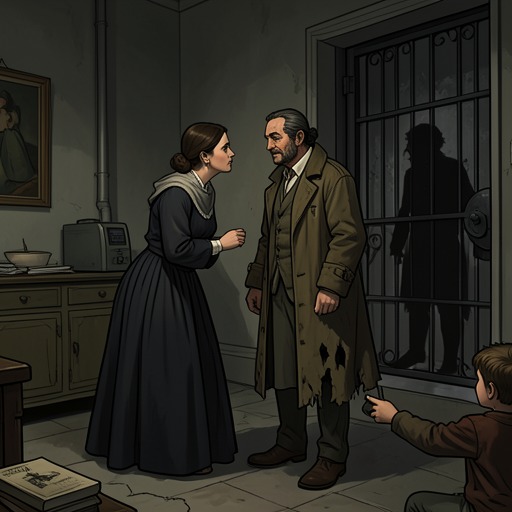
Guillaume de Guardestaing
The DecameronGuillaume de Guardestaing is a Provençal knight whose secret love for the wife of his close companion, Guillaume de Roussillon, turns a bond of fellowship into a deadly conflict. His death at Roussillon’s hands and the heart served to his lover make him the center of a tale in which private desire is answered with calculated violence, and the lovers’ final burial together outlasts the husband’s attempt to separate them.
Identity and Background
According to the Provençal account told in the story, Guillaume de Guardestaing and Guillaume de Roussillon are both noble knights, each possessing castles and vassals. Their prowess in arms is matched by an unusually intimate companionship: they love one another greatly, travel together to tournaments and jousts, and wear the same colors. Although their castles lie about ten miles apart, their friendship repeatedly brings them together. This established closeness gives Guardestaing’s later love its particular danger: he becomes enamored of the very woman whose marriage is joined to his friend’s household.
The Affair and Its Discovery
Despite his friendship with Guillaume de Roussillon, Guillaume de Guardestaing became intensely enamored of Roussillon’s wife. He pursued her by various means until she understood his passion. Knowing him to be a valiant knight, she welcomed his love and returned it; she desired him above all others and waited only for him to approach. They met more than once, turning a concealed attraction into a continuing affair.
The lovers were less discreet in their conversations than the secrecy of their relationship required, and Roussillon discovered their familiarity. His great affection for Guardestaing became mortal hatred, though he concealed that change more successfully than the lovers had concealed their attachment. He resolved to kill his friend. When a major tournament was proclaimed in France, Roussillon told Guardestaing of it and invited him to come the next day so they could discuss whether and how to attend. Guardestaing accepted gladly, unaware that the invitation was not an act of fellowship but the means by which Roussillon intended to draw him into danger.
Murder, Revelation, and Burial
Roussillon turned the promised meeting into an ambush. He waited in a wood about a mile from his castle, where Guardestaing had to pass on his way to supper. Guardestaing rode unarmed with two unarmed servants, expecting no danger from his friend. Roussillon charged with a lance and killed him before he could defend himself or speak. He then opened Guardestaing’s breast with a knife, tore out his heart, wrapped it in a lance pennon, and ordered one of his men to carry it back. The killing was not an impulsive clash between rivals: Roussillon had hidden his hatred and chosen the invitation as the means to make his companion vulnerable.
At the castle, Roussillon concealed the murder from his wife. When she asked why Guardestaing had not arrived for supper, he claimed that Guardestaing had sent word that he would come the following day. He gave the cook what he called a wild boar’s heart and instructed him to prepare it as a fine dish. At the table, Roussillon feigned that he was too ill to eat and had the seasoned ragout set before his wife, who found it delicious and ate it all. Only then did he disclose that the dish was Guardestaing’s heart, which he had torn from his friend’s breast himself. The deception made her unwittingly consume the remains of the man she loved before forcing her to confront what her husband had done.
The wife condemned Roussillon’s act as dishonorable and argued that, if she had offended him by freely giving Guardestaing her love, she—not the lover who had been killed—should have borne the penalty. She refused to let another meal follow the heart of a knight she regarded as valiant and courteous. Rising without hesitation, she fell backward through a high window and died on the ground below. Her death completed the violence Roussillon had set in motion, but it did not restore the separation he intended: the next day, Guardestaing’s people and the lady’s people buried the two lovers together in the chapel of her castle. Verses placed over their shared tomb recorded who lay there and the manner and cause of their deaths. The narrative’s account also identifies the episode with the well-known story of the troubadour Guillem de Cabestanh, whose name Boccaccio renders as Guardestaing.
Narrative Frame and Memorial
The tale is presented as Provençal tradition within a story told by the King, who introduces it in response to the company’s compassion for ill-fortuned lovers. He promises a calamity no less deserving of pity than the one just recounted, but involving people of higher rank and a more cruel misfortune. That framing places Guillaume de Guardestaing’s private affair within a pattern of tragic love, while the knights’ rank and public reputation sharpen the contrast between their honorable standing and the betrayal that ends their fellowship.
The final account preserves the lovers not through Roussillon’s explanation or authority, but through a shared grave and the verses placed above it. The inscription records their identities and the manner and cause of their deaths, making the tomb a public counter-memory to the husband’s concealment and attempted punishment. A note identifies the episode with the familiar story of the troubadour Guillem de Cabestanh, whose name the narrative renders as Guillaume de Guardestaing; the character thus stands both within the tale as a slain knight and within a remembered tradition of tragic love.