Guiscardo
The DecameronGuiscardo is the young serving-man whose love for Ghismonda, daughter of Tancred, becomes the center of a clandestine romance and a violent collision between personal worth and inherited rank. Though of humble extraction, he is judged nobler in worth and manners than the other men at Tancred’s court. His relationship with Ghismonda begins in reciprocal attraction, flourishes through her resourceful arrangements for secret meetings, and ends when Tancred turns discovery into a sentence of death. Guiscardo’s final answer to the prince makes love itself the force that neither rank nor authority can master.
Identity and Background
Guiscardo serves in the household of Tancred, Lord of Salerno. His birth is explicitly described as humble, but the narrative sets that status against his character: Ghismonda, observing the many men who frequent her father’s court, prefers him above all others for his manners and conduct. Her esteem is not presented as a mistake about his station; she recognizes his low extraction and chooses him because she considers his personal qualities superior to those of men of higher standing.
Ghismonda is Tancred’s only daughter. After her first husband dies, she returns to her father’s household, where he keeps her in comfort and does not arrange another marriage. Guiscardo’s position in that household places him near her, but their difference in rank and her father’s control of her circumstances make an open courtship difficult. Their love therefore develops in secrecy rather than through a public proposal or family-approved match.
Courtship and Secret Meetings
The attraction is mutual. As Ghismonda increasingly loves Guiscardo, he perceives her regard and welcomes it, allowing his attention to turn almost wholly toward her. She wants to meet him but chooses not to confide in anyone else. Instead, she sends him instructions in a letter hidden inside a hollow cane, handing it over with the explanation that he should make a bellows from it for a serving-maid to kindle the fire. Guiscardo recognizes that the cane and her playful explanation must carry a purpose. Back at his lodging, he examines it, finds the letter, understands what she has arranged, and prepares to follow her directions.
Their route makes the secrecy of the affair concrete. A long-abandoned grotto beside the palace is connected to a tunnel through the mountain, while a private stair from a ground-floor room in Ghismonda’s apartments leads down to the grotto. The stair has been unused for so long that almost no one remembers it. Ghismonda recalls the hidden way and works for many days with the tools available to her to make it usable without attracting notice. Guiscardo reaches the tunnel from outside by rope, and, once he has learned the route, returns repeatedly. Their meetings thus depend on a concealed passage through the very household that would forbid them: Ghismonda opens the way from within, and Guiscardo makes the difficult approach from beyond the palace.
Discovery and Confrontation
The secrecy fails when Tancred enters Ghismonda’s chamber while she is away in the garden. He closes the windows, sits at the foot of the bed, draws the curtain over himself, and falls asleep there. Ghismonda later returns without seeing him, opens the hidden door for Guiscardo, and meets him as usual. The lovers do not know that Tancred has awakened and witnessed them together. Rather than expose himself immediately, he stays hidden until they part, then slips out of the chamber and returns unseen to his own rooms.
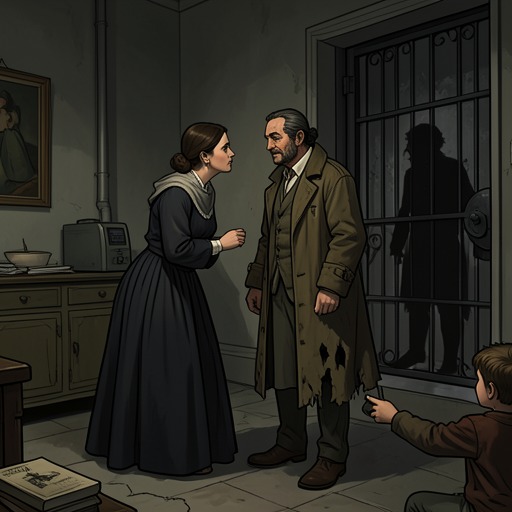
That night, Tancred has Guiscardo seized by two men as he emerges from the tunnel. They bring him secretly to the prince, still bound in his leather suit. Tancred reproaches him for the shame he believes Guiscardo has brought into his own family. Guiscardo does not offer a defense based on status, excuse, or denial. His sole answer is, “Love can far more than either you or I.” The brief reply acknowledges the power governing his actions while refusing to pretend that Tancred’s authority, or Guiscardo’s own judgment, has controlled it. Tancred orders him kept under guard in a chamber of the palace.
Death and Narrative Significance
After speaking with Ghismonda, Tancred chooses to punish Guiscardo in secret. He orders the guards to strangle him quietly and bring him his heart. The men carry out the command, and the next morning Tancred places the heart in The golden bowl containing Guiscardo’s heart and sends it to his daughter with a message that presents the gift as consolation for what she loves most. The object that once marked the lovers’ private attachment is made into an instrument of punishment: Tancred converts Guiscardo’s body into a message addressed to Ghismonda.
Guiscardo does not survive to answer the prince’s violence, but his death does not make him disappear from the story. Ghismonda recognizes the heart as his, kisses it, and treats the golden vessel as a fitting resting place for a heart of such worth. Her response confirms the depth of the bond and gives the prince’s attempted humiliation a different meaning: the heart he sends as proof of his power becomes, for her, evidence of Guiscardo’s value and of her enduring love. The movement from secret letter to hidden passage, from repeated meetings to the heart sent openly through the palace, gives the romance its grim shape. Guiscardo’s low birth remains the social distinction that shadows the affair, but the story’s judgments of his worth and manners refuse to equate rank with nobility. His answer to Tancred and the fate of his heart make that contrast central to the tragedy.