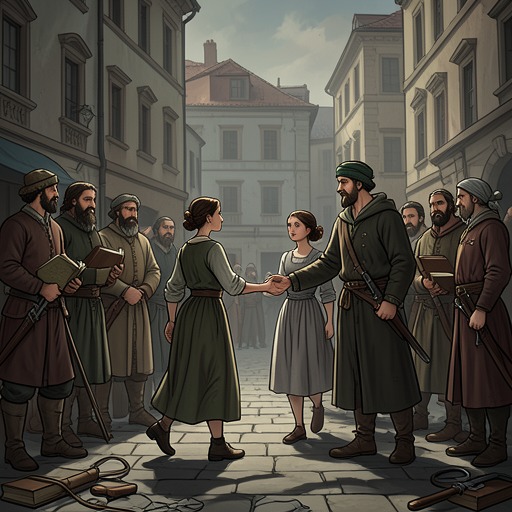
Iphigenia
The DecameronIphigenia is the center of Cimon’s transformation in the story of their love, but the change in him does not make his pursuit of her consensual. Her arranged betrothal to Pasimondas collides with Cimon’s determination to possess her: he takes her by force at sea, while she weeps and fears that the storm which follows is punishment for his defiance.
Identity and First Appearance
Iphigenia is a beautiful young woman encountered by Cimon in a leafy wood in May. She is asleep on the grass beside a clear spring, lightly covered, while two women and a man who serve her sleep nearby. The scene places her at rest and in the company of attendants; Cimon, passing through the meadow, stops to gaze at her.
Her beauty prompts an abrupt change in Cimon, who had been sent to live in the country because his father had lost hope of improving his uncouth, idle ways. He studies her face and figure, and the narrator presents this encounter as the awakening of a capacity for admiration that earlier instruction had failed to stir. Iphigenia does not witness this inward transformation while asleep; when she wakes, she sees Cimon standing over her.
The Encounter and Cimon’s Pursuit
On opening her eyes, Iphigenia recognizes Cimon, whose appearance and family are known in the region, and asks what he is seeking in the wood at that hour. He does not answer. His fixed gaze makes her wary that his rusticity might lead him to threaten her, so she calls her women, rises, and takes her leave. Cimon insists on accompanying her. Although she would rather be rid of him, she cannot prevent him from escorting her to her house.
The encounter changes Cimon’s conduct. He returns to his father’s house and refuses to go back to the country. He asks to be dressed like his brothers, joins young men of rank, and learns the manners expected of a gentleman and a lover. He also refuses to be called Galesus, keeping the name Iphigenia used for him. The story credits love with drawing out abilities that had remained obscured, but Iphigenia’s brief, guarded response offers no sign that she has welcomed his attachment.
Betrothal and Conflict
Cimon seeks Iphigenia’s hand from her father, Cipseus, more than once. Cipseus refuses because he has already promised her to Pasimondas, a young nobleman from Rhodes, and does not wish to break his word. When the time comes for the marriage, Pasimondas sends for Iphigenia. The conflict is therefore shaped by both Cimon’s desire and an existing family commitment: she is not free to marry him simply because he has become a gentleman.
Cimon secretly recruits young noblemen who are his friends and equips a ship for battle. He intercepts the vessel carrying Iphigenia to Rhodes, grapples it to his own, and boards with a cutlass. After his attack, the Rhodians surrender. Cimon says that he has come for Iphigenia, whom he loves and could not obtain from her father by peaceful means; he declares his intention to take Pasimondas’s place as her husband. The Rhodians give her up under force, not by free choice.
Capture and the Storm
Iphigenia is weeping when Cimon takes her aboard his ship. He tries to comfort her and presents his long love as a claim to her, contrasting it with Pasimondas’s pledged marriage. But her tears make clear that the seizure is not a willing elopement. Cimon releases the Rhodians without taking anything else from them, then consults with his companions; they choose not to return to Cyprus and instead steer for Crete, where they expect to find safety among friends and relatives.
Their course turns abruptly toward danger. Less than four hours after leaving the Rhodians, a violent storm rises as night falls. Clouds and fierce winds make it impossible to see where to steer, and the men cannot keep to the deck to work. Iphigenia weeps and fears each blow of the waves. She blames Cimon’s presumptuous attempt to marry her against the gods’ will, imagining that the gods have sent the tempest so that she will die first and Cimon will perish afterward. The episode closes with her fate unresolved, leaving the storm as an immediate threat and as the narrative’s sharp counterpoint to Cimon’s triumph at sea.