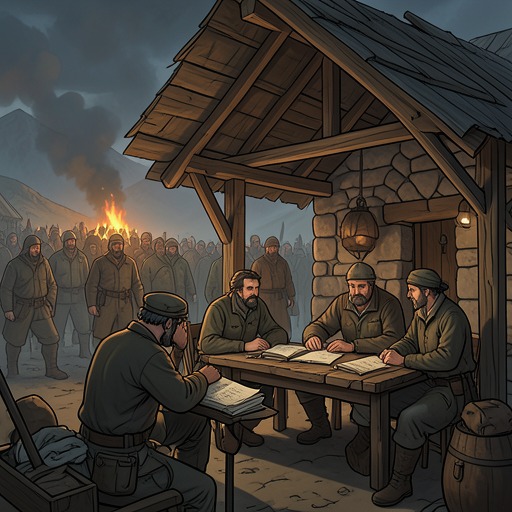
Lauretta
The DecameronLauretta is both a storyteller and, for a day, the elected ruler of the Decameron company. Her tales move between devotional questions, erotic ingenuity, and painful revenge; her queenship likewise turns a narrow topic about marital tricks into a wider inquiry into deception between people. She combines lively participation in the company’s pleasures with a clear sense of how stories answer, echo, and redirect one another.
Identity and Place in the Company
Lauretta belongs to the group of women and men who meet to tell stories after leaving Florence. She does not merely supply tales when called upon: at one gathering, after hearing Bergamino’s address praised, she recognizes that it is her turn and begins without waiting for an instruction. Her readiness makes her an active participant in the company’s exchange, where one story can prompt another through resemblance, disagreement, or a new angle on a shared subject.
Her role also includes the pleasures surrounding narration. When Filostrato asks her to lead a dance and sing, she says she knows no songs by other people and cannot readily think of one of her own that suits the joyful gathering. At his urging, she sings one of her own in a sweet voice and a somewhat plaintive manner. The contrast between the company’s merriment and the song’s plaintiveness gives her a presence beyond the formal work of telling tales: she contributes to the group’s shared recreation while allowing a note of sadness into it.
Stories of Faith, Love, and Deception
Lauretta’s stories often make a moral question vivid through a reversal. In one, she tells of an honest minstrel who rebukes a very rich merchant’s avarice. The tale resembles the one told just before it, but Lauretta argues that its similarity does not diminish its appeal, since good comes of the rebuke. Her framing emphasizes not novelty for its own sake but the practical consequence of exposing greed.
Another of her tales concerns Ferondo, who emerges from a sepulchre pale after a prolonged confinement without seeing the sky. Believing that prayers have delivered him from purgatory and restored him to life, he falls at the abbot’s feet in gratitude. The abbot tells him to comfort his wife, who has supposedly grieved throughout his death; Ferondo eagerly says that he will kiss her as soon as he finds her. Lauretta brings the deception to its comic conclusion through Ferondo’s credulous gratitude and immediate desire, while the scene also turns religious language into part of the scheme by which he has been kept in the dark.
In her tale of Madam Ghita and Tofano, Lauretta makes jealousy the starting point of a trick. Tofano, a rich man of Arezzo, becomes jealous of his fair wife without knowing why and cannot give her any particular reason for his suspicion. Ghita resents this baseless accusation. Knowing that her husband likes to drink, she considers how to bring her relationship with a young man who desires her from secret understanding to action. Lauretta introduces the episode as an example of Love’s resourcefulness, but its immediate cause is Tofano’s groundless jealousy: his suspicion creates the conditions for the deception he fears.
Lauretta also tells a story of Teodoro, a boy bought among captives taken by Genoese corsairs off the coast of Armenia. Messer Amerigo Abate supposes the boys to be Turks and purchases them as servants, but Teodoro’s bearing distinguishes him from the rest. The story’s later recognition alters his status: Fineo identifies him as his son and agrees that Teodoro should marry his daughter. Fineo apologizes for what has passed and is willing to give her to him; he adds that, if his son refuses, the sentence against him may take its course. Lauretta’s tale thus moves from enslavement and mistaken identity toward kinship revealed and marriage offered, while keeping the threat of punishment present at the moment of reconciliation.
Narrative Craft and Moral Reversals
Lauretta’s tales are attentive to the gap between how events appear and what they mean. Ferondo mistakes confinement for purgatory and the abbot’s contrivance for divine deliverance. Teodoro is treated as a captive servant before his parentage becomes known. In Ghita’s story, Tofano interprets his own jealousy as grounds for suspicion, although he cannot name a cause. Across these different situations, mistaken belief is not incidental: it directs action and determines who holds power until the truth or a counter-trick changes the balance.
She also uses the company’s conversation as part of her narrative method. After the previous storyteller has been commended, she selects a tale that resembles it but insists on the value of its distinct outcome. Later, when Filostrato criticizes the ending of Pampinea’s story as pleasing in part but preceded by too much that invites laughter, Lauretta answers that he is too severe toward lovers if he demands only unhappy endings. She then tells of three lovers who all fare badly and have little enjoyment of love. Her response does not simply reject his judgment: it meets his demand with a story that makes unhappy love its subject, while her own opening reflection identifies anger as a vice capable of harming both its practitioner and others.
On another occasion, a dream story told by Pampinea prompts Lauretta to speak of revenge. She calls the scholar’s vengeance in Pampinea’s tale stern, then introduces a revenge of her own that is less barbarous but still grievous to the person who suffers it. The relation between the stories gives her tale a defined place in the company’s memory: it is not an isolated anecdote, but an answer shaped by comparison with what the listeners have just heard.
Queenship and the Eighth Day
At the end of the day on which the company has discussed women’s tricks against their husbands, Lauretta receives the crown from Filostrato. She arranges for the tables to be set earlier than usual in a pleasant valley so that the company can return to the palace at leisure, then announces the next day’s theme. Rather than retaliate against the men by restricting the subject to tricks women play on them, she broadens it to tricks women play on men, men play on women, and people play on one another. The change makes deception a reciprocal social practice rather than the province of one sex.
The Eighth Day begins with the company’s customary activities under her governance. On Sunday morning, they walk through dewy grass, visit a nearby church around half-tierce for divine service, eat, sing, and dance; after the sun passes the meridian, they assemble by a fountain for the storytelling. Lauretta’s theme therefore belongs to an ordered day that joins religious observance and recreation with the company’s continuing exchange of tales.
Her own Eighth Day story concerns Master Simone, a physician persuaded by Bruno and Buffalmacco to go by night to a place where he is supposedly to become a member of a company that roves about. Buffalmacco throws him into a trench full of ordure and leaves him there. The tale’s stated design turns the physician’s credulity into physical humiliation, extending Lauretta’s interest in deception from marriage and love to practical jokes among men. After Dioneo finishes the final story, Lauretta praises Canigiano’s counsel and Salabaetto’s shrewdness in carrying it out, then places the laurel crown on Emilia’s head. Her authority ends with the day, but the broad theme she chose has given the company room to consider tricks across a whole range of relationships.