London
The DecameronLondon serves as both a place of commercial recovery and a stage for an exiled family’s concealed reunion. In separate episodes, three Florentine brothers rebuild their fortune there through moneylending, while Gautier of Antwerp arrives in disguise with his children and later returns to learn what became of them.
Setting and Separate Plotlines
London appears in two independent narratives rather than as the setting for one continuous sequence of events. For the brothers, it is a place to begin again after the family fortune has dwindled in Florence. For Gautier, it is part of a life of flight and concealment: he enters the city dressed as a beggar with his daughter, Violante, and son, and comes back years later to discover the lives his children have made there.
These episodes give London different narrative functions. In the brothers’ story, money earned there restores property and status at home, but also sustains a cycle of spending and borrowing. In Gautier’s, the city offers shelter and new family ties to Violante even as her father remains unknown to her.
Moneylending and Recovered Fortune
After their father’s treasure and their revenues proved inadequate to their expenses, the three brothers sold and mortgaged their estates until poverty forced them to leave Florence. They travelled to London, took a small house, kept their spending low, and applied themselves diligently to lending money at interest. Their fortunes improved: within a few years they had amassed a large sum and returned to Florence, where they bought back much of their property, acquired more, and married.
Their financial activity continued across the two cities. The brothers remained involved in lending in England and sent their nephew Alessandro there to oversee their affairs. He lent money to barons against their castles and other possessions, a business that yielded substantial profits. Meanwhile, back in Florence, the brothers resumed extravagant spending and borrowed freely, confident that English revenues would continue to support them.
That confidence depended on political stability. War broke out in England between the king and his son, the barons’ castles were taken from Alessandro, and his source of income disappeared. He stayed on in the hope that peace would restore the principal and interest owed to him. The brothers, however, continued spending and borrowing. When the expected settlement failed to come, their credit collapsed; creditors demanded repayment, their property proved insufficient, and they were imprisoned for the remaining debt. London and England had enabled a recovery, but the brothers’ reliance on distant, politically exposed income helped make their renewed prosperity precarious.
Exile, Disguise, and Separation
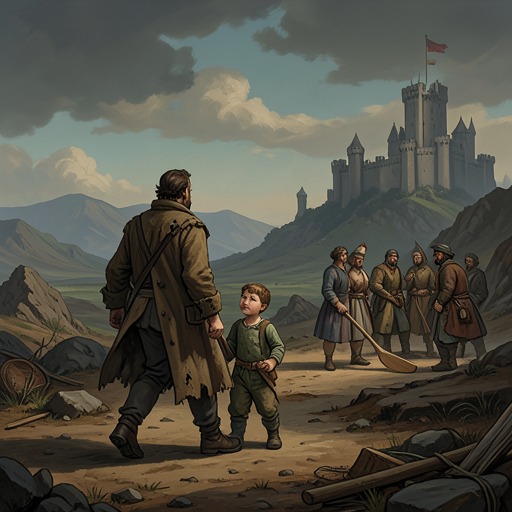
Gautier entered London in humble clothing with his two children, using the assumed identity of a poor man from Picardy. The names of the children were changed to keep their identities secret. At a church door, the wife of one of the king’s marshals saw Violante, was taken with her appearance and manner, and offered to take her into her household and eventually arrange a good marriage for her. Gautier accepted and, in tears, entrusted his daughter to the lady’s care.
After leaving Violante, Gautier did not remain in London. He travelled on to Wales with his son, so London became the point at which the family was divided rather than a settled home for all three. The marshal’s wife’s offer gave Violante a route into a protected household and, later, marriage, while Gautier and his son continued their difficult life elsewhere.
Return and Recognition
Eighteen years after fleeing, Gautier had endured a poor and arduous life and had grown so changed in appearance that he could not readily be recognized. He went to England to discover what had become of his children. After finding his son established as a marshal and great lord, he went to London to inquire discreetly about Violante. He learned that she had married Jamy Lamiens, the marshal’s son, and rejoiced that both children were alive and prospering.
Gautier then lingered near Violante’s home in the guise of a beggar. Jamy, taking pity on the old poor man, had him brought inside and given food. Violante’s young children gathered around Gautier and clung to him; he recognized them as his grandchildren, though they and their mother did not know who he was. When Violante came out and scolded the children for staying with the stranger, Gautier rose to honor her as a lady rather than reveal himself as her father. His altered appearance—old, bearded, lean, and darkened—prevented recognition even when they stood together.
London thus holds both the beginning of Violante’s new household and the scene of her father’s return to it. The city’s paired episodes contrast fortunes made through commercial credit with family bonds preserved through concealment: in one, distant wealth fails when political circumstances change; in the other, years of separation end in recognition for Gautier, though the reunion remains unspoken in the scene.