Lunigiana
The DecameronLunigiana is presented as a country near the storytelling company and as the setting where private misconduct, political displacement, and family reunion converge. A monastery stands in its secluded landscape; farther along, the Magra leads to the castle of Currado Malespina, where an exiled mother and an unrecognized son live under the same roof. The region’s importance lies less in a broad description of its towns than in the contrasting turns of fortune that unfold within it.
Setting and Geographic Frame
Dioneo introduces Lunigiana as a country not far from the company, giving his story of a monk and an abbot a setting that feels locally proximate. The monastery itself stands in a solitary place, and the young monk walks around its precincts at midday while the other monks sleep. The setting makes the encounter possible: he comes upon a young woman gathering herbs in the fields, brings her unseen to his cell, and is discovered when the abbot hears them. Lunigiana is thus first associated with secluded religious life and the opportunity, as well as the risk, of secrecy.
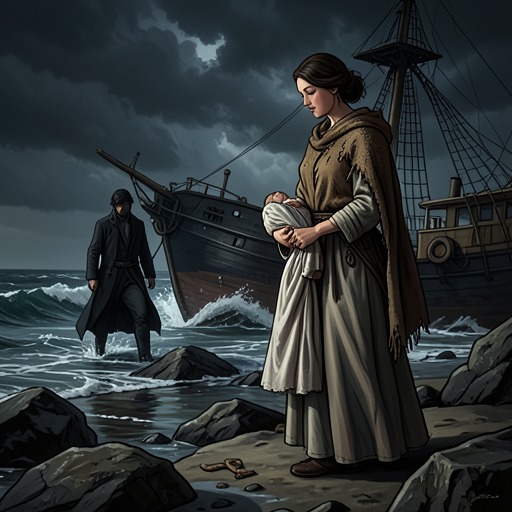
A different geography shapes the story of Madam Beritola Caracciola. After finding refuge on Ponza, she is persuaded to leave the island with Currado and his wife and travel to Lunigiana. They sail to the mouth of the Magra, identified in the text as a river flowing into the Gulf of Genoa, then proceed inland to Currado’s castle. The passage from island shore to river mouth and castle connects her isolation at sea to a household where she can survive, though not yet recover her former identity or family.
The Monastery and the Story of the Monk
The monastery is not described through its architecture or formal organization. Instead, the story sets its earlier reputation for sanctity against the conduct of one young monk, whose bodily vigor has not been subdued by fasting or vigils. At noon, while the rest of the community sleeps, he encounters the herb-gathering young woman and brings her into his cell. The quiet, solitary setting enables their clandestine meeting, but does not keep it hidden from the abbot.
The abbot hears the disturbance as he passes the cell, recognizes that a woman is inside, and initially considers having the door opened. He then changes his approach and waits for the monk to emerge. The episode makes Lunigiana’s religious setting a stage for a contest of concealment and authority: the monk’s attempt to hide his desire is exposed, while the abbot’s response turns the discovery into a test of the monk’s ability to escape punishment. The place’s narrative function is therefore not simply to signify religious discipline; it allows the tale to expose the gap between the monastery’s reputation and the impulses of its inhabitants.
Refuge, Household, and Recognition
In the family story, Lunigiana becomes a place of refuge after a political defeat overturns the lives of Arrighetto Capece and his household. When Charles I defeats Manfred at Benevento and Sicily changes hands, Arrighetto is captured. Madam Beritola, pregnant and fearful of what has happened to her husband, flees with her young son Giusfredi. A ship carrying her toward Naples is driven instead to Ponza; there she is separated from the nurse and both children, and remains behind on the island.
Currado Malespina encounters her months later while walking with his wife, servants, and dogs. The dogs chase the two kids Beritola has been nursing, and she rushes from the cave to beat them away with a staff. Currado and his wife first see a woman made lean, dark, and unkempt by her solitary life; after hearing her account, Currado recognizes her connection to Arrighetto and offers to take her home or support her as a sister. She will not return somewhere she might be recognized, but accepts his wife’s repeated entreaties to travel to Lunigiana. She arrives with the kids and their mother, the wild she-goat by which she has come to be known as Cavriuola, and lives modestly in widow’s clothing as a waiting-woman to Currado’s wife, continuing to care for the animals.
The castle also shelters Giannotto, the assumed name taken by Beritola’s elder son. After the nurse and the children are captured by corsairs and enslaved in Genoa, the nurse conceals their identity; the elder boy is renamed and warned that discovery could put him in danger. He later leaves service, travels for several years, and reaches Lunigiana after hearing that his father may still be alive. He enters Currado’s service, but neither he nor Beritola recognizes the other: time and hardship have changed them since their last meeting.
A Place Where Fortunes Turn
While in Currado’s household, Giannotto falls in love with Currado’s widowed daughter Spina. Their affair is discovered, bringing the secret history of the servant into collision with the honor of the family that has sheltered him. A gaoler’s report of Giannotto’s account leads Currado to question Beritola; her answer establishes the age and name of her missing elder son. Currado then tests Giannotto’s story against the details of his life and recognizes him as Giusfredi, the son of Arrighetto Capece.
Recognition alters the meaning of their shared residence. Giusfredi has been living beside his mother without knowing her, and she has unknowingly watched over her own son. Currado responds to the newly established identity by offering to make Spina, formerly Giannotto’s lover, his lawful wife, and to receive him as a son rather than punish him as a servant. When mother and son are brought together, Beritola recognizes his boyish features, rushes to embrace him, and faints from emotion; he recognizes her in turn and weeps with her. Currado announces the new family alliance and orders a feast. At Giusfredi’s request, he also sends agents to Genoa for the younger brother and the nurse, and to Sicily to investigate Arrighetto’s fate. Lunigiana thus becomes the hinge between dispersal and reunion: a refuge that preserves the family until identity can be restored and the next search can begin.