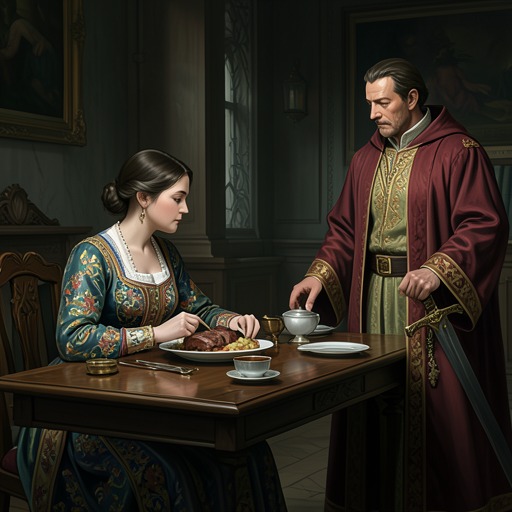
Marchioness of Monferrato
The DecameronThe Marchioness of Monferrato is a noblewoman whose wit turns an unwelcome royal visit into a test of restraint—and whose carefully staged banquet lets her refuse Philip II Augustus without surrendering either her composure or her dignity. While her husband is away on crusade, she recognizes why the king has come, receives him with full honour, and answers his desire not with confrontation but with a pointed lesson delivered at table.
Identity and Circumstances
The Marchioness is introduced through a report of her and her husband’s exceptional standing. At the court of Philip II Augustus, then preparing to depart France on a Christian crusade, a gentleman praises the marquis as outstanding among knights and his wife as the fairest and noblest of ladies. The report, offered while the marquis is overseas, has an immediate effect: although the king has never seen her, he falls passionately in love with the idea of her and resolves to travel by way of Genoa, so that he can visit her while her husband is absent.
The king’s desire is therefore founded first on another man’s account of the Marchioness, and only later intensified by seeing her. His plan depends on the opportunity created by her husband’s absence. The narrative presents her, by contrast, as perceptive before she is put to the test: when a messenger announces that the king will dine with her the following morning, she welcomes the visit graciously, then considers what it means for a king to seek her out at this particular time. She concludes that reports of her beauty have drawn him there.
Preparing the Banquet
Knowing the likely purpose of the visit does not lead the Marchioness to reject the king at the door. She decides instead to receive him honourably and calls on the gentlemen remaining in the household to help prepare for the occasion. The distinction between public courtesy and private judgment governs her response: she meets the king according to his rank while making arrangements that will allow her to address his intentions on her own terms.
She reserves the meal’s provisions and arrangement entirely to herself. Having gathered as many hens as could be found in the country, she instructs her cooks to prepare the royal table’s dishes from hens alone. The choice makes the banquet an argument in material form. Its abundance and variety satisfy the outward requirements of royal hospitality, yet the unvarying ingredient gives the meal a pattern the king cannot miss. The Marchioness does not need to accuse him or openly declare what she has inferred; she creates the occasion on which he will ask the question that lets her answer him.
The Question and Reply
The king arrives at the appointed time and is received with honour and gladness. Seeing the Marchioness, he finds her more beautiful and noble than he had imagined from the courtier’s praise, and his desire grows. He is also entertained in chambers furnished to suit a king and seated with her at the principal table, while the rest of the company dine according to their rank at other tables. Successive dishes and the best, costliest wines make the welcome seem generous. But each course consists of hens, though the country should offer game and the king’s advance notice has allowed time for a hunt.
After wondering at the repeated dish, the king asks, “Madam, are hens only born in these parts, without ever a cock?” The Marchioness recognizes the opening and answers, “Nay, my lord; but women, albeit in apparel and dignities they may differ somewhat from others, are natheless all of the same fashion here as elsewhere.” Her reply joins the banquet’s physical repetition to a direct statement: differences of clothing and status do not make women a different kind of being, available for a powerful man’s taking. The point is discreetly phrased but unmistakable, and the king understands both the purpose of the hens and the force of her words.
Restraint and Narrative Significance
The king recognizes that further words would be wasted and that violence is out of the question. He suppresses the passion he now sees as ill-conceived, completes the meal without renewing his approach, and thanks the Marchioness for her entertainment. He then sets out for Genoa, departing promptly so that his departure can make amends for the impropriety of his visit.
The episode makes the Marchioness’s intelligence practical: she reads the king’s intention, arranges the setting, and converts his own question into the means of refusal. Her resistance does not depend on a public quarrel or on denying him the formal respect due to a king. Instead, the repeated hens give her an indirect but unmistakable language, and her reply compels him to recognize the limit she has set. His departure completes the reversal: the visitor who hoped to benefit from her husband’s absence leaves having been checked by the woman he meant to approach.