Monferrato
The DecameronMonferrato is the setting for the Marchioness of Monferrato’s encounter with the visiting King of France, where hospitality becomes a defense against a king’s unwelcome passion. The story makes the region’s domain a place of political absence and personal presence: the Marquis is away on crusade, while his wife must receive a powerful guest on her own.
Setting and Circumstances
The Marchioness’s husband, the Marquis of Monferrato, has gone overseas with the Christian forces on a general crusade. At the court of King Philip II Augustus, a gentleman praises the Marquis’s virtue and declares that his wife is the fairest and noblest lady in the world. The king falls in love with her on the strength of this report, despite never having seen her, and arranges to travel by way of her husband’s domains under the pretext of taking ship for the crusade at Genoa.
Having sent his forces ahead, the king travels with only a few gentlemen. When he is within a day’s journey of the Marquis’s domains, he sends word that he will arrive for dinner the next morning. The visit brings the political weight of the French court into a household whose lord is absent, making the Marchioness responsible for receiving the king and discerning what lies behind his arrival.
The Royal Visit
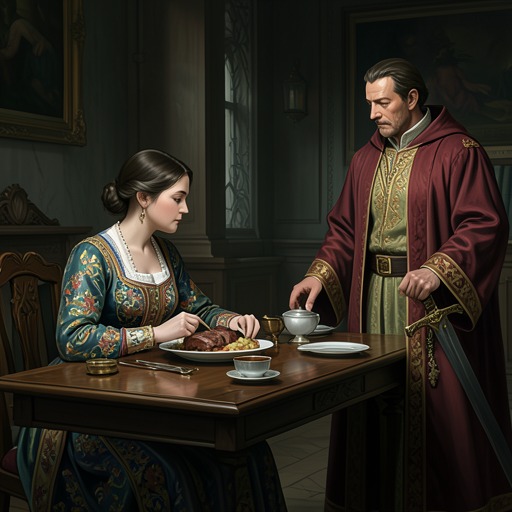
The Marchioness recognizes that her beauty has drawn the king to Monferrato, but she receives him with honor rather than openly challenging his intentions. She consults the gentlemen who remain there and arranges what is needed for the visit. She reserves the meal itself to her own direction, gathers as many hens as can be found in the country, and orders the cooks to prepare a variety of dishes from them alone for the royal table.
The king arrives at the appointed time and is welcomed with ceremony and pleasure. Seeing the Marchioness, he finds her still fairer and more gracious than the courtier’s description had led him to expect, and his desire grows. After resting in chambers furnished for a royal guest, he sits to dinner with her at one table; the rest of the company is served at other tables according to rank. The king receives successive dishes of hen and the finest, costliest wines while enjoying the sight of his hostess.
Narrative Significance
The setting gives the Marchioness room to answer power with controlled hospitality. The Marquis’s absence creates the occasion for the king’s visit, but within his domains the Marchioness directs the reception and, especially, the meal. The repeated hen dishes make the local country’s available food the instrument of her response: instead of accepting the king’s private purpose, she shapes the terms of his public welcome.
The story is told by Fiammetta after Dioneo’s tale, within a day devoted to the efficacy of ready and graceful answers. Its title identifies the outcome: the Marchioness’s dinner of hens and sprightly words curbs the King of France’s extravagant passion. Monferrato thus functions not merely as a destination on the king’s route to Genoa, but as the stage on which the Marchioness turns an encounter arranged by male power into an occasion for her own judgment and restraint.