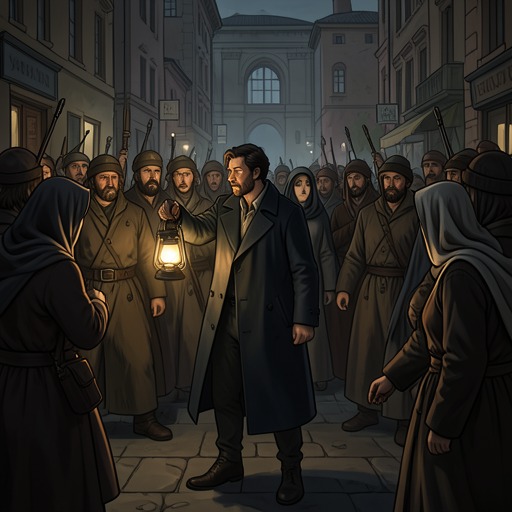
Nastagio degli Onesti
The DecameronNastagio degli Onesti is a wealthy young man of Ravenna whose pursuit of an unresponsive beloved is redirected by a supernatural vision at Chiassi. He turns that vision into a spectacle for her and her family, after which she agrees to marry him. His story joins the pleasures of a happy ending to an unsettling demonstration of how fear can compel a woman’s consent.
Identity and Background
Nastagio is a young man of Ravenna whose father and uncle have both died, leaving him extraordinarily rich. He is unmarried when he falls in love with the daughter of Messer Paolo Traversari, a woman of higher family than his own. His wealth gives him room to spend lavishly, but it does not erase the difference in their social standing or secure her affection.
The Fifth Day’s story is told by Filomena. She introduces it as an example of cruelty punished by divine justice, joining Nastagio’s courtship to the supernatural episode that alters its outcome. The story’s moral frame matters: the vision is not merely a marvel he happens upon, but an apparition that he interprets as relevant to his own pursuit.
Courtship, Rejection, and Expenditure
Nastagio hopes that his manner and conduct will win the Traversari daughter’s love. Instead, she remains cruel and unyielding; her beauty and noble birth are presented as reasons she has grown proud and disdainful. His efforts do not soften her. The more hope he loses, the more his love appears to intensify.
His rejection produces a cycle of distress and extravagant spending. At times he is so weary of complaining that he thinks of killing himself; at others he resolves to abandon the woman entirely or hate her as she hates him. Neither resolve lasts. He continues loving her and spending without measure until friends and kinsfolk fear that he will ruin both himself and his fortune. They repeatedly urge him to leave Ravenna for a while, hoping distance will lessen his passion and expenditure. He resists for a long time, then agrees when their entreaties become impossible to refuse.
Nastagio makes preparations as if he intends to travel to France, Spain, or another distant country. Instead, he rides out with his companions to Chiassi, about three miles from Ravenna. Once there, he sends his companions home, sets up tents and pavilions, and remains. His life at the encampment is not one of retreat or economy: he entertains guests lavishly, inviting different people to supper and dinner as before. The move changes the setting of his courtship without immediately changing his habits of expenditure.
The Vision at Chiassi
Near the beginning of May, on a fine day, Nastagio asks his servants to leave him alone so that he can think about the woman who has rejected him. Wandering melancholy through the pine wood, he goes about half a mile without remembering food or anything else. Almost five hours of the day have passed when he hears a woman’s terrible cries. He looks up and sees a beautiful woman, naked, fleeing through dense undergrowth and briars.
A knight pursues her, with two mastiffs at her heels. Nastagio draws back in fear as the knight catches the woman, kills her, and tears out her heart, which the dogs devour. The scene then begins again: the woman rises and flees toward the sea, pursued by the dogs, until the figures disappear from Nastagio’s sight. The violence is repeated rather than concluded, and the apparent ending gives way to another flight.
Nastagio remains caught between pity and fear. He notices that the spectacle occurs every Friday, marking both its recurrence and an opportunity to use what he has seen. Rather than keep the vision to himself, he decides to bring witnesses to the wood. He asks his friends and kinsfolk to arrange a Friday dinner with Messer Paolo Traversari, his wife, their daughter, their female relatives, and other ladies. He does not initially explain his purpose; he promises that the guests will see why he wants them there.
The Banquet and Reversal
Nastagio orders a magnificent banquet beneath the pines, at the very place where he witnessed the woman’s killing. He arranges the seating so that the Traversari daughter faces the spot where the recurring scene is to occur. The spectacle begins when the final dish has been served: the company hears the pursued woman’s cries, rises in alarm, and sees the woman, the knight, and the dogs. Some guests try to intervene, but the knight’s explanation of the scene stops them and fills them with fear. He then repeats the killing before the assembled company.
The women present weep as if the violence had been done to them. Nastagio’s beloved is especially terrified. She has seen and heard the entire episode and understands that it bears directly on her own conduct toward him. In her fear, she imagines herself fleeing before an enraged lover with mastiffs at her heels. The vision changes her response: that evening, she sends a trusted chamberwoman to tell Nastagio that she is ready to do what he wishes.
Nastagio accepts her offer but specifies that he wants her with honor, by taking her as his wife. She agrees, recognizing that it had rested with her alone that she had not already become his wife. She then tells her parents that she consents to the marriage. Their joy completes the reversal: the woman who had rejected Nastagio now accepts the union, but her change of heart follows a staged encounter with supernatural punishment.
Marriage and Narrative Significance
Nastagio marries the Traversari daughter the following Sunday, and the two live together happily for a long time. The story also extends the banquet’s effect beyond the couple: the women of Ravenna become more fearful and, thereafter, more amenable to men’s desires. Nastagio’s private courtship thus ends in marriage, while the narrated consequence is a wider change in women’s behavior across the city.
The ending is deliberately double-edged. Nastagio asks for a marriage that grants his beloved social honor, and the couple’s long happiness supplies the conventional reward of a successful love story. Yet her agreement follows terror, not a freely narrated growth of affection. Filomena’s framing presents the episode as justice against cruelty; its mechanics also make fear the means by which Nastagio overcomes rejection. His role is therefore not simply that of a patient lover rewarded at last: he turns a recurring spectacle of violence into an instrument of persuasion, and the story’s happy conclusion sits beside the coercive means by which it is reached.