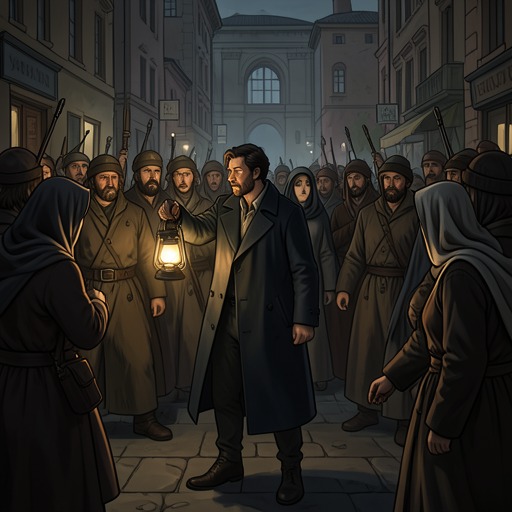
Ravenna
The DecameronRavenna is introduced as an ancient city in Romagna, home to the wealthy young nobleman Nastagio degli Onesti and the setting for the unrequited courtship that drives his story. Though the decisive supernatural episode unfolds nearby at Chiassi, its consequences reach back to Ravenna: Nastagio marries the woman he loves, and the tale says that the city’s women thereafter become more responsive to men’s desires.
The city and its social setting
The narrative describes Ravenna as a very ancient city with many noblemen and gentlemen. Nastagio, left exceptionally rich by the deaths of his father and an uncle, falls in love with the daughter of Messer Paolo Traversari, whose family is of higher rank than his own. The difference in their standing shapes the courtship from its outset: Nastagio hopes his conduct will win her affection, but his wealth and commendable behavior do not soften her refusal.
Her resistance leaves Nastagio grieving and repeatedly contemplating suicide, though he does not act on that thought. He continues to love her and spends without restraint, until friends and relatives fear that he will exhaust both himself and his fortune. Ravenna is therefore not merely his place of origin; it is the social world in which his public, costly pursuit becomes unsustainable.
From Ravenna to Chiassi
At the urging of his kin, Nastagio agrees to leave Ravenna for a time, hoping distance will lessen his passion and spending. Although he makes preparations as if to travel to France, Spain, or another far-off country, he rides only about three miles from the city, to Chiassi. He sends for tents and pavilions and establishes himself there, entertaining successive groups of friends and acquaintances at lavish meals.
The nearness matters to the story’s design: Nastagio has withdrawn from Ravenna without severing his ties to its people. While wandering alone in the pine wood at Chiassi, he encounters a spectral punishment involving a fleeing woman, a pursuing horseman, and two fierce dogs. He later uses the spectacle as the occasion for a dinner attended by his relatives and the woman he loves, so that a scene outside the city can alter relationships within its social circle.
Ravenna after the spectacle
The woman sees and hears the supernatural scene at the dinner and understands it as a warning relevant to her own treatment of Nastagio. Terrified that a similar fate might await her, she sends a trusted chamberwoman to say that she is willing to grant his wishes. Nastagio agrees, but insists that their relationship proceed honorably through marriage. She accepts, informs her parents, and marries him the following Sunday; the couple then live together happily for a long time.
The conclusion enlarges the episode’s consequence beyond the couple. The narrative reports that Ravenna’s women, frightened by what they witnessed, became more amenable than before to men’s desires. The city thus serves as both the community from which Nastagio departs and the audience in which the story’s unsettling lesson takes hold: the marriage is presented as the personal resolution, while the reported change among Ravenna’s women makes the tale’s social effect more troubling and far-reaching.