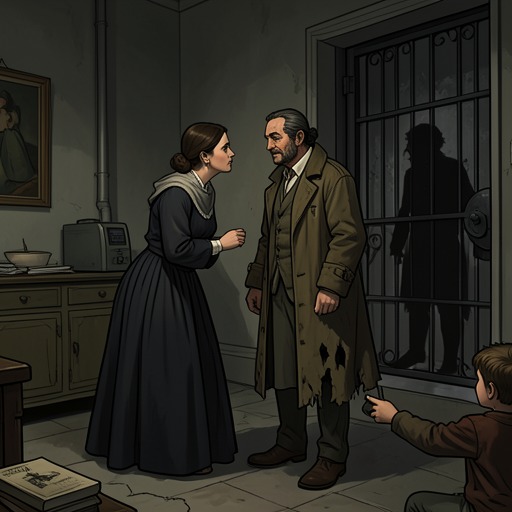
Restagnone
The DecameronRestagnone is a poor young nobleman whose secret affair with Ninetta develops into a scheme to unite three couples and their fortunes in Crete. His plan succeeds in carrying the lovers from Marseilles to a life of extraordinary comfort, but the abundance he helped secure soon becomes the setting for his own changing desire. When his attention turns elsewhere, Ninetta’s jealousy becomes lethal, and his death begins a wider unraveling among the companions.
Identity and Introduction
Restagnone is introduced as a young man of gentle birth but little money, in love with Ninetta, one of three daughters of a very wealthy merchant from Marseilles. Ninetta loves him in return, and the two have secretly enjoyed their relationship without anyone discovering it. Their intimacy is already established when two more young men enter the story, changing the scale of Restagnone’s ambitions.
The narrative gives no account of his family or earlier life beyond his noble birth and poverty. Instead, it defines him through the contrast between his means and his desires: he has secured Ninetta’s love, but he lacks the wealth to create the independent, comfortable life he imagines. His response is not simply to accept that limitation. He turns the arrival of two rich suitors into an opportunity to enlarge both his prospects and the lovers’ freedom.
The Escape Scheme
Folco and Ughetto, both wealthy and orphaned, fall in love with Ninetta’s sisters, Maddalena and Bertella. Restagnone notices their attachments, which Ninetta has shown him, and deliberately cultivates their company. He accompanies first one and then the other to visit the women, waiting until the young men regard him as a close friend. He then proposes that they pool their wealth, make him an equal partner, and choose somewhere in the world to live with all three sisters. He promises that, with their money and his plan, the women—and a large part of their father’s property—can be brought along.
The proposal makes Restagnone’s practical calculation plain. He is not rich enough to finance the venture alone, so he offers the two young men partnership in exchange for access to their wealth and cooperation in securing the sisters’ departure. His appeal is framed as mutual friendship and shared happiness, but its central mechanism is the pooling of resources. The young men, eager to possess the women they love, readily agree.
Restagnone then persuades Ninetta, whom he can reach only with difficulty, to approve the scheme. She wants to live with him without suspicion or interruption and accepts his proposal; she also assures him that her sisters will follow her wishes. When he reports that the women are prepared, the men sell land under the pretence of setting out to trade, convert their other possessions into money, and secretly outfit a light brigantine. Ninetta, in turn, persuades her sisters that the venture is desirable.
On the appointed night, the three sisters take money and jewels from their father’s great coffer and leave to join their lovers. The group rows out to sea and reaches Genoa the following evening, where the new couples first have an opportunity to enjoy their relationships openly. They continue from port to port and arrive in Crete before the eighth day. There they purchase substantial estates near Candia and build handsome houses. Their new life includes servants, hounds, hawks, horses, banquets, and continual merrymaking: the escape Restagnone engineered brings the group not merely privacy but conspicuous prosperity.
Abundance and a Change of Desire
The turn in Restagnone’s story comes after the success of his plan. He had loved Ninetta deeply, but once he can have her whenever he wishes, without obstruction or concealment, he begins to tire of her and his love wanes. The narrative makes access itself part of the reversal: the relationship that had required secrecy and effort loses its hold when it becomes entirely available.
At an entertainment, Restagnone sees a beautiful young woman of noble birth from the country and becomes strongly attracted to her. He begins courting her with great persistence, giving splendid entertainments in her honor and employing every kind of gallantry. His attention therefore shifts from the woman for whom he risked and organized the escape to a new object of desire, in the very setting of comfort and freedom he helped create. The story does not report whether the new woman returns his affection; it emphasizes that Restagnone pursues her and that Ninetta becomes convinced he has betrayed her.
Ninetta’s jealousy grows as she hears reports of his courtship. She reproaches him and herself, but those reproaches do not restore their earlier intimacy. Instead, the narration describes them as intensifying his new passion: denial sharpens his appetite. Whether Restagnone actually obtains the other woman’s favors remains uncertain, but Ninetta treats his infidelity as certain. Her suspicion hardens into grief, then rage, and finally hatred. The relationship that began as a mutual secret ends in a conflict shaped by a widening gap between his pursuit of novelty and her conviction that she has been wronged.
Death and the Consequences for the Company
Blinded by anger, Ninetta seeks revenge through Restagnone’s death. She approaches an old Greek woman skilled in preparing poisons and, with gifts and promises, persuades her to make a fatal drink. One evening, while Restagnone is heated and unsuspecting, Ninetta gives it to him. The poison kills him before morning. His death is sudden, and those around him do not initially know that he has been poisoned.
Folco and Ughetto, together with their lovers, mourn Restagnone and arrange an honorable burial; Ninetta mourns him too. That public grief conceals the act that caused his death. The truth emerges only after the old woman is seized for another offense and confesses under torture. The Duke of Crete then surprises Folco’s palace at night and takes Ninetta prisoner. Without torturing her, he obtains her confession about Restagnone’s murder.
Restagnone’s death does not end the danger for the group. Folco later gets Ninetta out of the Duke’s reach by telling her that her sister has arranged an escape, and the two leave at night with only the little money he can gather. Maddalena is then found murdered. Ughetto and his companion, who know nothing of Folco and Ninetta’s departure, are accused along with them and face death; they bribe their guards and flee by night to Rhodes, where they live in poverty and distress. The narrative closes by tracing the ruin of the group to Restagnone’s mad love and Ninetta’s rage. His own death follows his change of desire, but its consequences extend well beyond the couple whose affair set the chain in motion.