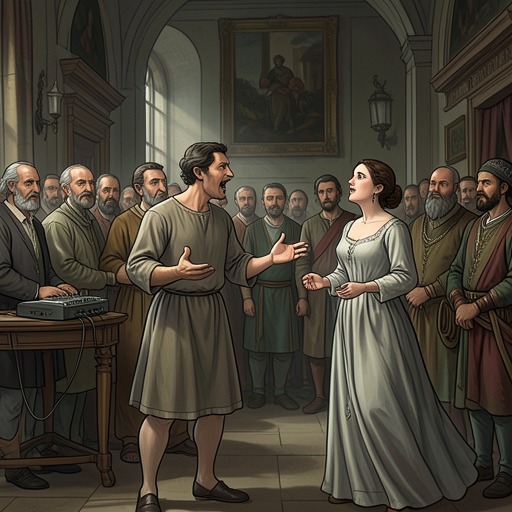
Ricciardo Manardi
The DecameronRicciardo Manardi’s story turns a clandestine meeting, discovered at the moment it could bring disgrace and danger, into a marriage accepted by both lovers and their families. His courtship of Caterina is secret and bold, but its resolution depends on Messer Lizio da Valbona’s decision to convert discovery into a demand for lawful marriage rather than punishment.
Identity and Introduction
Ricciardo is a young man of the Manardi family of Brettinoro, described as handsome, vigorous, and well mannered. He often visits the household of Messer Lizio da Valbona, where the older man and his wife, Madam Giacomina, regard him almost as a son. That familiarity gives him access to Caterina, but it also makes his concealed courtship a breach of the trust her parents place in him.
Caterina is the only child still living to her parents. They love her dearly, guard her closely, and hope to secure a great alliance through her marriage. Ricciardo’s attachment therefore develops within a household where affection, supervision, and expectations about family status all meet. Though the narration identifies him as a young man of good birth, his secret relationship with Caterina precedes any parental arrangement or public recognition.
Courtship and Secret Meeting
Ricciardo falls deeply in love after seeing Caterina’s beauty and lively, commendable manners. He takes care not to reveal his feelings at first. Caterina, however, notices them and returns his love; the relationship is mutual rather than a one-sided pursuit. When Ricciardo finally speaks, he tells her that he fears dying of love. She answers in kind, then explains the practical obstacle: her parents keep her so strictly that she cannot see how he might reach her.
Ricciardo proposes that she find a way to sleep in the gallery adjoining her father’s garden. If she can be there at night, he says, he will find a way to reach her, however high the ascent. Caterina agrees that she can arrange it. Their first exchange is brief: they kiss once and separate, leaving the dangerous plan to be carried out later.
The opportunity comes through a misunderstanding that Caterina deftly turns to her advantage. After she complains of the heat and says she wants to hear The nightingale, her mother argues that the girl should be allowed to sleep in the gallery. Messer Lizio agrees, believing the request innocent. Caterina has a bed prepared there and signals Ricciardo when the moment is right. Meanwhile, her father locks the door between his own chamber and the gallery before going to sleep.
Ricciardo waits until the house is quiet, climbs a wall with a ladder, and then works his way up the projections of another wall to reach the gallery. The climb is arduous and dangerous: a fall would have had serious consequences. Caterina receives him joyfully. They kiss, go to bed together, and spend most of the night in each other’s company. The story’s repeated nightingale image carries a double meaning: the song that supposedly explains Caterina’s request becomes the playful cover for the lovers’ encounter.
Discovery and the Marriage Demand
The short night and the lovers’ pleasure keep them from noticing how near morning has come. They fall asleep uncovered and entwined. When Messer Lizio remembers that his daughter is in the gallery, he enters quietly to see how well The nightingale has helped her sleep. Lifting the curtain, he finds Caterina and Ricciardo together and recognizes his familiar visitor.
Rather than raise an alarm, Messer Lizio goes to Madam Giacomina and brings her to see what has happened. She is angry at first, but her husband restrains her. He judges Ricciardo young, rich, and gently born, and sees that the discovery can be resolved by making him Caterina’s husband. His response is practical as well as protective: a marriage will secure his daughter’s future and prevent the encounter from becoming an open family disgrace.
When Ricciardo wakes in daylight and realizes he has been discovered, he believes himself lost. He apologizes and submits himself to Messer Lizio’s judgment, asking to be spared. Messer Lizio makes the choice plain: Ricciardo must marry Caterina, so that the intimacy of the night becomes a lasting lawful bond. Caterina weeps and asks her father to forgive Ricciardo; she also urges her lover to accept the demand so they can continue their life together without fear. Ricciardo agrees without hesitation, moved by shame, fear of death, desire to make amends, and his love for Caterina.
Marriage and Ending
Messer Lizio borrows one of Madam Giacomina’s rings. In the parents’ presence, Ricciardo gives Caterina a solemn promise of marriage. This immediate pledge settles the crisis in the bedroom, but it is distinct from the later public wedding: a few days afterward, Ricciardo marries Caterina again before their friends and relatives and brings her with ceremony to his own house.
The conclusion reverses the peril of the discovery. What began as a secret visit behind locked doors ends with family consent, a recognized marriage, and an honourable celebration. Ricciardo and Caterina live together in peace and pleasure, and the tale returns to The nightingale as a comic image for their continuing intimacy. The father’s discovery does not dissolve the couple’s attachment; it compels that attachment into a public and durable form.
Narrative Role and Significance
Filostrato introduces the tale as a brief, comic love story after complaints that his earlier choices had led the company toward sorrow. Its movement fulfills that promise: mutual desire and strict supervision produce a dangerous plan; the lovers’ success gives way to sudden exposure; and the threatened catastrophe becomes a marriage. Ricciardo’s daring matters, but the resolution depends equally on Caterina’s initiative in securing access and on Messer Lizio’s choice to negotiate rather than retaliate.
The story distinguishes the lovers’ private commitment from its social recognition. Ricciardo and Caterina have already chosen one another in secret, while her parents’ hopes for a suitable alliance and their close watch over her limit the means by which they can meet. Once discovered, the couple’s desire is not treated as sufficient by itself: Ricciardo must give his promise before the parents and then complete the union in a public wedding. The comic nightingale conceit softens that passage from concealment to family settlement, while the final peace makes marriage the condition under which their love can continue openly.