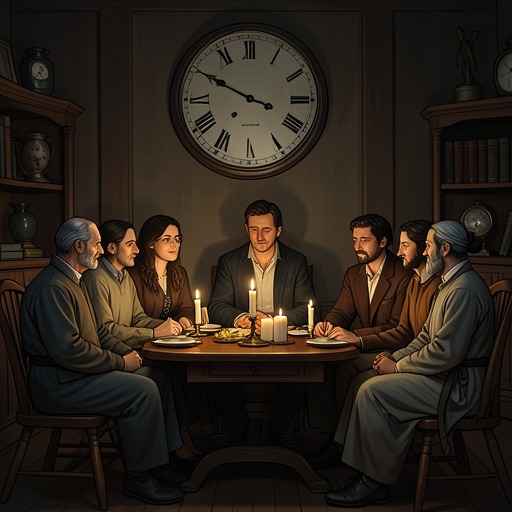
Rinaldo d'Asti
The DecameronRinaldo d'Asti is a merchant whose journey from Ferrara toward Verona becomes a sequence of reversals: he trusts men who are secretly highwaymen, loses nearly everything, and survives the night through an unexpected act of hospitality. His recovery comes not through his own servant or the prayer he relies on, but through a woman who shelters and assists him; by morning, fortune has also returned his stolen property.
Identity and journey
In the days of Azzo d'Este, Rinaldo comes to Bologna on business. Having completed his affairs, he sets out for home with only a mounted servant for company. As he leaves Ferrara, he joins three men who present themselves as merchants. They speak courteously and discuss respectable subjects, cultivating his confidence while privately looking for an opportunity to rob him.
The episode establishes Rinaldo as a traveler exposed to the risks of the road, but not as a fool: later, he recognizes the meaning of the woman’s welcome and responds to it. His vulnerability arises first from the highwaymen’s deliberate performance of civility, which makes their company seem fortunate rather than dangerous.
Robbery and the failed safeguard
During the journey, conversation turns to prayers said on the road. Rinaldo describes his morning custom: when leaving an inn, he recites a Pater and an Ave for the souls of St. Julian’s father and mother, then asks God and the saint to grant him a good lodging that night. His devotion is practical and tied to the hazards of travel; the lodging he seeks becomes an urgent need after his companions betray him.
Late in the day, at a river crossing beyond Castel Guglielmo, the three men attack and rob him of his money, clothes, and horse. They leave him on foot in his shirt. His servant, who witnesses the attack, does nothing to help and rides away to Castel Guglielmo, where he takes lodging without making further effort on Rinaldo’s behalf.
Cold, snow, and the approaching night turn the robbery into a threat to Rinaldo’s life. With the surrounding country still devastated by recent war, he sees no nearby shelter and runs toward Castel Guglielmo. Darkness overtakes him before he reaches it: the gates are shut and the drawbridges raised, so he cannot enter. The prayer for a safe night has not prevented disaster, and the town itself offers no refuge at the moment he arrives.
Shelter and reversal
Rinaldo nevertheless finds shelter with a woman inside the town. Recognizing that he owes his life to her aid, he willingly answers her amorous advances. They spend the remainder of the night together. At daybreak, wishing to avoid suspicion, she gives him old clothes and a purse of money, shows him how to enter the town and find his servant, and lets him out through a postern, asking him to keep their encounter secret.
Once the gates open, Rinaldo enters the town as though he has come from elsewhere and finds his servant. He puts on the clothes from his saddle-bags and is preparing to ride away when the three robbers are brought into the town. They have been arrested for another crime; after confessing, they surrender Rinaldo’s horse, clothes, and money. The robbery is thus reversed by events independent of his own action, while the woman’s help has already carried him safely through the night.
Return and narrative significance
Rinaldo thanks God and St. Julian and returns home safe and sound. His losses amount only to a pair of garters, which the robbers apparently could not account for. The three men, by contrast, face execution: the tale’s closing image leaves them to be hanged the following day.
The episode places Rinaldo between two failures of protection and two forms of unexpected aid. His servant abandons him at the moment of attack, while the woman provides immediate shelter and practical means to continue. His prayer does not avert the danger, but its request for lodging acquires an ironic fulfillment: after the town’s gates shut against him, a private household receives him. His restored property and safe return complete the reversal, with the missing garters preserving a small, concrete trace of the night’s losses.