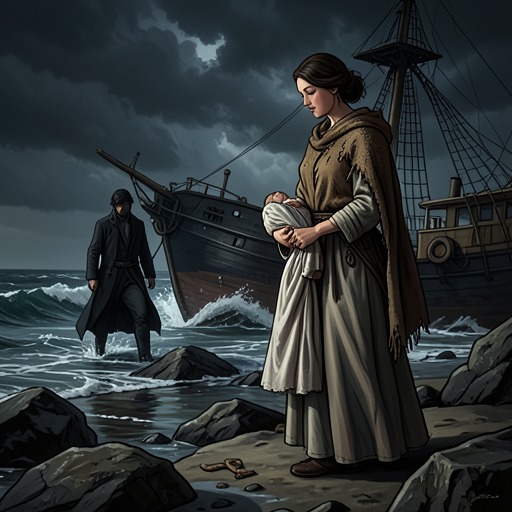
Scacciato
The DecameronScacciato is the younger son of Madam Beritola Caracciola and Arrighetto Capece, whose family is scattered by political upheaval, capture, and enslavement. Born during his mother’s flight from Sicily, he spends his early life separated from her and his father; his eventual recovery and marriage form part of the story’s reversal from dispossession to family restoration.
Birth and Flight
After King Charles I of Anjou defeated Manfred at Benevento, Arrighetto Capece was captured amid the transfer of power in Sicily. Fearing what had become of her husband, Madam Beritola abandoned her possessions and fled while pregnant, taking her elder son, Giusfredi Capece, with her. She reached Lipari, where she gave birth to Scacciato, then set out by ship with both boys and their nurse, intending to return to her kin in Naples. The vessel was driven instead to Ponza.
The family’s separation followed when corsairs seized the ship at Ponza. Madam Beritola had gone ashore and remained unseen; the nurse and the two children were taken to Genoa and allotted as booty to Messer Guasparrino d’Oria. They were sent to serve in his household. Scacciato was thus not merely displaced by the political crisis that had cost his father his position: he was carried away from his mother and made a servant in another man’s home.
Concealed Identity and Servitude
The nurse judged that revealing the children’s parentage could put them in danger. She told those who asked that the boys were her own sons, and she changed the elder child’s name to conceal his identity. Scacciato’s name, by contrast, remained unchanged. She explained the danger to Giusfredi and repeatedly urged him to keep the secret; her caution preserved the brothers while they lived in servitude.
Years later, after Giusfredi had been recognized by his mother and entered into an alliance with Currado Malespina, he asked Currado to send for Scacciato, whom he identified as still serving Messer Guasparrino in Genoa. The request turns the family’s reunion into an act of deliberate recovery: Giusfredi does not treat his own recognition as the end of the search, but seeks out the brother who remains captive and the nurse who has protected them both.
Recovery and Marriage
Currado’s messenger informed Messer Guasparrino of Giusfredi’s recognition and of the family’s history. Guasparrino initially warned the messenger not to trust the account, but questioned the nurse privately. Once her explanation matched what he had heard, and further inquiries strengthened his confidence, he accepted the truth and felt shame for his treatment of the boy. In reparation, he gave Scacciato his fair young daughter in marriage with a great dowry.
Guasparrino then travelled with Scacciato, his daughter, the nurse, and Currado’s messenger to meet Currado and the reunited family at a castle near Lerici. Scacciato was welcomed back by his mother and brother; the gathering also honored the nurse whose discretion had safeguarded them through captivity. At the feast, news arrived that Arrighetto was alive: freed during the Sicilian revolt, he had regained his honors and possessions under King Pedro and had sent a brigantine to bring his family to him. The announced conclusion restores the scattered household to high estate. Scacciato’s marriage, made possible by the very household in which he had been enslaved, is one of the concrete signs of that reversal.
Narrative Role
Scacciato has few spoken or independent actions in the surviving account, and the story presents him chiefly through the family’s search for him and his return. His unchanged name contrasts with the false identity imposed on his elder brother, while the nurse’s silence about their origins protects both boys until recognition becomes possible. His recovery connects the separate strands of the family’s displacement: the mother and elder son are reunited first, then the younger son is sought out, and finally word of the father’s survival completes the movement from loss toward restoration.