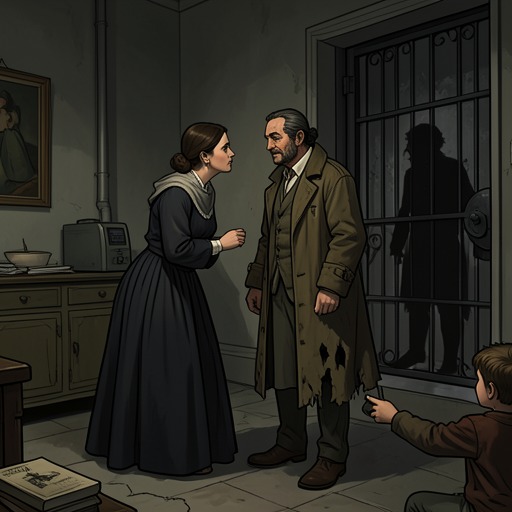
Tancred
The DecameronTancred, Prince of Salerno, is a ruler described as humane and kindly whose late-life violence against his daughter Ghismonda’s lover destroys the family he meant to protect. His story hinges on a bitter reversal: the father who had cherished his only child becomes the agent of her lover’s death, and his eventual repentance comes only after Ghismonda has died beside the heart he sent her.
Identity and Family Background
Tancred is the lord of Salerno and the father of Ghismonda, his only surviving child. The story presents him as tenderly devoted to her, but says that his affection led him to delay her marriage until she was well past the usual age. He eventually married her to a son of the Duke of Capua. After that husband died, Ghismonda returned to her father’s household, where she lived in comfort and luxury.
Tancred did not arrange another marriage for her. The narrative attributes this in part to his love for her, while Ghismonda herself considers it improper to ask him to do so. That combination leaves her at home, unmarried and closely tied to her father’s household, while Tancred’s care continues to shape the limits of her life. The story thus establishes his affection as genuine, but also as a force that leaves little room for his daughter to determine her own future openly.
Discovery of Ghismonda’s Love
Ghismonda falls in love with Guiscardo, a young servant of Tancred’s. Though Guiscardo is of humble birth, the narrative describes him as surpassing others in worth and manners. The lovers keep their relationship secret and meet through a concealed passage that leads to a grotto beneath the palace. Tancred’s discovery comes not through a confession or accusation, but by chance.
Tancred is accustomed to visiting Ghismonda’s chamber alone to talk with her. On one such afternoon, finding the windows closed and the bed curtains drawn, he sits concealed behind them and falls asleep. Ghismonda enters from the garden, unaware that he is there, and opens the secret door for Guiscardo. Tancred wakes and sees the two lovers together. He initially wants to confront them, but holds his tongue, deciding to wait and act later in private.
The concealment that had enabled the lovers’ meetings now gives Tancred the advantage of secrecy. After Guiscardo leaves by the passage, Tancred slips away without being seen. That night, as Guiscardo comes out of the tunnel, two men seize him on Tancred’s orders and bring him secretly to the prince. Tancred’s charge is personal: he says that his kindness and trust have been repaid with an outrage against his own flesh and blood. Guiscardo does not deny the love; he answers that love is mightier than either of them.
Punishment and the Golden Bowl
Tancred keeps Guiscardo under guard in the palace. He knows the strength of Ghismonda’s character, yet persuades himself that she may not be as steadfast in her resolve as she has claimed. Rather than punish her directly, he chooses to make her suffer through the death of the man she loves. He orders Guiscardo’s two guardians to strangle him quietly that night and bring him his heart.
The next morning, Tancred places the heart in a large, fine golden bowl and sends it to Ghismonda through a trusted servant. His message presents the heart as a consolation for what she loved most, while comparing her grief to the grief she has caused him. The object makes his vengeance brutally intimate: the secret lover’s body is reduced to a token delivered from father to daughter. Tancred’s gesture is not a public judgment or an attempt at reconciliation; it is a private punishment designed to reach Ghismonda through the very bond he has tried to break.
Ghismonda had prepared poisonous herbs and roots, distilled into water, in case the feared outcome came to pass. When the servant brings the bowl and message, she recognizes Guiscardo’s heart. She receives it steadily, acknowledges the worth of the golden vessel, and kisses the heart. Her composed response contrasts with Tancred’s assumption that suffering will weaken her resolve. She drinks the poison, then lies down with the bowl and presses the dead heart against her own.
Death, Repentance, and Narrative Significance
Tancred’s servants tell him what is happening, and he hurries to Ghismonda’s chamber. He arrives too late to comfort her. She rejects his tears and asks for one final favor: since he did not permit her to live with Guiscardo in secret, he should allow her body to rest openly beside his wherever Tancred has had him buried. As she dies, she holds Guiscardo’s heart to her breast. Tancred is left without either the daughter he cherished or the man whose death he ordered.
After much lamentation, Tancred repents of his cruelty and has the lovers honorably buried together in one sepulchre. The people of Salerno mourn them. The shared burial grants Ghismonda her last request, but it cannot undo the sequence that made it necessary: Tancred’s decision to answer discovery with secret execution, followed by his daughter’s deliberate death. His story’s decisive contrast is between his early paternal tenderness and the violence into which that tenderness turns when he treats Ghismonda’s love as an injury to himself. He is neither presented as wholly without affection nor spared responsibility for the consequences. His remorse recognizes the wrong only after the loss is irreversible.