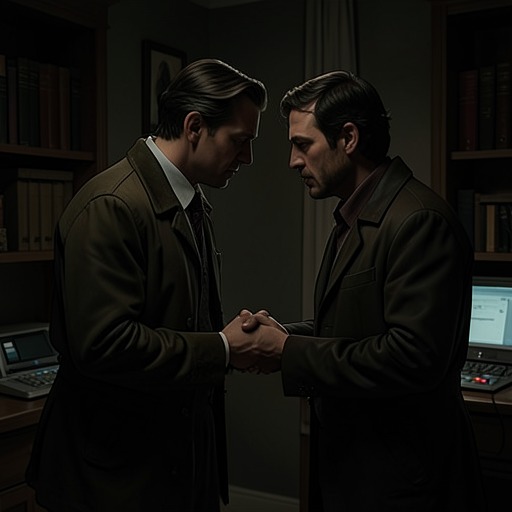
Tessa’s phantom-conjuration ruse
The DecameronTessa’s phantom-conjuration ruse is a comic piece of improvisation: when her lover arrives unexpectedly while her husband is in bed beside her, she recasts the knocking at the door as a haunting and leads her husband in an exorcism whose instructions direct the visitor to supper. The performance preserves her affair, feeds the lover, and makes the household’s religious language serve a practical, private purpose.
The affair and its signal
Mistress Tessa is presented as discreet and well advised, while her husband, Gianni Lotteringhi, is characterized as simple. She is in love with Federigo di Neri Pegolotti, a handsome young man who returns her affection. During the summer, she stays at a country house Gianni owns at Camerata. He comes there at times to dine and sleep, but often returns in the morning to his shop and his Laudsingers. The house therefore offers opportunities for the lovers to meet, but Gianni’s irregular presence makes secrecy a matter of timing.
At their first arranged meeting, Federigo comes toward vespers on the appointed day, when Gianni does not arrive. He and Tessa spend the night together, and she teaches him some of her husband’s lauds. Neither intends this to be their only meeting. To avoid depending on the serving-maid to summon Federigo each time, they devise a signal in the neighboring vineyard: an ass’s skull is set on a vine pole, and its muzzle indicates whether he should come. Turned toward Florence, it means that he may visit after dark; turned toward Fiesole, it warns him that Gianni will be present. He is to knock softly three times if the door is shut. The signal makes their meetings routine, but it also creates the vulnerability on which the later mishap turns: a sign can be misread or moved.
A missed warning
On one occasion, Tessa expects Federigo for supper and has two fat capons cooked. Gianni, who is not expected that night, arrives very late. Tessa is annoyed by the interruption and instead shares a separate piece of boiled salt pork with her husband. She has the maid wrap the capons, new-laid eggs, and wine in a white napkin and take them to a garden accessible without passing through the house. The food is placed at the foot of a peach tree, where Tessa sometimes dines with Federigo.
Her arrangements fail at one crucial point: she forgets to tell the maid to wait and warn Federigo that Gianni has arrived. The lovers’ established signal brings him to the door anyway. He knocks once, softly. The door is close to the bedchamber, so Gianni hears the sound, and Tessa hears it too. She pretends to be asleep. When Federigo knocks a second time, Gianni nudges her and asks whether she hears the knocking. The danger is immediate: Federigo is waiting outside, Gianni is alert, and the promised meal is hidden in the garden rather than available to him.
The phantom and the exorcism
Tessa answers Gianni’s suspicion with a story already prepared to fit the moment. She pretends to wake and claims that a phantom has frightened her on recent nights, making her hide beneath the clothes until daylight. Gianni counters with the prayers he has said before bed and with the protective sign of crossing the bed from side to side in the name of the Trinity. His confidence in these devotions gives Tessa a way to extend the supernatural explanation rather than challenge it.
She says that she will not feel safe unless they exorcise the phantom while he is there. To make the proposal credible, she describes an anchoress she encountered at the Pardon in Fiesole as the source of an effective prayer. Gianni agrees to rise and help. Tessa has converted his presence from the obstacle to the affair into the authority that makes her performance persuasive: he must stand with her at the door, and she instructs him to spit when she gives the signal.
The conjuration is at once mock-pious and practical. Tessa addresses a nighttime phantom and orders it away to the garden, to the foot of the great peach tree. There it will find a twice-anointed one and the eggs of her sitting hen, and it is told to put its mouth to the flagon before departing without harming either Tessa or Gianni. The disguised terms point to the actual provisions: the capons, eggs, and wine. The exorcism therefore communicates the information Federigo needs while allowing Gianni to hear only an apparently sacred instruction. When Gianni spits, Federigo, listening outside, understands the trick. Though vexed by the circumstances, he is so amused that he nearly bursts into laughter; his private response turns the threat of discovery into a shared joke.
Supper, laughter, and competing versions
After Tessa has repeated the conjuration three times, she returns to bed with Gianni. Federigo goes to the garden, finds the food at the peach tree, takes it home, and eats at his ease. At a later meeting, he and Tessa laugh together about the exorcism. The ruse thus succeeds on several levels: Gianni is reassured rather than alerted, Federigo gets the meal, and the lovers retain their intimacy through their understanding of the double meaning.
The tale then complicates its own account with an alternative explanation. In one version, Tessa had actually turned the ass’s skull toward Fiesole, but a passing husbandman struck it with a stick and spun it toward Florence. Federigo consequently believed himself summoned. In that telling, Tessa’s conjuration instead tells the phantom to leave in God’s name, explains that she did not turn the skull, and declares that she is in bed with Gianni; Federigo then goes away without supper or lodging. A very old neighbor, recalling what she heard as a child, says that both accounts happened, but that this second incident concerned another man named Gianni, who lived at Porta San Piero and was no less foolish.
Rather than resolve the discrepancy, the closing voice leaves the ladies to choose which prayer they prefer, or to keep both. That playful choice makes uncertainty part of the entertainment. In the principal version, a supernatural threat is only a fiction, but the mistaken signal in the alternate version shows how easily a small accident can produce a situation that requires quick invention. Across both tellings, the story’s comedy comes from the gap between appearances and uses: an ass’s skull becomes a lovers’ message, an exorcism becomes a supper invitation, and solemn household devotion becomes the cover for an affair.