Wit and Quick-Witted Responses
The DecameronWit and Quick-Witted Responses are a recurring instrument of survival, judgment, and social correction in the Decameron. A timely answer may rescue its speaker from a threatened punishment, turn anger into laughter, or expose an injustice that formal authority has failed to correct. Yet the stories do not treat cleverness as a single skill: some replies spring from fear and chance, others from a precise reading of the audience, and still others from the ability to convert an opponent’s assumptions into the basis of an argument.
Wit as timing and judgment
The Sixth Day’s introductory reflections present a smart saying as more than a clever turn of phrase. Its force depends on choosing the right moment, speaker, hearer, and setting. A retort should sting without becoming an outright insult; when it answers an earlier provocation, however, a sharper reply may be justified. The distinction makes wit a form of judgment as well as verbal agility: a speaker must assess not only what can be said, but what the occasion permits and what the audience will understand.
The contrast between a prepared argument and a sudden answer is especially clear in Neifile’s introduction to Chichibio’s story. Ready wit can furnish words suited to circumstances, she observes, but Fortune sometimes supplies a frightened speaker with a response that could not have been devised in advance. Chichibio’s predicament gives that idea its comic shape. Having yielded a crane’s thigh to Brunetta, he is challenged by his angry master, Currado Gianfigliazzi, and the next morning is taken to a river where the birds can be examined. When a dozen cranes appear perched on one leg, Chichibio uses their posture to support his claim that the cooked bird had only one. Currado calls out; the cranes lower their other legs and fly. Chichibio then makes the difference between the living birds and the roasted one the basis of an improvised excuse: Currado had not called out to the supper crane. The reply is not a proof, but its comic timing changes the scene. Currado’s anger gives way to laughter, and the threatened punishment is averted.
Retort as rebuke
Other episodes make the audience’s interpretation part of the response’s force. Nonna de' Pulci answers Bishop Antonio d'Orso during a public encounter with Dego della Ratta, a marshal for King Robert. The background is already compromising: Dego had arranged with the miserly husband of the bishop’s granddaughter to pay five hundred gold florins for a night with her, but passed off gilded silver poplins as the money. The woman had not consented. The bishop, though discreet, had affected ignorance of the affair.
On Saint John’s Day, while the bishop and Dego ride together and look at the women lining the route of a public race, the bishop points out Nonna, recently married and related to one of his companions. His question about whether she could make a conquest of Dego turns her into the object of a sexual jest before the people nearby. Nonna answers by redirecting the joke toward the marshal’s need to pay for a woman’s favor. The allusion makes both men feel implicated: Dego by his bargain and the bishop by the injury to his kinswoman. They ride away ashamed and silent. The retort works because it does not treat the bishop’s rank as protection from scrutiny; it makes the public setting carry the accusation back to its authors.
Guido Cavalcanti’s reply to Messer Betto Brunelleschi and his companions is quieter, but its meaning likewise depends on interpretation. They find Guido among the marble tombs near San Giovanni and tease him about his philosophical speculation and his refusal to join their company. Hemmed in by their horses, he answers that they may speak to him in their own house, then springs over a tomb and escapes. The companions initially take the remark for nonsense. Betto recognizes the implication: the tombs are houses of the dead, and Guido has compared the ignorant men surrounding him with the dead. Once the others understand the rebuke, they are abashed and no longer plague him. The answer first creates a moment of bafflement, then gains force through the hearer who can explain its double meaning.
Argument that alters an outcome
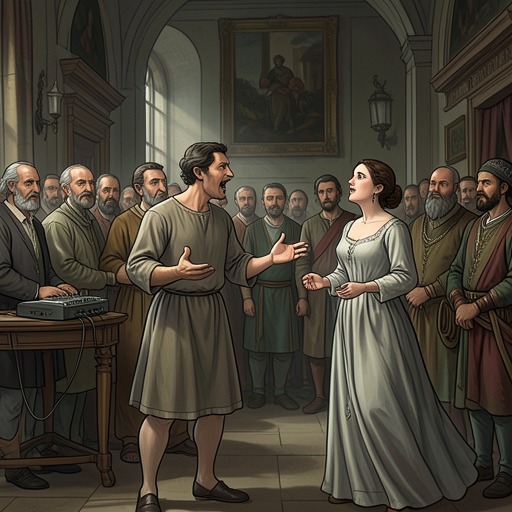
Madam Filippa’s courtroom defense turns quick speech into a challenge to the law itself. In Prato, a statute prescribed death for a wife found in adultery, treating her as severely as a woman who sold sex for money. Rinaldo de' Pugliesi finds his wife with Lazzerino de' Guazzagliotri and brings her before the provost under that law. Filippa refuses the advice of friends and relatives to deny the charge. She admits the affair, then argues that a law binding women alone was not made with the consent of the people it governed: women had neither consented to it nor even been summoned when it was established.
She also makes the case personal and difficult to evade. Filippa asks whether she had ever refused her husband the intimacy he wanted. Rinaldo acknowledges that she had always granted his requests. She then asks what she should do with what remained beyond his needs, reasoning that it was better to give it to a man who loved her than to let it go to waste. The packed court laughs and supports her, while the provost moves to alter the statute. It is thereafter applied only to women who take money from lovers. Filippa returns home free, while Rinaldo leaves in shame. Her speech does not merely find a clever escape within the law: it exposes the law’s unequal terms and helps change them.
Improvisation, performance, and change
Fra Cipolla’s escape from embarrassment shows another kind of verbal resourcefulness: performance that absorbs a failed plan and gives it a new meaning. He promises country people in Certaldo a feather of the Angel Gabriel, but two young men remove it from the casket and replace it with coals associated with the roasting of Saint Lawrence. Discovering the substitution when he opens the casket before his listeners, Fra Cipolla claims that he has brought the coals instead of the feather by mistake. He recasts the mishap as a providential choice, connects the coals to Saint Lawrence’s approaching feast, and tells the crowd that they can protect those marked with them from fire for the coming year.
The audience’s response completes the improvisation. The people approach reverently, offer more than usual, and ask to be marked; Fra Cipolla draws large crosses on their clothing and veils, claiming that the coals grow again in the casket as they diminish. His speech and ritual turn the young men’s intended exposure into a profitable preaching. After the crowd has dispersed, they reveal the trick and return the feather, which serves him again the following year. The episode makes wit inseparable from theatrical command: Fra Cipolla does not simply invent an explanation but sustains it through objects, gestures, and an audience willing to believe.
An earlier encounter between Guglielmo Borsiere and Ermino de' Grimaldi shows that a retort can have consequences beyond the immediate exchange. Guglielmo, welcomed by Genoa’s gentlemen, hears of Ermino’s avarice and visits him. In a new house, Ermino asks what unprecedented subject he might have painted in its hall. Guglielmo says he cannot name something never seen, except perhaps sneezing, but can name something Ermino has never seen: Liberality. The answer turns the house’s display of wealth into an accusation about the character of its owner. Ermino is so ashamed that he promises to have Liberality painted there, and from then on becomes, according to the account, Genoa’s most liberal and courteous gentleman, hospitable to strangers and citizens alike.
Taken together, these episodes give quick-witted speech several distinct powers. It can save a speaker from punishment, answer public humiliation, expose the limits of a law, or unsettle a listener into changing his conduct. Its success depends on more than speed: Chichibio needs a fortunate opening, Nonna and Guido make their hearers recognize an implication, Filippa joins timing to an argument, and Fra Cipolla turns words into performance. The stories make language consequential because each answer is fitted to a particular danger, audience, or imbalance of power.