Arvin’s final confrontation with Lee Bodecker
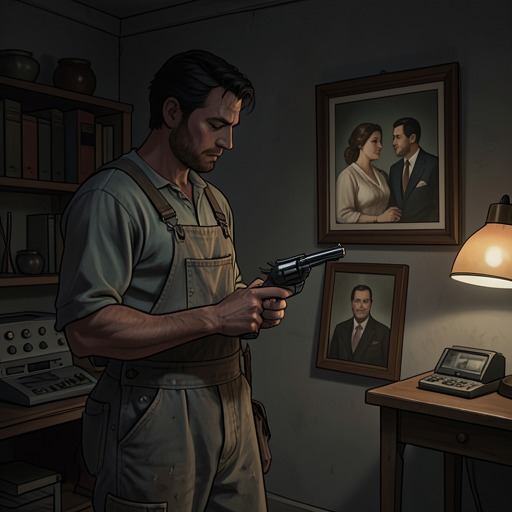
The Devil All the TimeArvin’s final confrontation with Lee Bodecker takes place at the abandoned Russell property, where Arvin has returned to pray and Lee has come to hunt him down. Their encounter brings together the sheriff’s public authority and private corruption, the photograph that Lee tried to destroy, and the childhood landscape Arvin is about to leave for good. It ends with Lee dead, the Luger buried beside Jack’s remains, and Arvin walking away from the place where his family’s history and his own violence have converged.
Background and Conflicting Motives
Lee approaches the confrontation after a night of drinking and a morning spent burning evidence. At the old dump on Reub Hill Road, he set fire to a shoebox containing photographs of twenty-six men and at least a couple hundred images, along with three film canisters. The destruction followed his review of the material; he could not bear the thought of people learning what Sandy Henderson had been doing in some of the pictures. His effort to erase the images was therefore not simply an attempt to manage an investigation: it was also an attempt to suppress knowledge about his sister.
Lee nevertheless considered how the case might serve his political prospects. He imagined presenting Arvin as a dangerous killer and using the pursuit to strengthen his chances of winning another election. He also contemplated buying the Russell land and building a house and orchard there. These calculations sit uneasily beside his stated duty as sheriff. He arrives armed with a revolver and a shotgun, with the aim of finding Arvin, while his thoughts turn between ambition, his family, and the job he believes he must do.
Arvin has returned to the property for a different reason. At the place where he once prayed beside his father, he kneels by the log, sets down the Luger, and tries to pray for guidance for the first time since his mother died. The bones hanging in the trees knock together when a gust passes through. After the breeze dies, ordinary sounds rise from the holler; then the cicadas pause, and Arvin hears a possible footstep behind him. He takes up the gun and moves away from the prayer place, leaving his gym bag behind. The return begins as an attempt to face his past, but the approaching sheriff makes it a confrontation.
The Search at the Russell Property
Lee drives along the dirt lane toward the remains of the Russell home, passing the old foundation and what remains of the barn. He proceeds on foot, looking for the path where he had once followed Arvin. He recalls killing two men for Tater Brown and feels both fear and excitement as he searches the brush. Three black crows cross the field before he finds trampled weeds and the beginning of the deer path. He follows it downhill with the shotgun ready.
Arvin hears Lee call his name and takes cover behind a hickory tree. Lee identifies himself as sheriff, says he wants to ask questions, and claims that he has not come to hurt Arvin. His actions undermine that reassurance: startled by a wood grouse, he fires the shotgun and reloads. As he moves into the clearing, he sees Arvin’s gym bag, the religious image left near the prayer place, and bones suspended in the trees. Lee interprets the scene as possible evidence that Arvin is unstable, an impression that leaves him poorly prepared to understand why Arvin has returned.
Arvin does not answer Lee’s approach by rushing him. He eases the safety off the Luger and throws a piece of dead wood so it strikes a tree below the prayer log. Lee fires twice toward the sound, then advances. Arvin circles behind him and orders him to put down the shotgun. Lee refuses, invoking the rule that law-enforcement officers do not surrender their weapons. The standoff makes their unequal claims plain: Lee speaks from the authority of his office, while Arvin insists that the armed sheriff is the immediate threat.
The Photograph and the Shooting
Lee challenges Arvin over the deaths of Sandy Henderson and Preston Teagardin, treating them as evidence that Arvin is a killer. Arvin answers with the photograph he has kept in his pocket. He says it shows Sandy holding a dead man and offers to show it if Lee lets go of the shotgun. The image is the same kind of object Lee tried to eliminate when he burned the photographs and film: a record that can outlast the story he wants to tell about his sister and the case.
Lee sees his own likeness on the front page of the morning newspaper lying in Arvin’s open bag. The portrait was taken after his election, a reminder of the official identity he has used while destroying evidence and considering how to manipulate public opinion. He then raises the shotgun and starts to turn toward Arvin. Arvin fires. Lee’s shotgun discharges into the wild roses, and Arvin fires again. Lee falls, wounded; when he tries to reach for his revolver, Arvin takes it away and throws it aside.
Arvin does not leave Lee to die without showing him the photograph. He sets the Luger on the log, turns Lee onto his back as gently as he can, and holds out the image. He explains that he had begged Sandy to put down her gun and had no choice. Lee looks from Arvin to the photograph, which shows Sandy cradling a dead man. He tries to take it but is too weak. In the reversal, the image Lee sought to suppress becomes Arvin’s account of what happened, offered directly to the brother whose grief and concealment have shaped his pursuit.
Death, Burial, and Departure
Lee takes only a few minutes to die, though to Arvin the wait seems much longer. As he listens, Arvin understands that there is no way to turn back, but also that he cannot continue as he has been. He imagines a door closing on an empty room; the thought calms him enough to make a decision. This pause gives the killing a consequence beyond the immediate end of the chase: Arvin recognizes that his old life, including his reliance on the gun, cannot simply resume.
He retrieves the Luger and goes to the hole he had dug for Jack. Remembering his father bringing the gun home years earlier, Arvin rubs its metal barrel and buries it alongside the dog’s remains. He covers the grave with dirt, leaves, and branches. He then takes down the image of Jesus on the cross, wraps it, and puts it in his gym bag, thinking that perhaps he will have somewhere to hang it someday. The gun and the religious image part ways: one is left with the bones, while the other travels with him.
Before leaving, Arvin puts the photograph of Sandy and the two rolls of film in Lee’s shirt pocket. This is not a return of all the evidence Lee destroyed; the shoebox and three canisters he burned are gone. But the surviving image and film remain with the dead sheriff, connecting Lee’s cover-up to his fate and preserving a record beyond the story he wanted to control. Arvin looks once more at the moss-covered log and rotting crosses, knowing he will not see the place again and probably will not see Emma or Earskell either. He climbs the deer path, enters the bright field, and walks north toward Paint Creek, hoping to reach Route 50 and find a ride.
Narrative Significance
The confrontation is both a pursuit and a collision between competing versions of justice. Lee has the badge, the weapons, and the public image of an elected lawman, but his destruction of the photographs and his political calculations expose the self-interest beneath that image. Arvin, by contrast, is a fugitive who has killed, yet he brings forward the photograph and asks Lee to see the circumstances of Sandy’s death rather than accept a simplified accusation. The scene does not make Arvin’s violence disappear; it sets his explanation beside the sheriff’s concealed wrongdoing.
The photographs also bind the encounter to the earlier killings committed by Carl Henderson and Sandy. Carl treated the camera as an instrument for staging and preserving victims’ deaths, and he argued that a victim’s final terror made a better picture. Lee’s attempt to burn the collection repeats the effort to control what those images mean, while Arvin’s use of one photograph turns the record into evidence in a personal reckoning. The image cannot undo the deaths, and it does not prevent Lee’s, but it changes what can be said at the scene.
The ending separates Arvin from the objects and places that have carried his inherited history. He buries the Luger associated with his father and takes the cross image away from the clearing, then leaves the homestead, the prayer place, and the people still connected to it. His departure offers no assurance about what comes next. It marks instead the close of this pursuit and his attempt to walk beyond a life in which family memory, faith, and violence have repeatedly met.