Bull Pen
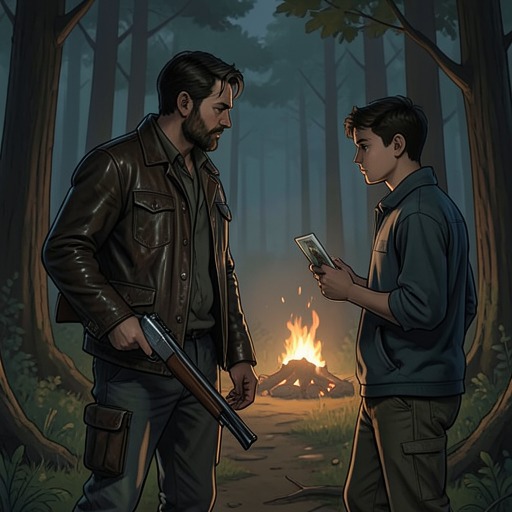
The Devil All the TimeThe Bull Pen is a drinking place on Shady Glen where Willard confronts two hunters in front of his young son, Arvin. The incident becomes, for Arvin, the best day he remembers spending with his father: a formative scene of protection that he keeps private and later recalls whenever Emma asks him about fighting. Its makeshift setting and its place in Arvin’s memory connect everyday rural life with the novel’s recurring entanglement of loyalty, violence, and religious feeling.
Setting and Use
The Bull Pen occupies a bald, muddy yard around the house of Snooks Snyder, a former railroader. Snooks lives there with his sister, Agatha, who spends the day at an upstairs window dressed in black and pretending to be a grieving widow. He sells beer and wine from the front of the house and stronger alcohol from the back to customers he recognizes. The arrangement makes the place both a residence and a neighborhood drinking spot, rather than a clearly separate commercial establishment.
Its outdoor facilities are practical and makeshift: picnic tables stand beneath sycamores, beside a horseshoe pit and an outhouse. The yard is scattered with bottle caps, cigarette butts, and beer cartons. These details establish the Bull Pen as a place of informal gathering, with drinking, games, and conversation unfolding around a private home. The hunters who arrive there sit on one of the tables with beer while their shotguns lean against a tree, bringing weapons into an otherwise ordinary setting of recreation.
Willard’s Confrontation
Willard takes a sharp turn up Shady Glen rather than stopping at the store. As the truck is still coming to a halt, he gets out and pursues one of the hunters, who has thrown a bottle at the vehicle and then tried to run. Willard knocks the man down and beats him. The second hunter takes a gun and leaves in a green Plymouth, carrying a brown paper sack and scattering gravel as he drives away.
After the assault, Willard returns to the table and takes the shotgun left behind. He removes its two red shells and breaks the weapon against a sycamore. Snooks appears in the doorway with a pistol pointed at him. Willard threatens him, then waits until Snooks retreats indoors. The sequence moves from a sudden attack to the destruction of a weapon and a direct challenge to the man who runs the premises; it ends with Willard leaving for his truck rather than continuing the confrontation with Snooks.
Arvin later understands this day as the occasion when Willard defended Charlotte’s honor in the Bull Pen parking lot. The location is therefore tied to a specific family allegiance, not just to an eruption of anger. Yet the scene does not present that defense as a private exchange between adults: Arvin is there to see it, and the event becomes part of what he learns about his father and about fighting back.
A Day Arvin Keeps
That evening, Arvin follows Willard back to the prayer log. He notices his father’s skinned knuckles. Willard has told Charlotte that he hurt his hand changing a flat tire, and Arvin recognizes the statement as a lie, though he believes God will forgive his father. The contrast between Willard’s deception at home and the boy’s faith in divine forgiveness complicates the memory: the day’s closeness survives alongside an early awareness that its heroism is not morally uncomplicated.
From the woods, Arvin hears the sounds coming up from the Bull Pen. The horseshoes striking their metal pegs seem almost like church bells, while the drinkers’ hoots and jeers bring back the hunter lying in the mud. The two places and their sounds converge in his memory that night: the gathering below becomes audible within the scene of prayer above. The comparison does not make the Bull Pen religious; instead, it shows how Arvin’s recollection carries the day’s violence into the quiet ritual he shares with Willard.
For a long time, Arvin regards the confrontation as the best day he ever spent with his father. He does not tell anyone about it, nor does he discuss the bad days that follow. When Emma asks about fighting, he instead answers with a blunt maxim inherited from Willard. His silence preserves the Bull Pen episode as a private measure of paternal protection, while concealing the wider history that would make that ideal harder to sustain.
Place in Arvin’s Later Recollection
The Bull Pen returns in Arvin’s thoughts rather than through a new visit. Whenever Emma asks him about fighting, he remembers the damp fall day when Willard defended Charlotte’s honor there. He does not recount the incident to her; his answer reduces the memory to a generalized warning about the dangerous people in the world. That shift from a precise remembered scene to a terse rule shows how an intimate lesson becomes part of Arvin’s way of understanding violence.
The location’s importance thus lies in a contrast. At the Bull Pen, Willard acts openly and decisively before his son; later, Arvin keeps the memory to himself and speaks only in a formula that echoes his father. The place anchors a rare moment of uncomplicated admiration in a relationship whose subsequent history includes painful days. Its ordinary features—the tables, horseshoe pit, and house where alcohol is sold—remain inseparable from the event that gives the yard lasting meaning for Arvin.
Narrative Significance
The Bull Pen brings the novel’s domestic and communal worlds into one scene. It is a family man’s destination, a place where local drinkers gather, and the setting for a confrontation witnessed by a child. The violence is not detached from ordinary social life: it occurs among tables, bottles, and a horseshoe game, within a yard attached to someone’s home. That everyday setting gives the event its particular force without making the Bull Pen itself an abstract symbol of lawlessness.
The scene also establishes a pattern in Arvin’s memory: his understanding of fighting is shaped by what he saw Willard do in defense of Charlotte, as well as by what he chooses not to tell. The later echo of horseshoes as church bells binds the Bull Pen to the prayer log through sound and recollection, while preserving the difference between a drinking yard and a place of prayer. As a remembered location, the Bull Pen holds together protection, concealment, and the complicated inheritance of violence.