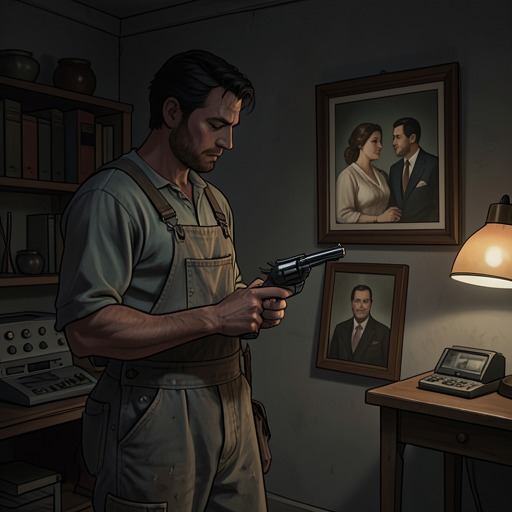
Carl’s photographs of his victims
The Devil All the TimeCarl Henderson’s photographs of his victims are not merely records of killings: they form a private archive through which Carl rehearses his control over other people and returns to scenes he has made into images. Kept in a shoebox beneath a bed, the collection binds photography to memory, Sandy Henderson’s uneasy participation, and the eventual destruction of evidence. Its meanings shift as it passes from Carl’s private ritual to an image discovered by Arvin Eugene Russell and, finally, a box burned by Lee Bodecker.
The Camera and the Making of the Archive
Carl’s photographic practice grew out of his first encounter with Sandy. She was a thin, lonely eighteen-year-old waiting tables at the Wooden Spoon in Meade, Ohio; Carl had recently lost his mother and felt he had little future beyond what a camera might offer. On that first night away from home, he watched her finish clearing the tables and felt an immediate need to photograph her. They remained together thereafter. The camera thus belongs to the beginning of their partnership as well as to the crimes that later defined it.
In the collection’s more sinister use, Carl introduces hitchhikers to his Leica M3 35mm camera, boasting that it cost four hundred dollars new and that he acquired it for almost nothing. He then uses a joking invitation to have a picture taken with Sandy to put a prospective subject at ease. The friendly performance conceals the purpose of the encounter: the camera is part of a practiced means of drawing men into danger and preserving the result. Sandy understands that Carl’s supposed bargain will cost them dearly in the end, even as his salesmanship continues to make grown men easy to approach.
Carl’s photographs make violence serve both as a crime and as a visual project. After one killing, he insists that the victim’s tears make for a good picture, treating fear not as a reason to stop but as an image’s valuable quality. The claim exposes the gulf between Sandy’s distress and Carl’s aesthetic judgment. For him, the camera turns another person’s last moments into material he can arrange, keep, and later inspect.
The Shoebox and Carl’s Ritual of Looking
The photographs are stored in a shoebox hidden beneath the bed. One evening, Carl locks the door, closes the curtains, turns off the lights, and settles on the couch with the box on his lap. There are more than two hundred photographs inside. He draws them out one at a time with his eyes closed, rubbing a thumb over the paper and trying to guess which image he has chosen before briefly illuminating it with a flashlight. The repeated clicks of the light punctuate the dark room; each glimpse is deliberately limited, so that looking becomes a ritual of anticipation as well as recollection.
The pictures show the remains of the killings and Sandy in staged poses. Carl’s method makes the box more than a collection: it gives him a controlled route back into scenes that would otherwise be past. As he moves through the images, places and voices return to him. By midnight, he has mentally traveled through much of the Midwest and revisited the last moments of twenty-four men. He imagines the dead as roused into a kind of singing by the act of viewing. The photographs preserve their absence while allowing Carl to make their remembered presence recur on his terms.
After a session with the box, Carl feels the need for Sandy’s company. He puts the collection back beneath the bed, cleans his pistol, studies road maps, and waits for her to return from work. When she comes home, he tells her that he has new pictures to show her, identifying one by the bandanna its subject wore. The casual announcement brings the secret archive into the couple’s shared life, but does not mean they experience it alike: Carl presents the images as objects of interest, while Sandy’s responses remain troubled and increasingly resistant.
Sandy’s Image and the Fraying Partnership
A photograph of Sandy with a murdered army hitchhiker changes how Carl sees his own collection. As he prepares for another trip, he studies the picture and notices a look of disgust and disappointment on her face that he had not registered before. He had already sensed that she had not been the same since that killing, as if the event had taken something precious from her. The photograph makes her reaction newly legible to him: the camera that once helped him recruit and control her now shows him a feeling he had failed to notice in person.
Carl’s response is not to reconsider the enterprise. Instead, he regrets having bought Sandy a pistol and worries that she may turn against him. He has also become suspicious because she asks where he goes in the evenings while she is working, and a waitress at the White Cow Diner no longer behaves as warmly as before. He unloads Sandy’s pistol and replaces its hollow-point ammunition with blanks, reasoning that she is unlikely to need to fire it. In this way, his reading of the photograph feeds directly into efforts to limit her ability to act. The picture does not simply preserve a moment between them; it prompts a further measure of control.
Carl carries another image in his wallet: a photograph from their first hunt, taken after five days on the road without finding a hitchhiker. They were short of money and arguing about whether to go home when they encountered a cheerful young man on a potholed road. In Carl’s favorite print, Sandy cradles a dead man’s head and looks down with an expression that reminds Carl of a painting of Mary with the baby Jesus. He values the image not because it is technically among his best, but because it recalls a sweetness in Sandy’s face that he believes has since disappeared. It also reminds him that, despite their conflicts, he cannot imagine finding another partner as capable as her. The print turns their shared past into a private ideal, sharply at odds with the evidence of her changed feelings in the later photograph.
Discovery, Evidence, and Destruction
The photographs eventually acquire a life beyond Carl’s private looking. After Arvin kills Carl and Sandy, he searches Carl’s wallet and finds a photograph tucked behind money. It depicts Sandy cradling a dead man, with a bullet wound visible above the man’s eye. Arvin takes the photograph and leaves the wallet on Carl’s body. The image gives him a visual record of the pair’s earlier crimes, linking the dead couple to a pattern that the current scene alone could not fully show. He also takes two film canisters from the car’s glove compartment before wiping down what he may have touched and leaving.
Lee Bodecker later opens the shoebox at an old dump on Reub Hill Road. He counts photographs of twenty-six different men and estimates that the bundled collection contains at least a couple of hundred separate shots, a count consistent with the box’s earlier description as holding more than two hundred photographs. He adds three film canisters, sets the box alight, and watches the pictures burn to ashes. The destruction removes a substantial body of photographic evidence, though the photograph Arvin had taken from Carl’s wallet has already left Carl’s control.
The collection’s path—from Carl’s concealed shoebox, to a picture in Arvin’s possession, to the ashes watched over by Lee—shows how photography both prolongs and unsettles the power Carl claims over his victims. For Carl, the images allow repeated private possession of scenes he has recorded. For Sandy, the camera preserves expressions that reveal her alienation more clearly than Carl’s assumptions do. For Arvin, one photograph connects the dead killers to the violence that preceded their deaths. And for Lee, the archive is evidence to be erased. The photographs outlast the individual act of looking, but their survival and destruction remain contested.