Hank Bell
The Devil All the TimeHank Bell is a twenty-two-year-old store clerk in Knockemstiff whose life is shaped by routine, thwarted ambition, and a habit of imagining a future elsewhere. His evening encounter with Arvin Russell, shortly after Arvin has lost both parents, shifts Hank from detached observer of local troubles to the person asked to help summon the law.
Identity and Daily Life
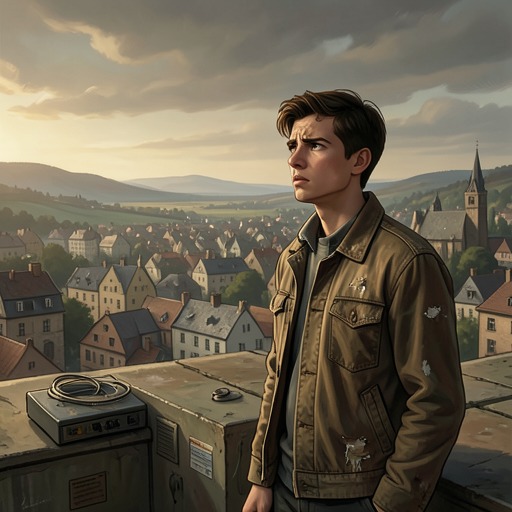
At exactly nine o’clock, Hank closes Maude’s store, turns out the lights, and takes a six-pack of beer from the meat case to the camper behind the concrete-block building where he has lived for four years. A small transistor radio in his shirt pocket keeps him company: on this evening, the Reds are losing in the sixth inning in a game played on the West Coast. Hank thinks about the difference in local time, an ordinary detail that opens onto his sense that life might be larger beyond the place he knows.
A cigar tree beside the store connects that routine to an earlier home. Hank planted it in his first year working there, using a start from the tree at the house where he and his mother had lived before she died and the bank took the property. It has grown nearly five feet. He cannot say why he planted it, and the tree stands as a modest remnant of a life already lost even as he imagines another one beginning.
Ambition and the Life He Imagines
Hank talks to customers about leaving Knockemstiff. He saves a little from the thirty dollars Maude pays him each week, though he has not decided whether he would go north or south. At twenty-two, he tells himself there is time to choose. His plans gather around Cincinnati, about ninety miles away by his reckoning, beyond Mitchell Flats and down Route 50. He has never traveled farther west than Hillsboro and has never visited the city, but he imagines attending a Reds doubleheader, eating ballpark hot dogs, and returning home changed. The trip represents more than leisure: Hank imagines it as the point at which his life will finally begin.
That imagined excursion also includes a paid sexual encounter, planned in advance with the same elaborate attention he gives the rest of the outing. He intends to buy a new shirt and get a haircut in Bainbridge. The fantasy answers, in part, to an earlier encounter with Mildred McDonald, the only woman he has been with, which became a source of ridicule among men at the Bull Pen. More than three years later, the jokes still sting. Hank imagines leaving town with his dignity restored, then buying the men a farewell beer so they will know he bears no grudge. He can also recognize an unintended benefit: since he stopped going to the Bull Pen, he has saved money.
A Narrow View of His Neighbors
As he listens to the game, Hank watches the evening mist rise from Black Run Creek and cross the rocky field behind the store, part of Clarence Myers’s pasture. Boys gather on the concrete bridge whenever cars pass, even in bad weather. Hank thinks they expect little from life and, at moments, envies their freedom from ambition. His own plans are larger, but they remain largely imagined: he has not traveled far, and his departure date and destination are still uncertain.
Hank’s account of the community is also marked by prejudice and rumor. He has heard that the praying at the Russell home stopped three nights earlier, and that a woman had been dying there while Willard and his son prayed for hours. Stories about dead animals and a missing hound have made the household seem sinister to him rather than comprehensible as a family in crisis. He also treats the reported affair between Edith Dunlap and a Black man as evidence against them in Henry Dunlap’s suspected killing, despite the absence of a body. His judgment is shaped less by established facts than by racial prejudice and concern for public shame; he even entertains the idea that a husband might be excused for killing a wife over such an affair. The confidence of his conclusions contrasts with the uncertainty of what is actually known.
Arvin’s Visit
After the funeral for Charlotte Russell, Hank sees someone crossing Clarence Myers’s pasture with a flashlight. The figure slips through a barbed-wire fence and approaches the store. Hank recognizes Arvin, whom he has never seen away from the hill by himself; he has heard that Willard would not let the boy go off alone. The change in circumstances is plain to Hank: Charlotte has just been buried, and Willard may have loosened his hold on his son. Arvin appears gaunt, pale, and sweaty, with what looks like blood on his face and clothes.
The store is closed, but Hank tells Arvin that he can open it if the boy needs something. Arvin asks how to contact the law and says his father is in the woods, a little way from the house. Hank reaches for the phone book. His response is cautious rather than effortless: a recent caller had repeatedly sent him to report a window peeper, and the dispatcher had hung up after the fifth call in two months. Remembering that dismissal, Hank warns Arvin not to send the law on a wild-goose chase. When Arvin asks why he would do that, Hank accepts that the boy is telling the truth. The scene gives his routine a sudden public consequence: a young man who has spent the evening imagining departure must attend to an emergency arriving at his own back door.