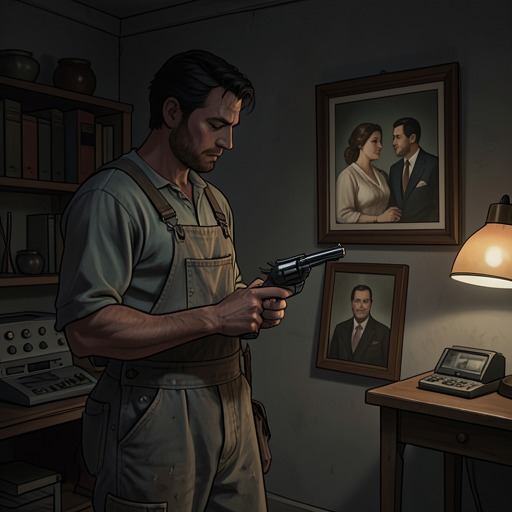
Lee Bodecker
The Devil All the TimeLee Bodecker’s career brings him from a young deputy fresh out of the Army to sheriff, but the badge increasingly serves private interests rather than public justice. His entanglement with Tater Brown, his coercive protection of Sandy Henderson, and his pursuit of Arvin Eugene Russell converge at the old Russell homestead, where Bodecker’s authority cannot save him.
Identity and Early Career
At twenty-one, Bodecker was six months out of the peacetime Army and working as a deputy. He was in no hurry to settle into family life: he spent evenings with his girlfriend Florence, often eating at Johnny’s Drive-in, the White Cow Diner, or the Sugar Shack before stopping for beer along River Road. The easy pleasure of those nights belongs to an earlier phase of his life, before the burdens and compromises of the sheriff’s office became central to him.
In one early encounter at Maude’s store, Bodecker arrived in his cruiser with a flashlight and asked what had happened, expecting another call about a local nuisance. The episode places him among the small-town routines he would later dominate as sheriff. In another encounter, he put Arvin in the cruiser and drove him up Baum Hill, following a narrow lane Arvin indicated. Bodecker slowed the car and quietly unsnapped his holster. The gesture establishes an early wariness toward the boy who would later become his quarry.
Sheriff, Sobriety, and Political Pressure
By the time he held the sheriff’s office, Bodecker was contending with both political insecurity and personal dependence. With county elections still more than a year away, his former boss Hen Matthews was already attacking his record and spreading claims that lawmen under Bodecker could not catch criminals. Bodecker had gone two months without alcohol, but his wife Florence tried to help him manage the change by keeping sweets around the house. He sometimes woke at night eating hard candy, and he relied on red sleeping capsules to get rest. Her concern and care unsettled him because they reminded him of how far he felt he had fallen.
The strain of the office also appears in Bodecker’s relationship with Sandy, his younger sister. He was five years older than her; although they had not been close for years, he still thought of her as family. When he visited her at the Tecumseh Lounge, he ordered a Coke and noticed that she seemed in poor health. He blamed Carl Henderson for her decline and resented the way he believed Carl lived off her. His concern, however, was inseparable from control: Bodecker accepted Sandy’s infidelity as her own business, but insisted she could not sell sex for money in Ross County while he was sheriff.
Bodecker framed that prohibition partly as protection from political exposure. He feared that an opponent could use Sandy’s work against him during the election, but he also worried that scrutiny might uncover his dealings with Tater Brown and the accumulated bribes he had taken since becoming a lawman. His protection of Sandy therefore served a double purpose: it expressed a remaining family attachment while attempting to contain a danger to his own power. When he left her, he asserted that being the law made a decisive difference, then sat in his cruiser considering how long it would be before he had to kill Tater—or someone decided to kill him.
Corruption and Violence Behind the Badge
Bodecker’s connection to Tater was not simply political or financial. He used his badge to help Tater locate a man named Coonrod hiding in a shack near the Paint Creek bottoms. After arresting Coonrod, Bodecker drove him to the gravel road at the top of Reub Hill, took him into the woods, and shot him. At the time of another meeting with Sandy, he was waiting for Tater to bring him money. Rather than respond to a radio report of a hit-and-run, he turned down the volume and continued to wait. The contrast makes his priorities plain: official calls could be ignored, while the private business sustained by his badge demanded his attention.
His dealings also generated fear. Carl Henderson once saw Bodecker arguing beside his cruiser with someone in a black Lincoln and watched the encounter from his own car. Sandy had warned Carl that her brother might end up in prison if he kept company with people such as Tater and Bobo McDaniels. Carl’s suspicions do not establish what he witnessed, but they show how Bodecker’s associations looked from outside the sheriff’s office. At the gas station, Bodecker encountered Carl and Sandy as they were filling a can and had their belongings packed into their station wagon. He joked with Carl and asked whether they were taking a trip, an ordinary exchange that later became part of the pattern of contact surrounding the couple’s departure.
Bodecker’s treatment of Sandy also shows the limits of his professed concern. He could resent Carl’s treatment of her and feel protective toward his sister, yet he confronted her with the authority of his office rather than offering support without conditions. He gave her five dollars and departed after insisting that the law made his command effective. The scene leaves his care compromised by surveillance, shame, and self-preservation.
The Henderson Murders and the Pursuit of Arvin
When a farmer discovered Carl and Sandy Henderson’s bodies beside their station wagon, the sheriff’s chief deputy, Howser, was already at the scene with several cruisers and uniformed officers. Bodecker arrived about an hour after the bodies had been found. He examined Sandy and the car, wiped his eyes with a handkerchief, and searched for evidence. He recovered a bullet from the driver’s-side door, judged it to be a nine-millimeter round, and noticed a .22 pistol near the brake pedal. He also asked Howser whether the back door had been open when the officers arrived. His grief was real enough to interrupt his work, but it did not prevent him from conducting a practical investigation.
His response to Carl was markedly different. Bodecker disparaged his brother-in-law and counted fifty-four dollars in the wallet on the body, reasoning that the amount made robbery an unlikely explanation. The disparity between his attention to Sandy and his contempt for Carl reflects their family relationship, but it also reveals how readily personal judgments entered his official assessment.
After returning to his office, Bodecker reached for hard candy when he found himself wanting whiskey. He called Sheriff Thompson, and information gathered in that conversation brought back details of an earlier encounter: the prayer log, dead animals, and a young boy with pie juice on his face. He identified the boy as Arvin Eugene Russell. Bodecker then studied a map, tracing a possible route from Johnson City and Lewisburg through West Virginia and into Ohio on U.S. Route 35 at Point Pleasant, near where the Hendersons had been killed. The route gave him a possible link between Arvin and the couple, while the mismatch between Sandy’s stated plan to go to Virginia Beach and the couple’s presence in Johnson City deepened his suspicion. Their packed guns added another question he could not explain.
The investigation turned into a personal manhunt. Bodecker pointed his revolver at a storekeeper and demanded to know whether he had seen Arvin. His willingness to threaten a civilian shows the same coercive use of authority that had marked his dealings with Sandy and Tater. Rather than separating police work from private force, he pursued the boy as a sheriff accustomed to making people comply.
The Old Russell Homestead and Ending
Bodecker followed the dirt lane back to the property where the Russells had once lived. His cruiser rocked over the ruts as he moved through saplings and weeds, stopping roughly fifty yards from the remains of the house. He could make out part of the rock foundation and what remained of the barn. Even while searching for Arvin, he imagined buying the property after the trouble was over, building a house and planting an orchard. He considered leaving the sheriff’s job to Matthews, a future that might suit Florence. Then he reached for a pint and thought that he would have to deal with Tater as well. The imagined domestic retreat and the continuing criminal entanglement occupy the same moment: Bodecker could picture escape, but had not escaped the choices that made it necessary.
At the homestead, Bodecker fired first; the shot struck the wild roses beside Arvin. Arvin fired back, and the sheriff fell. When Bodecker tried to reach his pistol, Arvin took it from him and moved it out of reach. Bodecker died within minutes. The confrontation ends the pursuit and reverses the relation of power that had governed their earlier encounters: the armed lawman, who had used his badge and weapons to control others, is left unable to command the boy he hunted.
After Bodecker’s death, Arvin picked up his Luger and went to the hole where he had buried Jack’s remains. He placed the gun beside the animal’s bones, covered the grave, and concealed its traces. The act connects the sheriff’s death to the weapon’s history in the Russell family and gives the ending a second consequence: Arvin does not leave the homestead carrying the Luger. Bodecker’s downfall closes the immediate chase, while Arvin’s burial of the gun marks a deliberate attempt to put that instrument of inherited violence away.