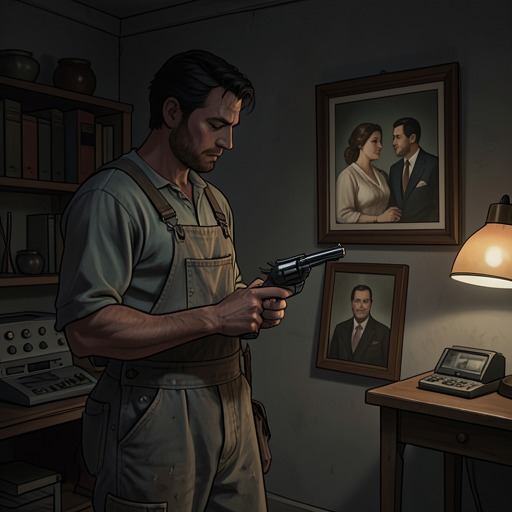
Lee Bodecker’s investigation and cover-up of the Henderson murders
The Devil All the TimeLee Bodecker’s investigation of Carl Henderson and Sandy Henderson’s murders becomes a cover-up: instead of preserving evidence and pursuing the killer impartially, he removes incriminating material, misdirects his deputies, and sets out to find Arvin Russell. His inquiry exposes the murders’ photographic record and links Arvin to the crime, but Bodecker’s loyalties—to his dead sister, his own political ambitions, and his criminal past—corrupt the search from its first hours.
The scene and its clues
A farmer discovers Carl and Sandy’s bodies, then flags down a truck for help. By the time Bodecker arrives on Tuesday around noon, four police cruisers are at the scene and his chief deputy, Howser, has begun managing the response. Bodecker is shaken to find his sister dead. He asks to be left alone with her, examines the scene, and removes a bullet from the car door. The wound and the bullet suggest a nine-millimeter weapon; nearby, Sandy’s .22 pistol has been fired once, but its remaining cartridges are blanks. Carl’s .38 has not been fired. These details tell Bodecker that the apparent exchange of gunfire is misleading: Sandy’s weapon could not deliver the expected live shots, and Carl never fired his.
Bodecker initially performs some ordinary investigative acts. He asks whether the car door was open when the deputies arrived, orders a search of the cornfield, and tells Howser to arrange for the car to be checked for prints. But he also begins taking evidence for himself. While Howser is occupied with the other deputies, Bodecker pockets rolls of film from the open dashboard and removes keys from the ignition ring. He notices a hotel receipt from Johnson City, dated two nights earlier, and recalls that he saw the couple sixteen days before. In his estimation, they were close to getting home. The receipt and route become part of a pattern he will investigate privately rather than share openly.
A patch of vomit in the grass provides another clue. From its position by the backseat, Bodecker reconstructs a likely arrangement: Carl was outside with his gun, Sandy was in front, and a third person had been sitting behind them. The killer, he reasons, fired three shots before Carl could shoot, then became sick. Bodecker recognizes the reaction from his own first killing for Tater Brown and concludes that the shooter may be inexperienced at killing but knows how to handle a gun. The deduction is personal as well as forensic: his memory of violence supplies a measure by which he judges the unknown killer.
Identifying Arvin
A call from a sheriff in Lewisburg, West Virginia, gives Bodecker a name. The young man is Arvin Russell, eighteen, whose parents died in the region and who has lived with his grandmother in Coal Creek for roughly seven or eight years. The caller says Arvin is known locally and suggests that the preacher Arvin killed may have been exploiting young girls, while acknowledging that this would not justify the killing. Bodecker asks for a photograph, then recognizes the name when the call ends. Memories return of Arvin’s prayer log, dead animals, and the boy with pie juice on his face. The apparently distant preacher case and the murders of Carl and Sandy now converge in his mind.
Bodecker traces a route on a map from Johnson City through West Virginia and across Ohio on U.S. Route 35 at Point Pleasant, stopping near the area where Carl and Sandy were killed. The route troubles him. Sandy had said she was going to Virginia Beach, yet the stay in Johnson City seems to take the couple out of their way. Their possession of guns also raises questions. He does not yet establish exactly where the couple encountered Arvin, but he sees enough to suspect that the young man is connected to their deaths.
The strongest evidence of what Carl and Sandy had been doing is not at the roadside but in their apartment. Using the keys he took from the scene, Bodecker enters and searches the rooms. At first nothing seems unusual. Then he realizes that there are no photographs on the walls or lying about, an absence that is striking because Carl’s life revolved around his camera. He searches again and finds a shoebox hidden under spare blankets beneath the bed. Earlier scenes establish what makes the discovery significant: Carl carried a Leica M3, used flirtation and staged offers of photographs to draw men into his control, and treated the victims’ final moments as material for his pictures. He kept more than two hundred photographs in a box and repeatedly examined them. At the crash scene, Arvin found a photograph of Sandy with a dead man among the possessions of one victim, took it, and removed two film canisters from the car. The image and film make the private collection evidence of a pattern of killings, not merely a photographer’s archive.
Evidence turned into a cover-up
Bodecker’s handling of the film and photographs is deliberate. He first takes film from the car while Howser is away; later, after finding the hidden box, he removes the photographs and film from the official investigation. At an old dump on Reub Hill, he counts pictures of twenty-six different men and sees at least a couple hundred shots bundled together. He adds scraps of a catalog and the film canisters, lights the box, and watches the collection burn. The destruction erases material that could have helped identify Carl’s victims or establish Sandy’s part in the crimes. It also prevents the photographs from becoming public evidence about his sister.
His reasons are mixed rather than cleanly protective. At the scene, he thinks of Sandy as his sister even while judging her appearance and clothing. Later, he cannot bear the thought of everyone learning what she had been doing in some of Carl’s pictures. But he also considers how the Arvin case might serve his political future: the young man could be presented as a dangerous killer, and voters, he thinks, respond to a hero. Bodecker’s concern for Sandy’s reputation, his electoral calculation, and his willingness to conceal evidence reinforce one another. He chooses not to distinguish a search for the truth from a story that might benefit him.
The cover-up extends to his dealings with the department and the town. When asked whether the call from West Virginia relates to the murders, Bodecker denies the connection and describes it as a matter involving a preacher. He then searches for Arvin through Hank, confronting the storekeeper with a gun and threatening to frame him for a killing if he refuses to answer. Hank tells him that Arvin mentioned the old house where he used to live. Bodecker leaves with the information, while Hank remains behind, distressed by the threat. The exchange shows Bodecker using the authority of his office and the threat of fabricated evidence to turn a witness into a coerced source.
Pursuit and significance
Bodecker also tries to shape how other officers approach the search. He tells Howser to send Taylor and Caldwell after the suspect, describing Arvin as someone likely to shoot them. The warning can sound like a precaution, but it is part of a larger effort to keep control of the pursuit while he moves toward Arvin himself. He has already concealed the West Virginia connection, destroyed the photographic evidence, and threatened Hank; his official investigation no longer offers a reliable account of what he knows or intends.
He drives to the property where the Russells once lived, imagining that he might buy the land, build a house, and plant an orchard after the immediate trouble is over. He also considers what Arvin’s case could do for his campaign and for the reputation of Sandy, whose photographs he cannot bear to have exposed. Then he sets those calculations aside long enough to approach the abandoned homestead. He carries a revolver and takes a shotgun from the cruiser, moving carefully from the remains of the house and barn toward the field and tree line. The supplied scene ends with him searching for the path Arvin had taken toward the place where his father died; it does not establish the outcome of this approach.
The investigation’s central reversal is that the sheriff who appears to be solving a double murder becomes an active obstacle to the truth. Carl’s camera had turned murder into a private spectacle, preserving images that outlasted the victims; Bodecker’s destruction of those images extends the violence into the investigation by denying the victims an evidentiary record. At the same time, the clues that remain—the blanks, the unused .38, the vomit, the route, and Arvin’s name—give Bodecker enough to pursue the young man. His investigation therefore advances two conflicting processes: it reveals how Arvin may be connected to the killings, while Bodecker’s own misconduct makes the search less a matter of justice than of concealment and control.