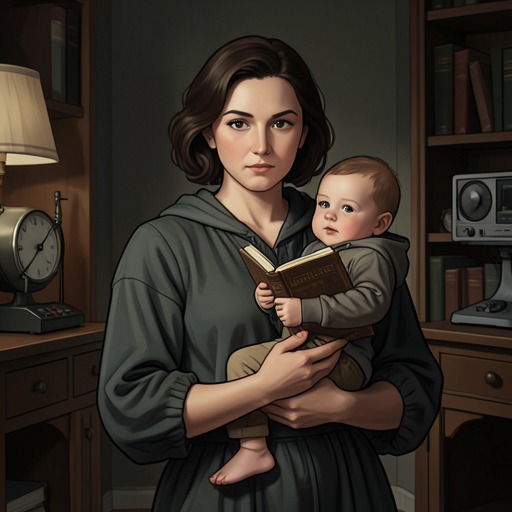
Lenora’s pregnancy
The Devil All the TimeLenora Laferty’s pregnancy turns a concealed relationship into an immediate crisis and exposes the cost of Preston Teagardin’s power over her. When Lenora tells him she is carrying his child, he denies having touched her and urges her to get rid of the pregnancy. His rejection is followed by her death by suicide. The pregnancy thus binds together the novel’s account of sexual exploitation, religious hypocrisy, and a young woman left to face the consequences without support from the man responsible.
Discovery and Circumstances
By the middle of August, Lenora knows she is in trouble: she has missed her period twice, and the dress Arvin Russell bought for her no longer fits as it did. The changed fit makes her fear materially visible, while the missed periods give her reason to understand that she is pregnant. Preston Teagardin had ended their relationship a couple of weeks earlier. He had told her that continued meetings might expose them to his wife or congregation, placing the danger of discovery at the center of his decision to abandon her.
Lenora returns to the church after passing it several times. Teagardin is there, in the same place where she first approached him three months earlier, but he does not welcome her. When she tells him she is pregnant, the narrative places her urgent disclosure against his effort to think quickly and protect himself. The scene does not present the pregnancy as a mystery between them: Lenora identifies Teagardin as the father, and his own thoughts confirm that their relationship was sexual. His concern is not how to care for her or the child, but what exposure might cost him.
Teagardin’s Denial
Teagardin responds by recasting Lenora’s knowledge as delusion. He tells her that he has never touched her, despite her recollection of what happened in his car, and invokes his status as a preacher as a reason people would believe him over her. His denial is therefore more than a refusal to acknowledge paternity: it uses the authority attached to his public role to make her testimony appear less credible than his own.
He also turns the pregnancy into a threat of disgrace. Teagardin tells Lenora to find a way to end it and warns that the child would bring shame on her and on the elderly woman who raised her. The appeal to Lenora’s concern for her grandmother makes his rejection more coercive: instead of accepting responsibility, he burdens Lenora with the anticipated consequences of his own conduct. He directs her out of the church, and she leaves without another word.
Outside, Lenora collapses near the gravel road, still able to see the church she has attended throughout her life. She recalls having felt God’s presence there, but realizes that she has not felt it since the new preacher arrived. The contrast links her personal crisis to the institution that should have offered spiritual care: the church remains physically present, yet its new leader has made it a place where she is shamed and turned away. Soon afterward, Pamela Sue Reaster approaches the church looking happy and goes inside, a detail that underscores the continuation of Teagardin’s access to other young women even as Lenora is rejected.
Pregnancy and Lenora’s Death
That evening, Lenora stays home while Emma Russell and Arvin go to the church service. She says she is ill and has a severe headache, has not touched her food, and lets Emma feel her cheek for fever. Emma accepts that she should remain at home and says a prayer will be offered for her. The ordinary domestic exchange gives Lenora a moment in which her distress is visible, but its cause remains unspoken to her family.
After the others leave, Lenora goes alone to the smokehouse and prepares to hang herself. While she is there, she wavers. She thinks she might wait another day or two, that Teagardin could change his mind, and that she could still have the baby and leave, as her father had done. Those thoughts show that the pregnancy has not erased her hope of continuing her life; she imagines both keeping the child and escaping the place in which she has been abandoned. But as she begins to reconsider, she slips and is left unable to free herself. Her death follows from the failed attempt to step back, not from a settled resolution expressed without doubt.
Disclosure and Significance
The pregnancy’s circumstances become known to Arvin only after Lenora’s death. The sheriff takes him aside, waits until other men have moved away, and asks whether he knew Lenora was carrying a baby. Arvin reacts with disbelief and insists that someone is lying. The sheriff explains that he has just come from the coroner’s office and that the coroner estimates Lenora was about three months pregnant. This report gives Arvin a fact he had not known and confirms the pregnancy for the family after Lenora can no longer explain what happened to her.
The pregnancy clarifies why Lenora confronted Teagardin and what was at stake in his denial, while the sheriff’s disclosure makes that knowledge arrive too late to help her. Its tragic significance lies not only in the loss of the unborn child but in the way Lenora is left alone with a crisis created by an adult who uses religious authority to evade responsibility. Her experience also sharpens the contrast between faith as a source of comfort and religious leadership as an instrument of concealment: Lenora once felt God’s presence in the church, but her final encounter there gives her no protection, acknowledgment, or practical help.