Religious Faith, Prayer, and Sacrifice
The Devil All the TimeReligious faith, prayer, and sacrifice in the Russell family move from Willard Russell’s desperate attempt to influence Charlotte Russell’s fate to Arvin Russell’s later, quieter reckoning with grief. The woods and the prayer log become a place apart from ordinary life, but the ritual’s meaning changes: for Willard, it is a plea to keep his wife alive; for Arvin, it is first an unbearable burden and eventually a setting in which he can understand his father and speak to God again.
Prayer and the search for a sacred place
Willard’s return to prayer begins amid fear for his family. After learning from a letter that Helen Laferty’s remains had been found near Coal Creek, he becomes increasingly troubled by the news and worries that something bad may happen to his household. He has not prayed since encountering a crucified Marine during the war. Now he feels an urgent need to make things right with God, but the cramped apartment offers no place in which he can worship as he needs to. Nor, in his view, can a church provide that connection. He tells Charlotte they must leave, seeking woods where he can pray in his own manner.
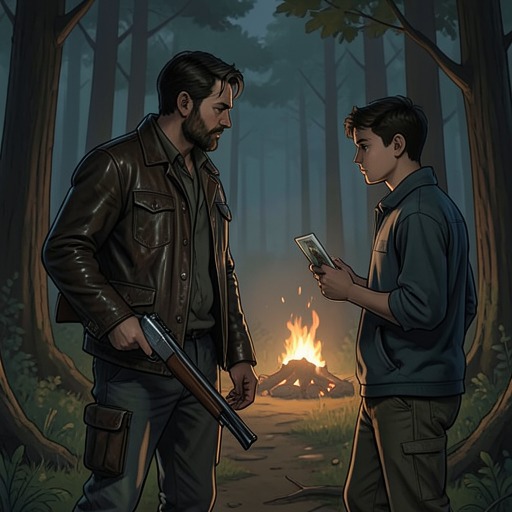
That distinction between ordinary and sacred space persists after the family moves. Willard clears a place around a log in the woods and makes it the center of his worship. The clearing is not simply a setting for private reflection: it becomes a site of repeated prayer, sacrifice, and shared labor. Its separation from the home allows Willard to treat the woods as a place where he might answer the crisis of Charlotte’s illness, though the narrative does not confirm that his offerings have divine effect.
Offerings and the family ritual
As Charlotte’s condition worsens, Willard comes to feel that prayer and sincerity alone may not be enough. He brings home a lamb with an injured leg, bought for five dollars, and rebukes Arvin when the boy asks whether he can name it. Willard uses the animal as an offering at the prayer log. The next stage expands the practice: he collects animals killed along the road, including dogs, cats, raccoons, possums, groundhogs, and deer. Some are placed on crosses or in trees around the clearing, turning the site into a visible record of his escalating attempt to secure mercy.
Arvin is drawn into the ritual rather than allowed to remain an observer. He and Willard kneel at the log and call for the Savior’s mercy. Their circumstances narrow around the practice: they stop bathing, wear protective clothing against insects, and live on lunch meat and crackers from Maude’s store. The repeated prayers therefore bind father and son together even as they expose Arvin to a form of faith shaped by desperation. Willard’s appearance also changes; his eyes grow hard, and his beard seems to turn gray rapidly. When he asks whether Arvin wants such a death for his mother, he makes the sacrifice a direct, frightening expression of his hope that Charlotte will survive.
The ritual’s public meaning is sharply different from Willard’s private one. When Lee Bodecker reaches the clearing with Arvin, he finds animals displayed among the trees and crosses and reacts with alarm. Arvin identifies the place as a prayer log. The scene presents the same site at once as Willard’s church and as something that appears disturbing and incomprehensible to an outsider. Faith here does not erase the physical consequences of Willard’s choices; it gives those choices a sacred purpose for him, while leaving their cost visible to his son and to the lawman.
Loss, refusal, and Willard’s death
After Charlotte dies, the clearing becomes inseparable from Arvin’s grief. He remembers her sparse funeral and the darkness of burial, then goes looking for Willard when his father does not return. The prayer log has not been visited for three days. There, Arvin tells his father he will not pray anymore. When Willard does not answer, Arvin approaches and discovers that he has died by suicide. The discovery ends the shared ritual abruptly: the place where father and son had knelt in hope becomes the place where Arvin encounters the consequences of Willard’s despair.
Arvin’s refusal is not presented as a settled rejection of all faith. At this point, he rejects the prayers that have made him participate in his father’s effort to save Charlotte. The scene gives the prayer log a painful double meaning: it holds the memory of Willard’s devotion to his wife, but also the loss that his offerings could not prevent. Arvin’s later return shows that he carries the place and its religious associations with him, even after separating himself from his father’s practice.
Return and a changed understanding
When Arvin comes back to the Russell homestead, the house is gone and the barn is largely ruined, but the prayer clearing remains. Five crosses are still standing, while four have fallen; the site has been partly reclaimed by plants. Seeing the remains of Jack at the first cross Willard raised brings back the period before Charlotte’s death. Arvin now recognizes that his father would have done anything to keep her alive. He also reinterprets Willard’s words on the drive from the cemetery, when he suggested that Arvin stay with Emma Russell in Coal Creek: Arvin understands this as his father’s attempt to say that he was leaving too, and that he was sorry.
At the clearing, Arvin gathers Jack’s remains and buries them at the foot of the dog’s cross. He hangs a painting of the crucifixion, taken from a motel, on a nail there. These actions echo the religious imagery of Willard’s clearing but are directed toward care and remembrance rather than an attempt to bargain for Charlotte’s recovery. Arvin then kneels at the log, sets down his Luger, and tries to pray. He cannot hold an image of God in his mind, so he imagines his parents looking down on him instead. He asks to be told what to do, and a gust of wind makes the bones still hanging in the trees knock together. The moment offers no definite answer; it places his prayer alongside the remains of his father’s ritual and the memory he has only now come to understand.
Significance
The recurring prayer clearing gives religious faith a material and changing form. For Willard, prayer becomes inseparable from sacrifice as he confronts the limits of ordinary remedies and fears losing Charlotte. For Arvin, the same practice first represents an imposed burden and then, much later, provides the setting for mourning his parents, honoring Jack, and asking for guidance. The woods do not resolve the conflict between faith and suffering: Charlotte dies despite Willard’s devotion, and Arvin’s final prayer does not supply a spoken revelation. Instead, the novel links belief to acts of attention and care, while showing how religious desperation can bind a family together and leave a child with pain he can only reinterpret over time.