Russell farmhouse
The Devil All the TimeThe Russell farmhouse is the deteriorating home rented by Charlotte Russell, Willard Russell, and their son Arvin Russell on Mitchell Flats. For Charlotte, the leaky house and its well represent the possibility of a permanent home she never had as a child; for Willard, its proximity to the woods makes it possible to establish a private place of worship. The house consequently holds two kinds of hope: the ordinary security Charlotte wants for her family and the religious certainty Willard increasingly seeks. It is also where Arvin confronts his mother’s illness, and where the family’s private hopes fail.
A rented home and the hope of ownership
The Russells rent the farmhouse for thirty dollars a month from Henry Dunlap, a lawyer who treats real estate as a hobby. The house is run-down and leaks, and the family must draw water from a well. Charlotte initially objects to the move, but soon grows attached to the place and imagines buying it. Each month, she and Willard try to save another thirty dollars toward a down payment. Her wish is not simply to own property: having grown up in rented rooms and apartments, she wants Arvin to have a home he can always claim as his own.
Charlotte’s longing for stability is shaped by a childhood marked by loss. Her father died when she was five, her mother died after Charlotte entered ninth grade, and her sister Phyllis left the rooms they shared when Charlotte was still young. By the time Charlotte becomes a mother, the farmhouse offers a prospect of continuity absent from those earlier homes. The hope of purchase, however, remains dependent on a landlord who controls whether the family can stay.
That dependence creates a recurring conflict. When Dunlap learns that the Russells want to buy the farmhouse, he alternately changes the price and suggests that he may not sell. He also belittles the rent Willard brings from his work at the slaughterhouse, describing what the small payment means to a wealthier man. Willard repeatedly imagines answering the insults with violence, but Charlotte’s fear that they might be evicted restrains him. The house thus makes their unequal economic position part of everyday family life: even the prospect of belonging there is subject to Dunlap’s whims.
The sickroom and the family’s crisis
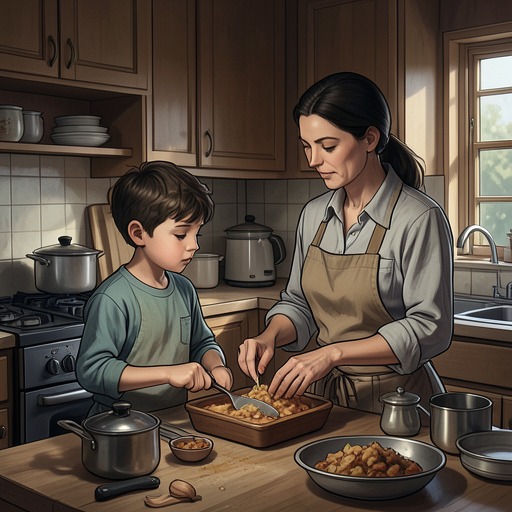
Charlotte begins suffering abdominal pain at the start of the year, but she attributes it to less serious causes and keeps it secret. Hospital costs threaten the money saved for the house, and she hopes the illness will pass. By April she is bleeding; by the middle of May the bleeding has become persistent. When Arvin finds her unconscious on the kitchen floor, there is no telephone in the house. He props her head on a pillow, tries to clean up, and waits beside her, praying that she will keep breathing. A pan of biscuits burns in the oven as he waits for Willard to return from work.
Charlotte is taken to the hospital, but the doctors tell Willard that her condition is hopeless and give her only weeks to live. After she returns home, Willard carries her into the back bedroom and makes her comfortable. The farmhouse becomes organized around her care: Willard prepares food for the family, tries to tend to Charlotte, and sits beside her bed. When she cannot keep down the broth he heats for her, he cleans up and stays near her through the night. The back bedroom, once part of an ordinary household, becomes the room in which the family waits for an outcome it cannot control.
The illness also changes how the farmhouse relates to the surrounding land. Willard pours out his whiskey and begins enlarging a clearing in the woods around a prayer log, carrying boards from the barn with Arvin to build additional crosses. He tells his son that the doctors cannot help Charlotte but that prayer may save her. As the ritual intensifies, the clearing becomes a second center of family life, though it is outside the house: Willard and Arvin spend hours there while Charlotte remains in her sickroom. Willard brings a lamb there as a sacrifice and later adds animals found dead along the road. The effort does not change Charlotte’s condition, but it draws Arvin into his father’s increasingly desperate practice.
Death, departure, and the nearby clearing
As Charlotte grows weaker, Willard begins locking the door to her room and tells Arvin not to disturb her. The boy remains caught between the sickroom and the prayer clearing, where his father insists that he continue praying. After Willard shoots Jack, the dog Arvin had taken in, and places the animal at one of the crosses, Arvin stops speaking to his father. His anger and isolation accompany the long summer in which he rarely leaves the hill.
Charlotte dies in 1958. Two days later, she is buried in a small cemetery outside Bourneville. On the way home, Willard suggests taking Arvin to visit Emma Russell in Coal Creek, where the boy could meet his uncle Earskell and Lenora Laferty. Arvin says little; he is grieving his mother and has not recovered from Jack’s death. At home, he sits in Charlotte’s rocking chair and thinks about her burial. The farmhouse is now a place of absence as well as shelter: the person whose hope had been to make it a lasting home is gone.
That evening Arvin goes looking for Willard and finds him kneeling at the prayer log. Arvin tells his father that he will not pray anymore. When he touches Willard’s shoulder, he discovers that Willard has died by suicide. The clearing, made in the hope of saving Charlotte, has become the site where the family’s remaining bond is broken. The farmhouse and the woods are distinct spaces, but the path between them carries the sequence of care, coercion, grief, and loss that defines Arvin’s childhood there.
Ruins and remembered home
Years later, Arvin returns to the property and finds the house gone. He enters where the back door had been and walks through what remains of the kitchen and the hall to the room where Charlotte died. Charred lumber and cinders are all that remain of the structure; he finds no keepsake from his mother or the small objects he once kept in his bedroom. A rusty doorknob is among the few physical remnants. The former home survives most fully as memory, while its damaged foundation makes the absence concrete.
The barn is also reduced to a shell, but a feed bucket Willard once used in the sacrifices remains there. From the ruined house and barn, Arvin follows the old deer path to the overgrown prayer clearing. Five crosses still stand, while four have fallen. Seeing Jack’s remains at the first cross leads him to gather what he can and bury the dog there. At the same site, Arvin reconsiders his father: he recognizes that Willard’s desperate actions had been driven by his desire to keep Charlotte alive, and understands the proposed visit to Emma as his father’s attempt to prepare him for leaving. The return does not restore the farmhouse or undo the losses. Instead, the property’s surviving objects and paths allow Arvin to revise the meaning of a home that had once held both his father’s devotion and the damage caused by it.